
+91 9310106988
mail@pioverseas.com
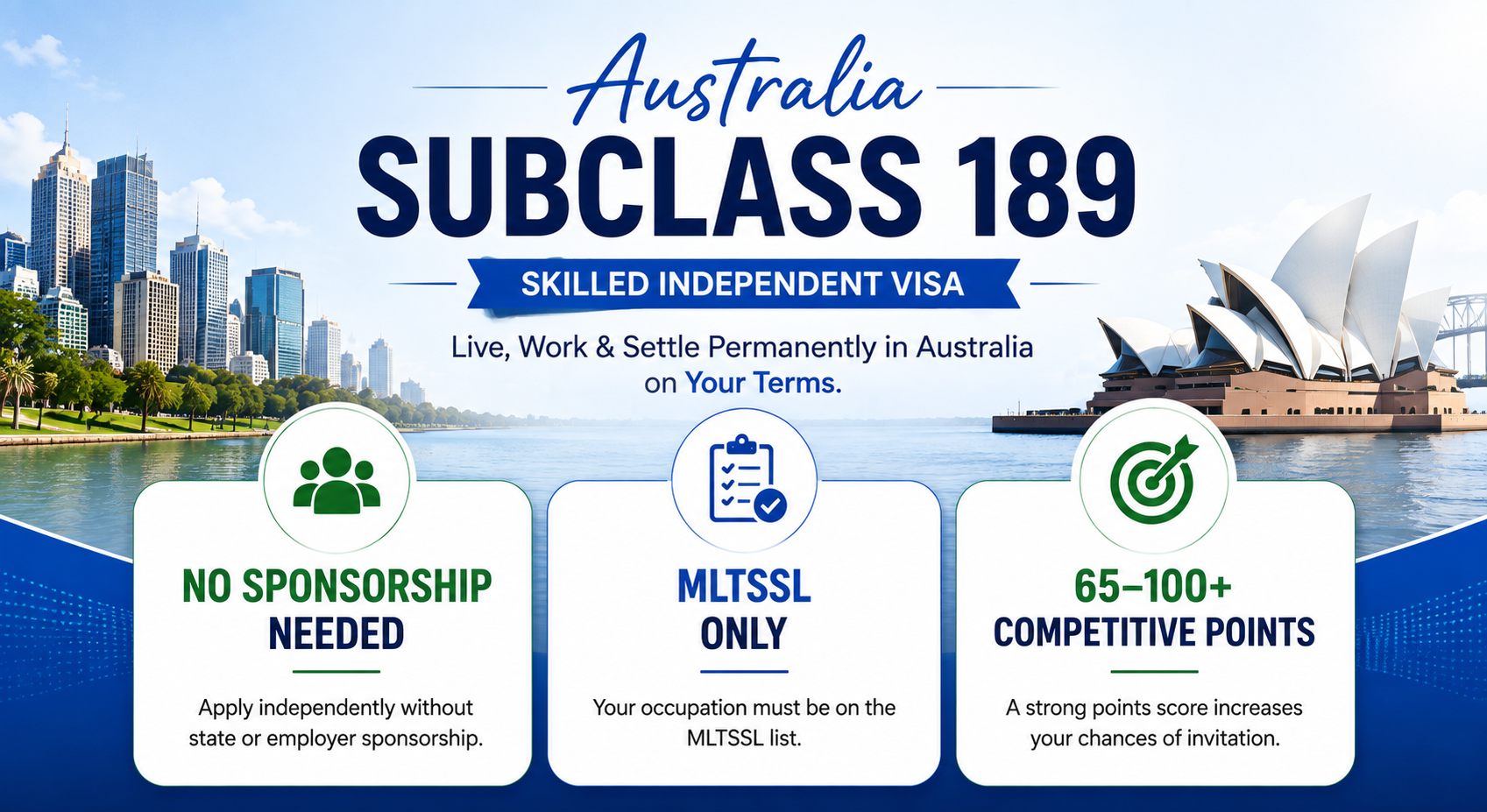
The Subclass 189 (Skilled Independent) visa is Australia’s only points-tested permanent residency visa that requires no sponsorship whatsoever — no employer, no state or territory nomination, and no family sponsor. If your points score and occupation are competitive, you can apply purely on your own merit and be granted PR with complete freedom to live, work, and study anywhere in the country from day one.
That independence comes with a trade-off worth being upfront about: the 189 draws from the narrowest occupation list of the three points-tested skilled visas (MLTSSL only, unlike 190 and 491 which also accept STSOL and ROL occupations), and because there’s no nomination bonus to lean on, the points you’ll realistically need are often well above the legislated 65-point minimum.
NOTE: To qualify for the Subclass 189 visa, you need a minimum of 65 points, an occupation on the MLTSSL, and a positive skills assessment — but in practice, competitive scores in recent invitation rounds have ranged from 65 points for some trade occupations up to 100 points for ICT, engineering, and accounting roles. No sponsorship or job offer is required, and the visa grants immediate, unrestricted permanent residency.
Key features:
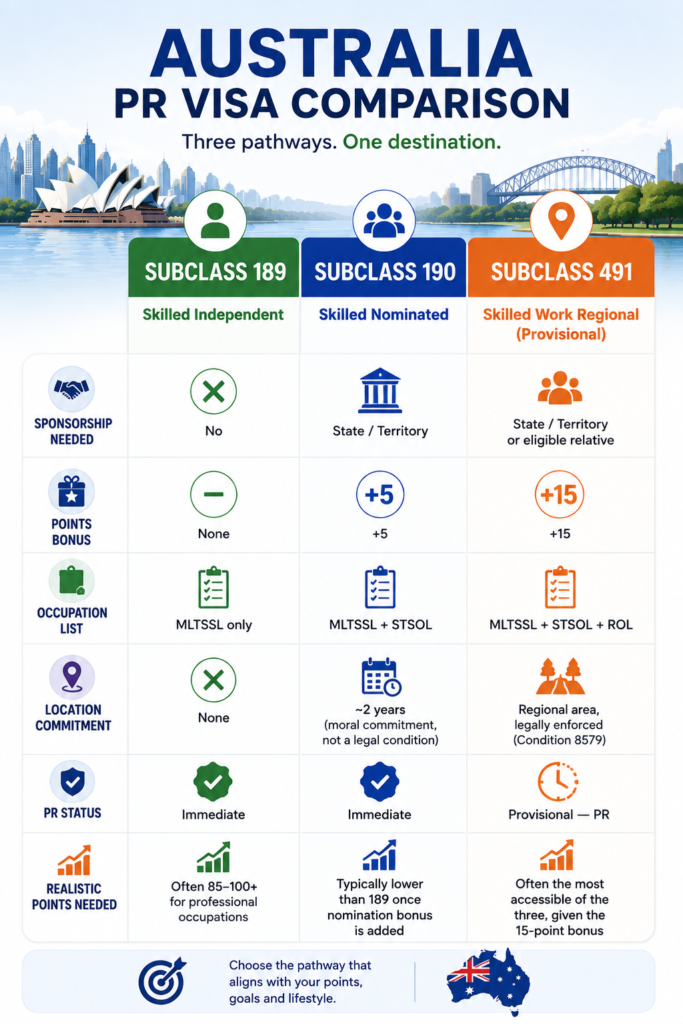
Criteria | Subclass 189 | Subclass 190 | Subclass 491 |
Sponsorship needed | No | State/Territory | State/Territory or eligible relative |
Points bonus | None | +5 | +15 |
Occupation list | MLTSSL only | MLTSSL + STSOL | MLTSSL + STSOL + ROL |
Location commitment | None | Nominating state, ~2 years (moral commitment, not a legal condition) | Regional area, legally enforced (Condition 8579) |
PR status | Immediate | Immediate | Provisional — PR via Subclass 191 after 3 years |
Realistic points needed | Often 85–100+ for professional occupations | Typically lower than 189 once nomination bonus is added | Often the most accessible of the three, given the 15-point bonus |
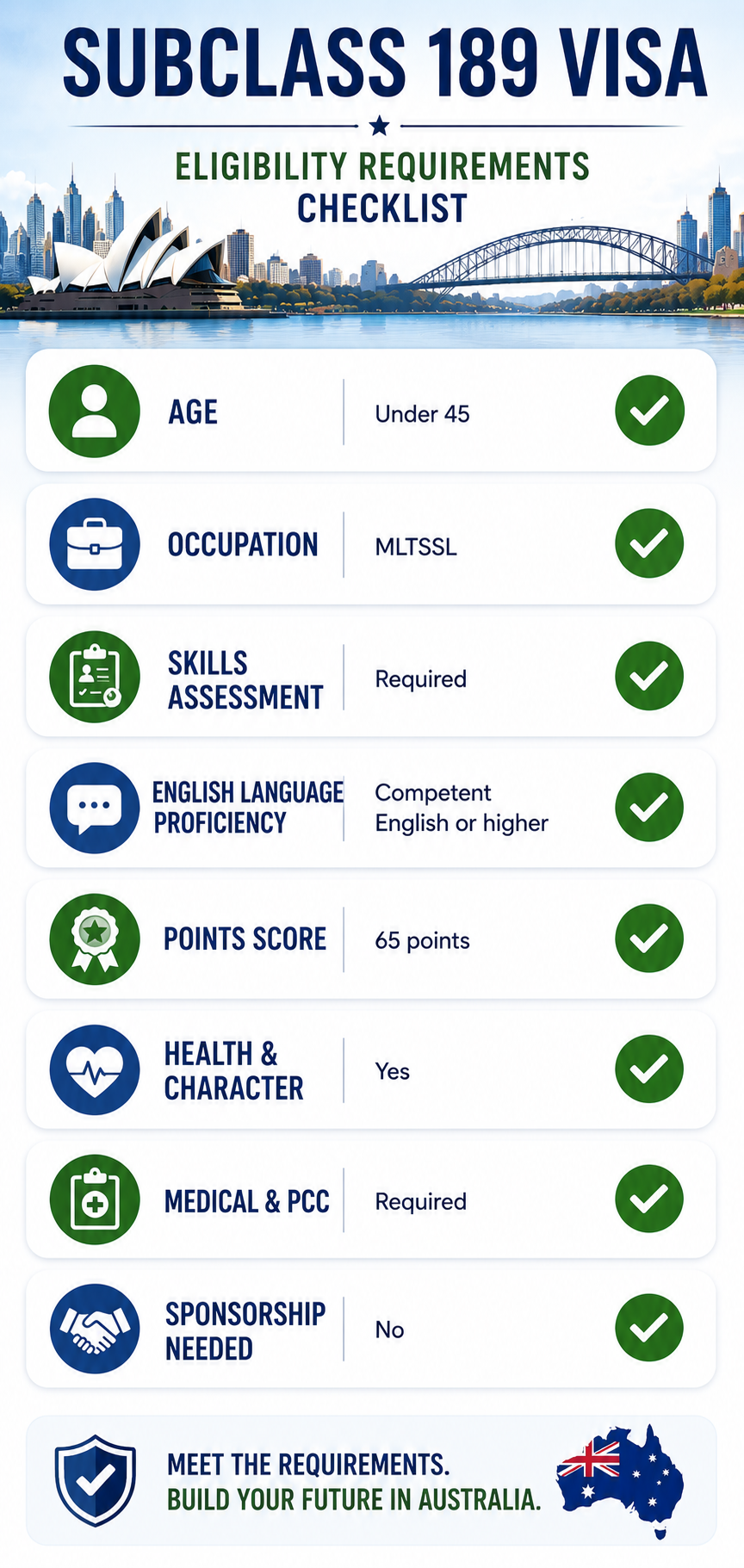
Age: Under 45 at the time of invitation
Occupation: Listed on the MLTSSL (Medium and Long-term Strategic Skills List) — this is the only list that unlocks 189 eligibility
Skills assessment: A positive skills assessment from the relevant assessing authority for your occupation
English language proficiency: Competent English or higher (Superior English scores 20 points and significantly improves competitiveness)
Points score: Minimum 65 points — though realistically often much higher depending on your occupation (see below)
Health and character: Medical examinations and police clearance certificates for all applicants.
No sponsorship needed: No job offer, employer nomination, state nomination, or family sponsor required.
The 189 uses the same core points test as the 190 and 491, but without any nomination or sponsorship bonus — every point has to come from your own profile.
Factor | Points Available |
Age (25–32 years — highest-scoring band) | 30 |
English language proficiency (Superior) | 20 |
Skilled employment outside Australia (8–10 yrs) | 15 |
Skilled employment in Australia (8–10 yrs) | 20 |
Educational qualification — Doctorate | 20 |
Educational qualification — Bachelor’s/Master’s | 15 |
Australian study requirement | 5 |
Study in a designated regional area | 5 |
Credentialed community language qualification | 5 |
Professional Year in Australia | 5 |
Skilled spouse or de facto partner | 10 |
Partner with Competent English only | 5 |
Single applicant, or partner is citizen/PR holder | 10 |
This is the section most competitor content skips, and it’s genuinely the most useful thing you can tell a prospective 189 applicant: 65 points is the legislated minimum, but it is rarely enough to receive an invitation in practice.
From 2026, the Department of Home Affairs moved the 189 to a predictable quarterly invitation round model (four major rounds per year), replacing the previous irregular schedule. Based on recent rounds:
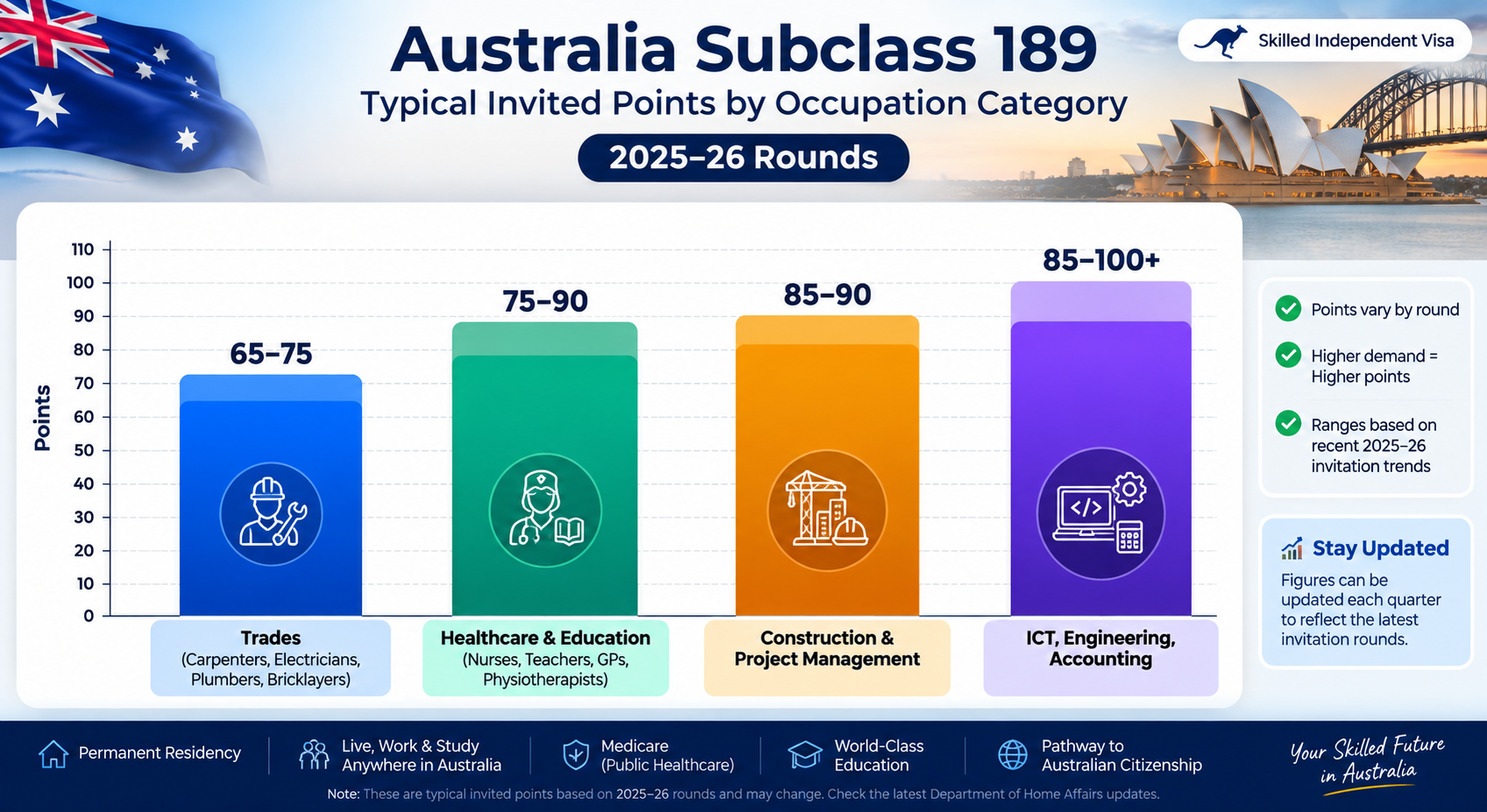
Occupation Type | Typical Invited Points (2025–26 rounds) |
Trades (Carpenters, Electricians, Plumbers, Bricklayers) | 65–75 |
Healthcare & Education (Nurses, Teachers, GPs, Physiotherapists) | 75–90 |
Construction & Project Management | 85–90 |
ICT, Engineering, Accounting | 85–100+ |
In one recent round, over 16,000 invitations were issued across a single program year, with construction and trade occupations consistently receiving invitations closer to the 65-point floor, while ICT and professional occupations regularly required scores in the 90s. There are no occupation ceilings on the 189, so unlike some other categories, a high-demand occupation won’t suddenly become unavailable mid-year — but it will remain competitive.
What this means practically: if you’re in a trade occupation, 65-75 points may realistically get you an invitation. If you’re in IT, engineering, or accounting, budget for needing 85-100+ points — and if you’re short of that, the 190 (with its 5-point bonus) or 491 (with its 15-point bonus) may get you to PR faster than waiting to raise your 189 score alone.
Unlike the 190 and 491, the Subclass 189 draws from a single list: the MLTSSL (Medium and Long-term Strategic Skills List), currently around 212 occupations. This is the narrowest occupation list among the three points-tested skilled visas — occupations on STSOL or ROL alone are not eligible for 189, even if they qualify for 190 or 491.
Because MLTSSL occupations are considered in strong medium-to-long-term demand, they also unlock the broadest range of visa pathways overall — an MLTSSL occupation can be used for 189, 190, 491, and in many cases 186 (Employer Nomination) and 482/Skills in Demand as well.
Step 1: Confirm Your Occupation Is on the MLTSSL
Check the current MLTSSL and confirm your occupation and its ANZSCO code.
Step 2: Take an Approved English Test
Sit for IELTS, PTE Academic, or another accepted test — aim for Superior English (20 points) if you’re in a competitive occupation.
Step 3: Get Your Skills Assessed
Apply to the relevant assessing authority for a positive skills assessment.
Step 4: Calculate Your Points & Submit an EOI
Calculate your points honestly against the table above, and submit your Expression of Interest through SkillSelect.
Step 5: Wait for an Invitation Round
Invitation rounds now run on a predictable quarterly basis — monitor your occupation’s typical invited points and adjust your EOI (English retest, additional experience, etc.) if you’re below the competitive range.
Step 6: Receive Your Invitation to Apply (ITA)
If invited, you’ll have 60 days to lodge your full application.
Step 7: Lodge Your Application with Full Documentation
Submit all supporting documents — health, character, identity, and skills evidence — within the 60-day window.
Step 8: Health & Character Checks, Then Visa Grant
Complete medical exams and police clearances, and receive your Subclass 189 visa with immediate, unrestricted permanent residency.
Applicant | Fee (AUD) |
Primary applicant | ~6,135 |
Additional applicant (18+) | ~3,065 |
Dependent child (under 18) | ~1,530 |
On top of the government fee, budget for skills assessment (AUD 500–2,000, varies by authority), English test (AUD 400–450), medical examinations, and police clearance certificates. Additional factors — such as a partner’s English test results or health exam outcomes — can affect total cost, particularly if a partner requires a separate skills assessment for partner points. (Verify exact current figures via the official Visa Pricing Estimator).
Processing generally takes 6.5 to 10 months from invitation to grant, though this varies by occupation, application completeness, and how many supporting documents require verification. Because there’s no separate nomination step (unlike 190/491), the 189’s total timeline is often more predictable once you’ve received your ITA — the main variable is simply how long it takes to become competitive enough to receive that invitation in the first place.
If you are willing to know more about the Australia Subclass 189 Visa process, you can certainly contact us by writing us an email at mail@pioverseas.com and one of our experts will help you out in every possible way. Call us at +91-9310-10-6988 or you can also receive a call back from our expert once you fill out the inquiry form. You can also talk to our experts directly through our live chat feature and clear your doubts instantaneously.
We at Pi Overseas have a team of dedicated experts that cater to every need of the clients. We have a proven track record in the immigration industry which was achieved in a very short span of time. Our experts will help and guide you through every step of the filing process and keep you posted throughout the whole cumbersome process of visa filing.