Canada Immigration department permits Canadian provinces and territories to nominate and select skilled working professionals to migrate and settle in Canada while helping their economy in a fruitful manner through the Provincial Nominee Program (PNP). Immigration, Refugees, and Citizenship Canada (IRCC) makes the provinces sign an agreement in order to participate in this activity. By this agreement, the provinces are allowed to select candidates as per requirements.
Canada PNP program lets prospective candidates file through a specific province or territory in Canada. The related province or territory can then nominate the candidates through Canada Provincial Nominee Program (PNP). All the provinces fall in this category except Quebec which is having its own set of criteria for selecting eligible candidates.
The efforts of the Citizenship and Immigration Canada (CIC) made it possible for all provinces and territories to come to an agreement keeping in mind the skilled immigration agreement. This agreement involves the particular requirements of employers and capital investment as per each geographical need. As a matter of fact, all the provinces in Canada have designed their own set of rules and business immigration schemes in order to uplift and stabilize their economy by motivating skilled professionals in their provinces.
Every province and territory in Canada has its own Provincial Nominee Program, specifically designed to meet the needs of that province. The requirements can be related to drawing business individuals, skilled manpower, or investors. The applicants are required to select any Canadian province that they wish to move to through the designated Provincial Nominee Program (PNP). The PNPs available in Canada are given below:
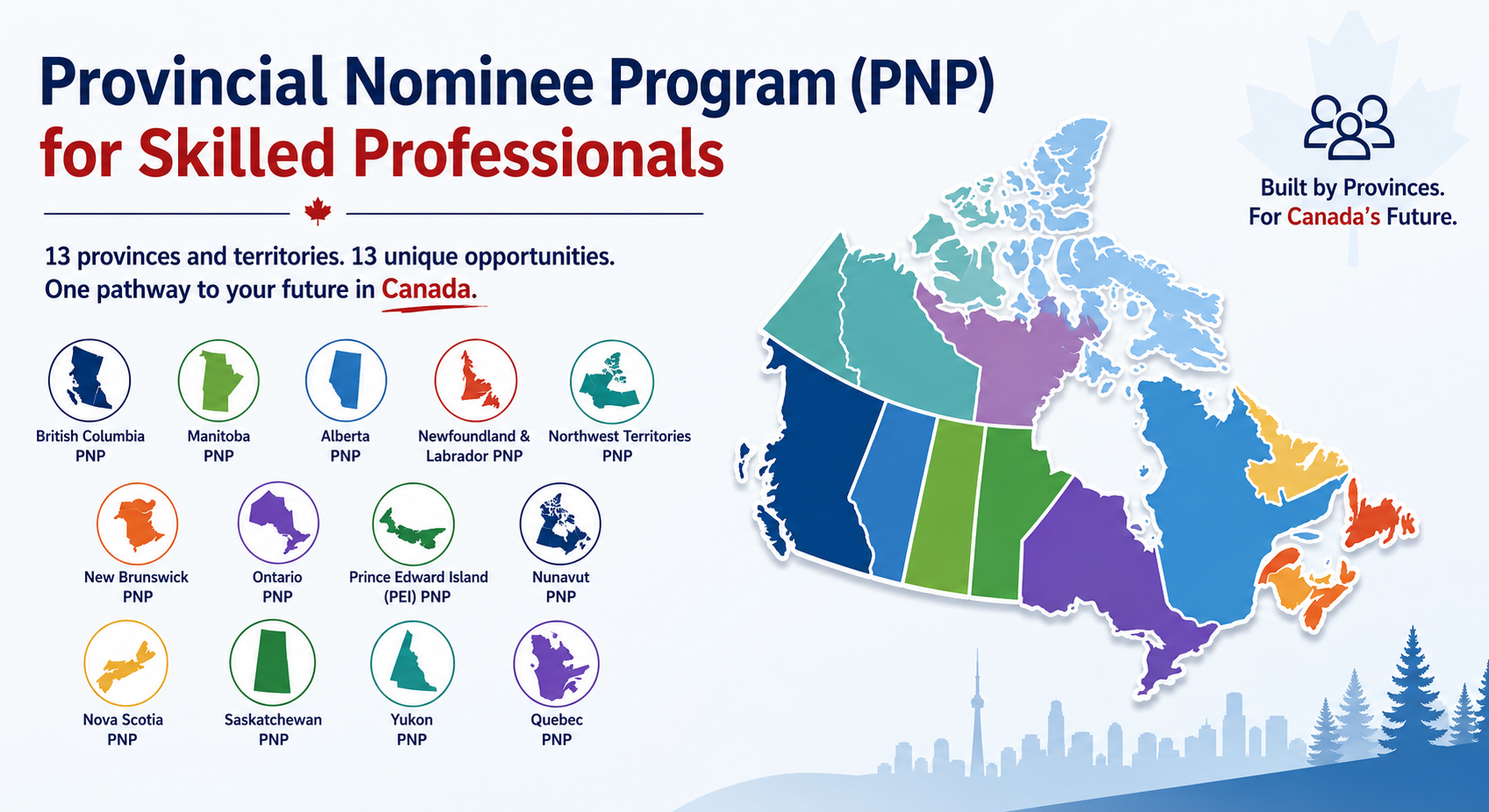
As a potential aspirant who wants to migrate to Maple Leaf country, it’s everyone’s right to get a nomination from the designated province. In order to shift to Canada as a provincial nominee, the applicant needs to represent an application letter to the involved province or territory where there are willing to stay, through the nomination course. There is a profile appraisal needed by the immigration and provincial visa authorities if the applicant is willing to get a PR visa from an explicit Canadian Province.
Before submitting an application through the Provincial Nominee Program (PNP), the applicant among other things should:
Must have a nomination from a specific Canadian province or territory and then submit to Citizenship and Immigration Canada (CIC), to obtain a Permanent Residency visa.
As we all know that every province and territory has its own set of requirements and guidelines. And they have the autonomous power for amending these guidelines without prior notice. So it is advisable that the applicant must always be updated about the guidelines for the latest updates through the designated and authorized websites of provinces.
Once all the pre-requisite criteria are met, the applicant is required to present a submission before CIC for a PR visa. This should be done as soon as the desired province or territory acknowledges your profile.
The applicant must follow these steps in order if they are filing for a provincial nomination through the Express Entry pool.
As we all know Express Entry is one of the most common immigration pathways for skilled working professionals. But the applicant needs to cross the required points requirement according to the latest draw in order to receive the Permanent Residency visa. But if the applicant does not meet the current score requirement, Canada PNP is another option to get Canada PR without any hassle. It is actually one of the most convenient ways to migrate to Canada as there aren’t any additional requirements and points regulations.
Manitoba and Saskatchewan are the provinces that do not have any language proficiency requirements. They accept the application form with a minimum CLB ( Canadian Language Benchmark) 4.
If you are willing to know more about the Canada PNP Visa process, you can certainly contact us by writing us an email at mail@pioverseas.com and one of our experts will help you out in every possible way. Call us at +91-9310-10-6988 or you can also receive a call back from our expert once you fill out the inquiry form. You can also talk to our experts directly through our live chat feature and clear your doubts instantaneously.
We at Pi Overseas have a team of dedicated experts that cater to every need of the clients. We have a proven track record in the immigration industry which was achieved in a very short span of time. Our experts will help and guide you through every step of the filing process and keep you posted throughout the whole cumbersome process of visa filing.
A Provincial Nominee Program lets individual Canadian provinces and territories nominate candidates who match their specific labour market needs for permanent residence. A provincial nomination adds 600 points to your CRS score, which virtually guarantees an Invitation to Apply in the next Express Entry round. Each province runs its own PNP with different streams targeting specific occupations, and some PNP streams operate entirely outside Express Entry.
PNP applicants often need to demonstrate a genuine connection to the province, such as previous work, study, or a valid job offer there, though requirements vary significantly by province and stream.
Quebec runs its own independent immigration selection system (not a PNP), and Nunavut does not currently operate a nominee program.
The most significant 2026 change took effect March 30, 2026: IRCC transferred authority for assessing a candidate’s “ability to become economically established” and “intent to reside” in the nominating province entirely to the provinces themselves. A valid provincial nomination certificate now serves as sufficient proof these assessments were already completed — federal officers can no longer reassess intent or economic potential, and instead focus only on identity verification, nomination validity, and admissibility (criminal/medical checks). This is intended to reduce duplication and speed up federal processing once a candidate is nominated.
Separately, Ontario’s OINP replaced 9 individual streams with 3 consolidated pathways in May 2026 (Employer Job Offer, Priority Healthcare, and Entrepreneur/Exceptional Talent streams), and the federal 2026–2028 Immigration Levels Plan raised PNP admission targets to roughly 91,500 — a significant increase from the 2025–2027 plan, signaling continued strong federal reliance on the PNP as an economic immigration channel.
There’s no single “easiest” PNP; the right fit depends on your occupation, CRS score, and provincial ties. As a general pattern, Saskatchewan (SINP) and Manitoba (MPNP) are often considered more accessible for candidates without a job offer, since both run active Occupation In-Demand and skills-based categories with relatively lower CRS thresholds compared to Ontario. Ontario (OINP) holds the largest allocation nationally but is also the most competitive due to volume of applicants.
Province | Known For |
Ontario (OINP) | Largest allocation; tech, trades, international student, and employer streams |
British Columbia (BC PNP) | Strong Tech stream with accelerated processing |
Alberta (AAIP) | Healthcare, technology, and primary industries; often lower fees |
Saskatchewan (SINP) | Popular for candidates without a job offer via Occupation In-Demand list |
Manitoba (MPNP) | Emphasizes community and labour-market connections |
Atlantic provinces (AIP) | Dedicated employer-driven pathway with settlement support |
For 2026 specifically, Saskatchewan and Manitoba continue to be the provinces most commonly recommended for candidates seeking a realistic PR pathway without an exceptionally high CRS score, thanks to regular draws, diverse streams, and lower cutoffs relative to Ontario or British Columbia. If you already have a valid job offer, the Atlantic Immigration Program is often the fastest overall route to PR, since it’s employer-driven and skips much of the competitive scoring entirely.
How to Choose the Right Province for You in 2026
Saskatchewan and Manitoba are the provinces most consistently cited by immigration professionals as offering the most accessible PNP pathways in 2026, largely due to their Occupation In-Demand lists, lower CRS thresholds, and streams that don’t require a job offer. The Atlantic provinces (via the Atlantic Immigration Program) are also frequently recommended for candidates who already have, or can secure, a job offer from an Atlantic Canada employer, since AIP is one of the faster employer-driven routes available.
Provinces Often Considered More Accessible
Province | Why It’s Considered Accessible |
Saskatchewan (SINP) | Occupation In-Demand and Express Entry sub-categories with no job offer required; among the lowest application fees (~$350) |
Manitoba (MPNP) | Points-based system rewarding work experience and community/family connections; low fee (~$500) |
Atlantic provinces (AIP) | Fast, employer-driven pathway with dedicated settlement support once a job offer is secured |
Alberta (AAIP) | Comparatively lower CRS thresholds in several streams; often low or no provincial fee |
Express Entry is a single federal pool where IRCC invites candidates nationally based purely on CRS score. PNP lets individual provinces select candidates who match their specific local labour needs, regardless of where they rank nationally. A provincial nomination can be layered onto Express Entry (adding 600 CRS points) or used as a standalone application path entirely outside Express Entry. In short: Express Entry ranks you against everyone in Canada; PNP lets a province choose you specifically.
| Express Entry | PNP |
Who selects you | IRCC, nationally, by CRS rank | Individual province, by its own criteria |
Job offer needed | No | Depends on stream |
Adds CRS points | N/A | +600 if enhanced/EE-linked |
Can bypass CRS ranking | No | Yes, via base (non-EE) streams |
Enhanced streams are linked to Express Entry; a nomination adds 600 CRS points, and you’re invited in the next federal round, with federal processing around 6 months after nomination. Base streams operate entirely outside Express Entry as a paper-based application directly to IRCC, which currently takes roughly 16 months at the federal stage. Enhanced streams are faster overall but usually require a higher starting CRS profile; base streams suit candidates who wouldn’t otherwise be competitive in Express Entry.
Not always. Many PNP streams, such as Ontario’s Human Capital Priorities stream and Saskatchewan’s Express Entry and Occupations In-Demand categories, nominate candidates based on skills, education, and Express Entry profile alone, without requiring a job offer. Other streams, particularly employer-driven categories, do require a valid job offer from an employer in that province. Whether you need one depends entirely on which specific stream you apply through, not the PNP system as a whole.
Provincial application fees vary significantly, from $0 in some provinces (historically Alberta, Nova Scotia, and the territories have run free or low-cost streams) up to roughly $1,500 CAD in others, such as Ontario. This is separate from federal PR fees ($1,590 CAD per principal applicant as of April 2026), language testing ($280–436 CAD), and an Educational Credential Assessment if required.
Province | Typical Application Fee (CAD) |
Alberta (AAIP) | Often free or low-cost, depending on stream |
British Columbia (BC PNP) | ~$1,150–1,475 |
Saskatchewan (SINP) | ~$350 |
Manitoba (MPNP) | ~$500 |
Ontario (OINP) | ~$1,500 |
New Brunswick / Newfoundland | ~$250 |
Prince Edward Island | ~$300 |
Note: Fees vary by stream within each province and change without much notice. Always confirm the current fee directly on the specific province’s official PNP page before applying — the figures above are a general guide, not a quote.
Total PNP timelines have two stages: provincial nomination (varies widely by province and stream, often 2–6 months) plus federal PR processing after nomination, roughly 6 months for enhanced/Express Entry-linked streams or around 16 months for base (non-Express Entry) streams. Employer-driven streams with clear documentation tend to process faster at the provincial stage than skills-based streams with larger applicant pools.
Generally, yes; there’s no federal rule preventing you from applying to multiple provinces’ PNP streams simultaneously, as long as you meet each province’s individual eligibility requirements. However, applying broadly without a clear connection to each province can weaken your case for “intent to reside,” which provinces now assess independently under the 2026 rule changes. A more targeted strategy, applying to provinces where your occupation, education, or existing ties genuinely align; tends to produce stronger outcomes than a scattershot approach.
You’re expected to show a genuine intent to reside in the nominating province when you apply, and this is now something the province itself formally assesses under the March 2026 rule changes. That said, Canadian permanent residents have constitutional mobility rights and are not legally barred from moving to another province after landing. In practice, moving very soon after receiving PR; especially if it appears to contradict the intent shown in your application, can raise concerns in future immigration matters, even though it isn’t strictly illegal.
No. A provincial nomination significantly improves your chances, especially when combined with the 600 CRS points for enhanced streams, but the final PR decision is always made by IRCC, the federal immigration department, not the province. Admissibility issues (criminal record, medical concerns, misrepresentation) can still result in a federal refusal even after a provincial nomination has been granted, though under the 2026 changes, IRCC must consult the nominating province before making such a refusal.
Eligibility for the Provincial Nominee Program varies by stream, but most applicants must meet three core conditions: (1) have the skills, education, or work experience to contribute to that province’s economy, (2) show a genuine intent to live and work in the nominating province, and (3) be willing and able to apply for Canadian permanent residence. Beyond these basics, each stream sets its own specific bar: language test scores (IELTS, CELPIP, or TEF), an Educational Credential Assessment (ECA) for foreign credentials, proof of settlement funds, and sometimes a valid job offer or an existing Express Entry profile.
Common PNP Eligibility Requirements
Requirement | Typical Standard |
Language proficiency | CLB 4–7+ depending on stream (IELTS, CELPIP, or TEF/TCF for French) |
Education | Assessed via ECA if credentials are from outside Canada |
Work experience | Usually 1+ years in an eligible or in-demand occupation |
Job offer | Required for some employer-driven streams; not required for others (e.g., Ontario Human Capital Priorities, SINP Express Entry sub-category) |
Settlement funds | Required for most non-Express Entry (base) streams |
Provincial connection | Employment, study, or family ties in the province, or alignment with its in-demand occupation list |
Express Entry profile | Required only for “enhanced” streams linked to the federal system |