
+91 9310106988
mail@pioverseas.com
Express Entry is Canada’s primary system for managing applications for permanent residence under three federal economic immigration programs, using the Comprehensive Ranking System (CRS) to rank candidates and invite the highest scorers to apply. Launched by Immigration, Refugees and Citizenship Canada (IRCC) in 2015, it remains one of the fastest, most predictable pathways to Canadian PR.
Most importantly: since 25 March 2025, having a job offer no longer adds any CRS points — a change that reshaped the entire competitive landscape of the Express Entry pool. We cover exactly what this means for you below, along with current proof of funds requirements, category-based draws, and how to calculate your own CRS score.
NOTE: Express Entry ranks candidates using the CRS, based on age, education, work experience, and language proficiency, with a provincial nomination remaining the single largest score boost at 600 points. A job offer no longer adds CRS points as of March 2025, though it can still make you eligible for certain programs and exempts you from the proof of funds requirement. Single applicants currently need CAD $15,263 in proof of funds (more for larger families) unless exempt.
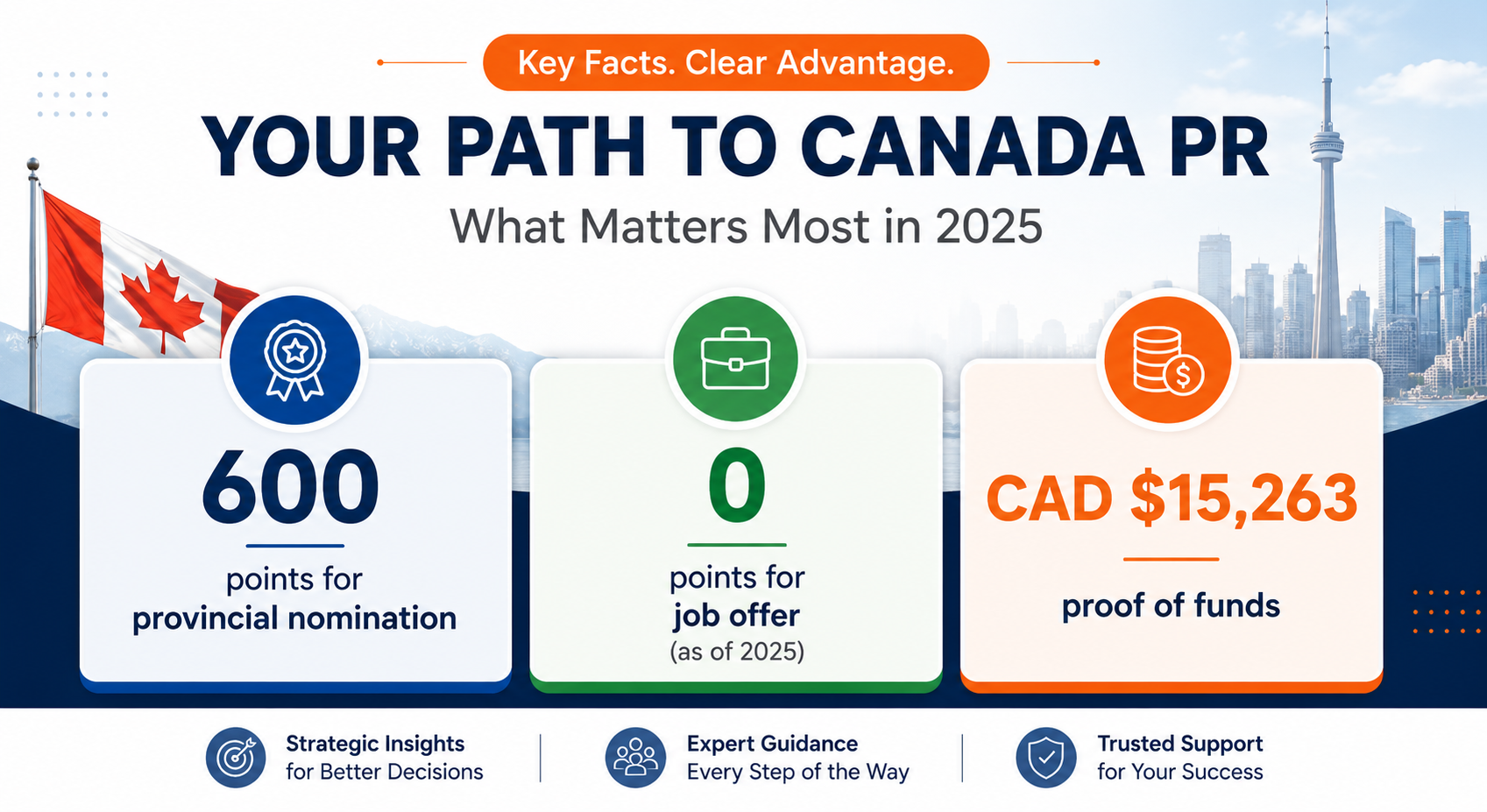

As of 25 March 2025, IRCC removed job offer points from the Comprehensive Ranking System entirely — for all current and future candidates in the Express Entry pool. This applies to:
This change was introduced to address a documented pattern of fraud, where employers and intermediaries were selling fraudulent Labour Market Impact Assessment (LMIA) letters to Express Entry candidates. By eliminating the points, IRCC removed the financial incentive driving that fraud.
What hasn’t changed: if a job offer is part of the eligibility criteria for a specific program — such as the Federal Skilled Trades Program, Federal Skilled Worker Program, or certain PNP streams — this change doesn’t affect your eligibility for those programs. You should still include job offer details in your Express Entry profile to remain eligible where relevant. A valid job offer also continues to exempt you from the proof of funds requirement, even though it no longer boosts your CRS score directly.
Worth watching: IRCC’s 2026-27 Departmental Plan, published March 2026, signals an intention to reintroduce CRS points for job offers in high-wage occupations and for Canadian work experience — but as of this writing, this remains a proposed policy direction under public consultation, not a confirmed or implemented change. No implementation date, point values, or eligibility criteria have been finalized. We recommend planning your Express Entry strategy around the current rules, not around a change that may or may not take effect in its proposed form.
Express Entry manages applications for three federal economic immigration programs:
The CRS score has a maximum of 1,200 points, split across four sections. The exact points available for the first three sections depend on whether you have a spouse or common-law partner accompanying you.

Factor | Max Points (No Spouse) | Max Points (With Spouse) |
Age | 110 | 100 |
Level of education | 150 | 140 |
Official language proficiency (first language) | 160 | 150 |
Canadian work experience | 80 | 70 |
Subtotal | 500 | 460 |
Factor | Max Points |
Spouse’s level of education | 10 |
Spouse’s official language proficiency | 20 |
Spouse’s Canadian work experience | 10 |
Subtotal | 40 |
Combination | Max Points |
Education + language proficiency | 50 |
Education + Canadian work experience | 50 |
Foreign work experience + language proficiency | 50 |
Foreign work experience + Canadian work experience | 50 |
Certificate of qualification (trades) + language proficiency | 50 |
Subtotal (capped) | 100 |
Factor | Max Points |
Provincial nomination | 600 |
Job offer | 0 — removed 25 March 2025 (previously up to 200) |
Post-secondary study in Canada | 15–30 |
Sibling living in Canada (citizen or PR) | 15 |
French language proficiency (NCLC 7+) | 25–50 |
Subtotal | Up to 600 |
Maximum possible CRS score: 1,200 (Core/Human Capital + Spouse factors + Skill Transferability, capped at 600 combined, plus up to 600 in Additional Points).
A provincial nomination remains by far the most impactful single factor you can add to your profile — worth pursuing through a PNP if your base CRS score isn’t competitive on its own.
Note that the “no spouse” and “with spouse” columns aren’t a choice — they reflect the two different scoring tracks IRCC uses depending on your actual family situation, so use whichever applies to you.
Alongside general CRS-ranked draws, IRCC runs category-based selection draws, inviting candidates who meet specific criteria tied to labour market needs or French-language ability, even if their CRS score would be too low for a general draw. Categories have included:
Category-based draws are reviewed and updated periodically to reflect current labour market priorities — if your occupation or language ability aligns with an active category, your realistic chances of an invitation can be significantly better than the general pool would suggest.

Applicants under the Federal Skilled Worker Program and Federal Skilled Trades Program must show proof of settlement funds, updated annually based on 50% of Statistics Canada’s Low-Income Cut-Off (LICO). Current figures (updated 7 July 2025, applicable through 2026):
Number of Family Members | Funds Required (CAD) |
1 | $15,263 |
2 | $19,001 |
3 | $23,360 |
4 | $28,362 |
5 | $32,168 |
6 | $36,280 |
7 | $40,392 |
Each additional member beyond 7 | +$4,112 |
This table shows the minimum amount required — if you have more funds available, list the full amount in your profile or application rather than just the minimum threshold.
Who’s exempt:
IRCC requires funds that are liquid, unencumbered by debt, and accessible to you within a few days of landing — not just money you own on paper.
Generally accepted:
Generally not accepted:
What your bank letter must include:
IRCC scrutinizes large, sudden deposits closely — if a significant deposit appears shortly before you apply, be prepared to document its source (for example, a signed gift letter or proof of an asset sale), or it may be treated as a red flag rather than genuine, available funds.
Important nuances:

Step 1: Confirm Your Eligibility
Check whether you qualify under FSWP, FSTP, or CEC based on your education, work experience, and language ability.
Step 2: Get Your Credentials Assessed
Obtain an Educational Credential Assessment (ECA) if your qualifications were earned outside Canada.
Step 3: Take a Language Test
Sit for IELTS/CELPIP (English) or TEF/TCF (French).
Step 4: Calculate Your CRS Score
Use an official or reliable CRS calculator to estimate where you stand.
Step 5: Create Your Express Entry Profile
Submit your profile into the pool, including any job offer details relevant to program eligibility.
Step 6: Pursue a Provincial Nomination (Optional but High-Impact)
If your CRS score isn’t yet competitive, a provincial nomination adds 600 points — often the fastest way to become invite-ready.
Step 7: Receive Your Invitation to Apply (ITA)
Once ranked highly enough in a draw, you’ll receive an ITA.
Step 8: Submit Your Complete Application
Lodge your full application with all supporting documents, generally within 60 days of your ITA.

Creating an Express Entry profile and entering the pool is free — you only pay government fees once you receive an Invitation to Apply (ITA) and submit your application for permanent residence. These fees increased on 30 April 2026, so figures you may see quoted from earlier in the year are now out of date.
Fee | Amount (CAD) |
Processing fee (per adult) | $990 |
Right of Permanent Residence Fee (RPRF) (per adult) | $600 |
Total per adult (if paying RPRF upfront) | $1,590 |
Total per adult (if deferring RPRF until approval) | $990 (then $600 later, before PR is granted) |
Dependent child | $270 per child (does not include RPRF — children are exempt) |
Biometrics | $85 per person, capped at $170 per family |
A worked example: a family of four (2 adults + 2 children) applying together would pay $1,590 × 2 (adults) + $270 × 2 (children) = $3,720, plus biometrics of up to $170 for the family — before any third-party costs.
Beyond government fees, budget separately for:
Practical tip worth including: paying your processing fee and RPRF together at the time of application (rather than deferring the RPRF) can help avoid delays later in your file — and if your application is refused or withdrawn, the RPRF is refunded.
If you are willing to know more about the Canada Express Entry process, you can certainly contact us by writing us an email at mail@pioverseas.com and one of our experts will help you out in every possible way. Call us at +91-9310-10-6988 or you can also receive a call back from our expert once you fill out the inquiry form. You can also talk to our experts directly through our live chat feature and clear your doubts instantaneously.
We at Pi Overseas is one of the best Canada Immigration Consultancy and have a team of dedicated experts that cater to every need of the clients. We have a proven track record in the immigration industry which was achieved in a very short span of time. Our experts will help and guide you through every step of the filing process and keep you posted throughout the whole cumbersome process of visa filing.