Canadian Experience Class (CEC)

Many immigrants from all over the world visit Canada in search of work and a better life.

Among all these people, there are a few who wish to become permanent residents of Canada for a variety of reasons.

CEC is an ideal Canadian immigration category for temporary foreign workers in Canada and international graduates who want to become permanent residents.

What is a Canadian Experience Class?

Canadian Experience Class or CEC is a program that allows people who have previously worked in Canada for at least one year to immigrate permanently to the country.

Canada’s Express Entry immigration system includes the Canadian Experience Class.

Express Entry System

In an effort to increase Canadian immigration, the Express Entry System was launched on January 1, 2015.

With Express Entry, the Canadian government has welcomed so many economic immigrants since it was launched.

The Express Entry system provides the best immigration for students and highly skilled workers who wish to immigrate to Canada.

Express Entry helps select applicants based on guidelines set by Immigration, Refugees, and Citizenship Canada or IRCC.

As per IRCC, candidates with higher scores and ranking in the Express Entry pool are sent an ITA or invitation directly from the country if they have skills and abilities that will make a contribution to the growth and expansion of the Canadian economy.

The applicant must follow the standard procedure once the application is received if they wish to immigrate to Canada through the Canadian Experience Class.

In addition to the Canadian Experience Class, there are other Express Entry pool options you can choose from.

If you wish to immigrate to Canada, you must meet the requirements of either of the following programs:

  • Federal Skilled Worker Program
  • Federal Skilled Trades Program

No Canadian work experience is required to apply for a visa through either of the two above programs.

Benefits of CEC PR visa?

Canadian Experience Class (CEC) Benefits

There are various benefits of the PR visa obtained through the Canadian Experience Class. These benefits are given below:

Immigrants in the Canadian Experience Class have already gained a year of working experience, which is highly valued in the Comprehensive Ranking System.

Canadian Experience Class applications are usually processed within five to six months since the required documents are relatively few.

Unlike the FSTP and FSWP, candidates under the Canadian Experience Class are not required to show any proof of settlement funds.

Does Canada Experience Class require a job offer?

It is not necessary to have a job offer to qualify for the Canada Experience Class visa. However, applicants must have at least one year of experience in an occupation that is listed in the NOC.

Can we apply for Canada PR without work experience?

If you don’t have any work experience in a Canadian province, you cannot apply for the Canada PR under the Canadian Experience Class. You must have at least a year of work experience in a Canadian province.

Who is eligible for the Canadian Experience Class?

The Canada Experience Class program is not open to everyone residing in Canada. Only individuals who are currently residing in Canada and who meet certain eligibility criteria are eligible to apply.

Canadian Experience Class applicants must have at least one year of skilled work experience in Canada within three years of their application date.

To apply for the Canadian Experience Class, you must meet the following requirements:

  1. Within three years of your application date, you must have at least one year of skilled work experience in any of the provinces in Canada. Even the experience gained while living in Quebec is also counted.
  2. Work experience in Canada must be authorized.
  3. Among the Canadian NOC or National Occupational Classification list, skilled work is defined as managerial, professional, technical, or skilled trade jobs.
  4. Ideally, you should have at least 12 months of full-time work experience, which is 30 hours a week of paid work or more, or an equivalent number of hours if you work part-time.
  5. A candidate’s working experience while a full-time student will not be considered.
  6. The Canadian Language Benchmark, or CLB, is the language level needed for the job, and you must meet CLB 7 (TEER 0 or TEER 1 occupations),  CLB 5 (TEER 2 or TEER 3) in all four parameters.
  7. As well, you must take a language test that is approved by Citizenship and Immigration Canada to demonstrate your proficiency in speaking, reading, listening, and writing in either English or French.
  8. The state of Quebec has its own program for skilled workers called the Quebec skilled worker program, which requires you to live and work outside of Quebec.
  9. While education is not an essential requirement for the Canadian Experience Class, if you want to earn more points for your education under the Express Entry program, you will need to provide the relevant documents like:
  • Diploma or degree certificate from a Canadian high school or post-secondary institution.
  • You must provide the CIC with a completed foreign credential along with an ECA or Educational Credential Assessment report.
  1. In addition, candidates must obtain a security clearance and undergo medical examinations. The processing time for the Canadian Experience Class is approximately six months.

How much does it cost to get this visa?

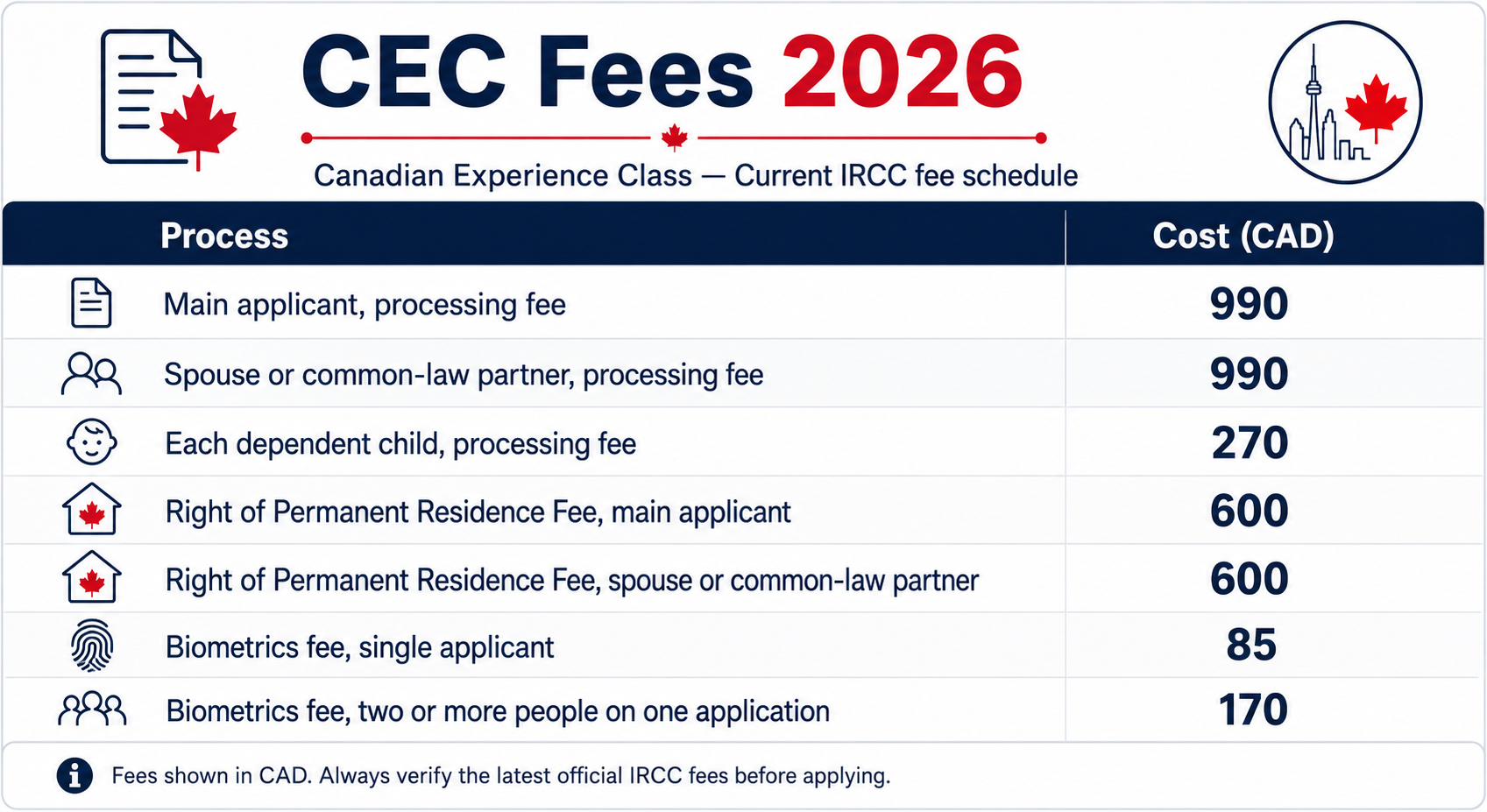
The cost of applying for permanent residence through the CEC program can vary depending on a number of factors, such as the number of family members included in the application, whether or not the applicant needs to take language tests or obtain educational credential assessments, and any fees associated with medical exams or police certificates.

As of March 2023, the fees associated with a CEC application for a single applicant are as follows:

  • Processing fee for the main applicant: CAD 950 
  • Right of permanent residence fee (RPRF): CAD 575

If the applicant is including family members on the application, additional fees will apply. For example, the processing fee for a spouse or common-law partner is CAD 1,525, and the processing fee for a dependent child is CAD 260.

It is also worth noting that there may be additional fees associated with obtaining language test results or educational credential assessments, as well as any fees associated with medical exams or police certificates.

It is important to check the most up-to-date fee schedule on the Immigration, Refugees, and Citizenship Canada (IRCC) website before submitting a CEC application, as fees can change over time.

What are the requirements for Canadian Experience Class?

The Canadian Experience Class (CEC) is a program designed to help foreign workers who have gained skilled work experience in Canada to transition to permanent residence status. To be eligible for the CEC, an individual must meet the following requirements:

Canadian Experience Class (CEC) Requirements

  1. Skilled Work Experience: The applicant must have at least one year of skilled work experience in Canada within the past three years. The work experience must be in an occupation classified as TEER 0 (Managerial Occupations), Teer 1 (Professional/University Degree), or TEER 2 (Technical/College Diploma, 2+ years training), and TEER 3 (intermediate/college diploma, under 2 years training) of the National Occupational Classification (NOC) system.
  2. Language Proficiency: The applicant must meet the minimum language proficiency requirements in either English or French, which is typically demonstrated through a standardized language test such as the IELTS (International English Language Testing System) or CELPIP (Canadian English Language Proficiency Index Program) for English, or the TEF (Test d’évaluation de français) for French.
  3. Educational Qualifications: There is no official educational requirement for this program. However, higher levels of education can improve an applicant’s chances for the program.
  4. Intention to Reside Outside Quebec: The applicant must intend to reside outside the province of Quebec, as Quebec has its own immigration programs and requirements.
  5. Admissibility: The applicant must be admissible to Canada, which includes passing a security and criminal background check, and not being inadmissible for health or financial reasons.
  6. Other Requirements: The applicant must meet any additional program-specific requirements or criteria, such as work experience in a specific industry or occupation.

Overall, the CEC program is a great option for individuals who have gained valuable skilled work experience in Canada and wish to transition to permanent residence status. Meeting the above eligibility criteria is essential to submitting a successful CEC application.

Reason to Choose Pi Overseas:
  • Consultations at Pi Overseas are provided by professional and authorized immigration consultants
  • A step-by-step guide to the eligibility and application process
  • Our online process is secure and transparent
  • For any process, there is a system addressing complaints for a smooth consumer experience.
  • Having processed thousands of applications
  • We assess every case multiple times before submitting it
  • Qualifications and other skills are evaluated by our certified experts for error-free proceeding.

If you are willing to know more about Canada (CEC) PR Visa process, you can certainly contact us by writing us an email at mail@pioverseas.com and one of our experts will help you out in every possible way. Call us at +91-9310-10-6988 or you can also receive a call back from our expert once you fill out the inquiry form. You can also talk to our experts directly through our live chat feature and clear your doubts instantaneously.

We at Pi Overseas have a team of dedicated experts that cater to every need of the clients. We have a proven track record in the immigration industry which was achieved in a very short span of time. Our experts will help and guide you through every step of the filing process and keep you posted throughout the whole cumbersome process of visa filing.

Let’s Start Your Visa Journey — Contact Us Today

Frequently Asked Questions

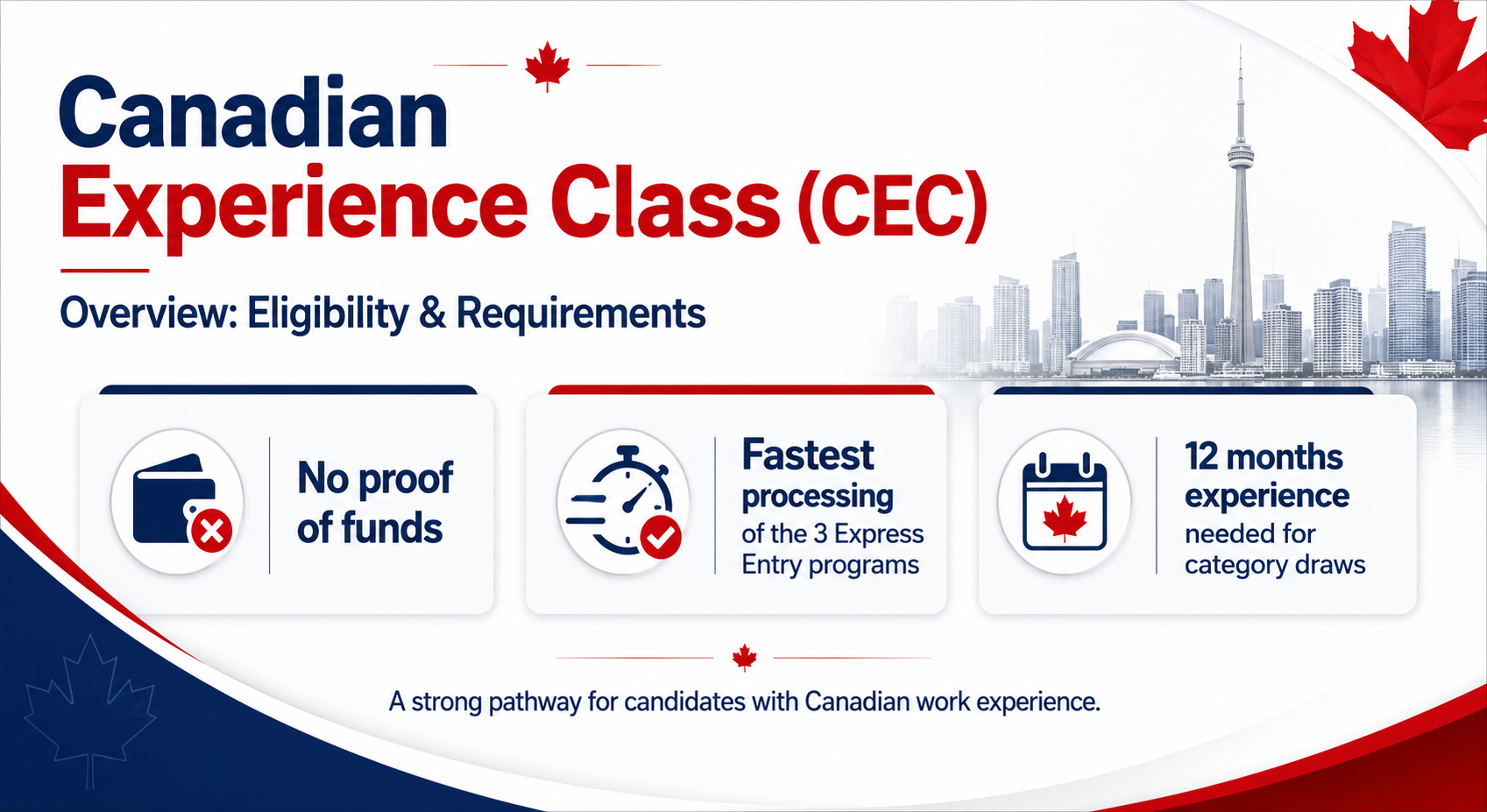
The Canadian Experience Class is one of three federal economic programs managed through Express Entry, designed specifically for candidates who already have skilled work experience gained inside Canada. It’s widely considered the most accessible and often fastest-processing of the three Express Entry programs, since it recognizes applicants who are already integrated into the Canadian workforce, no job offer, minimum education level, or proof of funds is required.

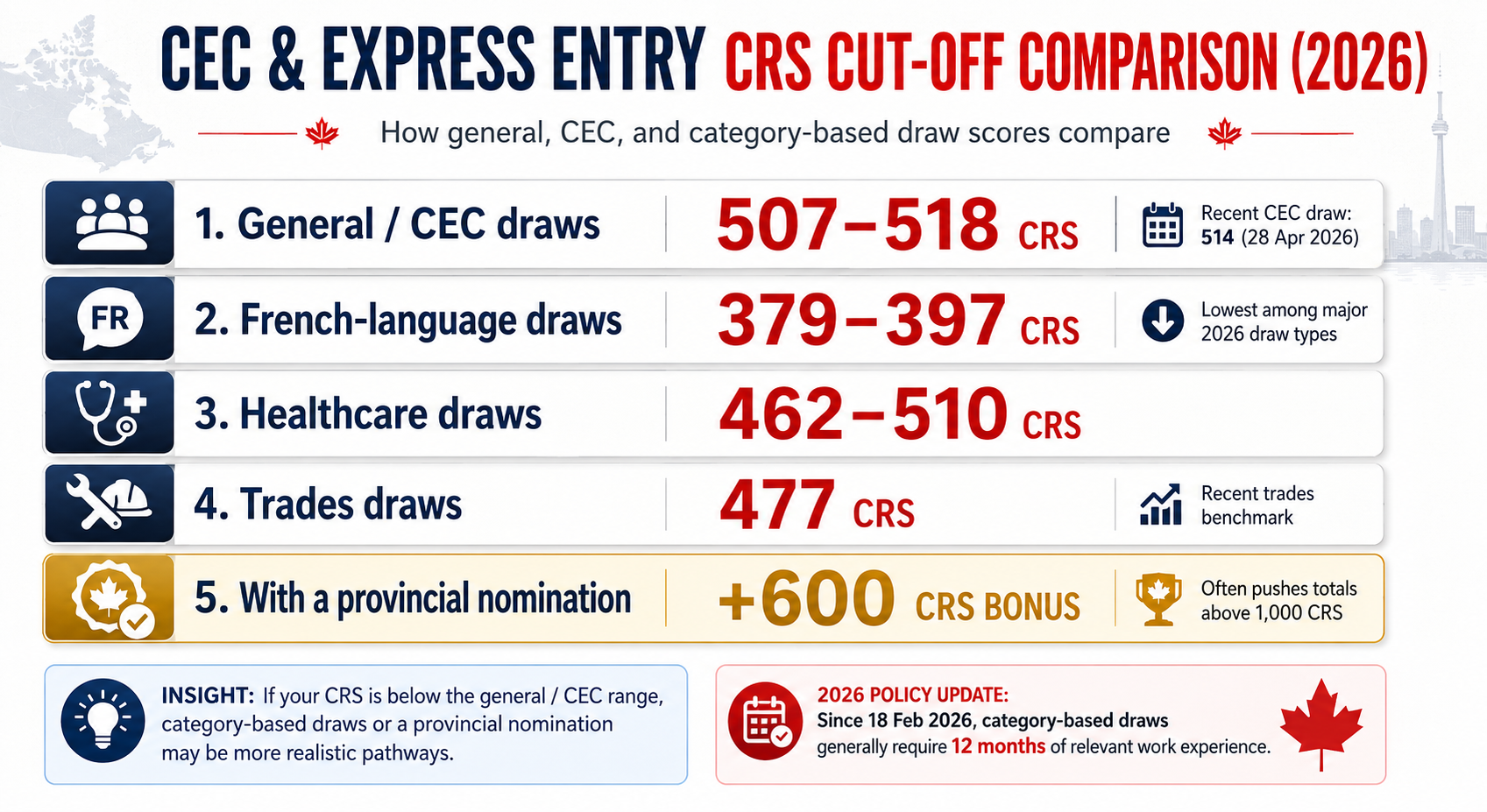
Not for general or CEC-specific draws in 2026, but it can still work. Current CEC and general Express Entry cutoffs have consistently held in the 507–515 range throughout 2026, so a 450 score falls short by roughly 60 points for those rounds. However, 450 remains realistically competitive for categorybased draws-healthcare, skilled trades, and French-language proficiency rounds have run at meaningfully lower cutoffs, sometimes dipping well below 470, making 450 a genuinely usable score if you qualify for one of these categories.

Where 450 Actually Stands in 2026:

Draw Type

Typical 2026 Cutoff

Is 450 Enough?

General / CEC-specific

507–515

No — roughly 60+ points short

Healthcare & social services (category)

~462–510

Sometimes — depends on the specific round

Trades (category)

~477 and below in recent rounds

Often close or sufficient

French-language proficiency (category)

~380–420

Yes, comfortably

With a provincial nomination (+600)

1,050+

Yes, overwhelmingly

Note: Cutoffs shift with every draw and applicant pool composition. Always check IRCC’s live rounds-of-invitations page for the current numbers before assuming any single figure applies to your situation.

As of mid-2026, CEC-specific and general draw cutoffs have consistently held in the 507–515 range, with a recent CEC draw on April 28, 2026 issuing 2,000 invitations at a CRS cutoff of 514. A CRS score around 470 is generally too low for general or CEC-only draws in 2026, but can still be highly competitive for category-based draws (healthcare, trades, French-language proficiency), which have run at meaningfully lower cutoffs throughout the year.

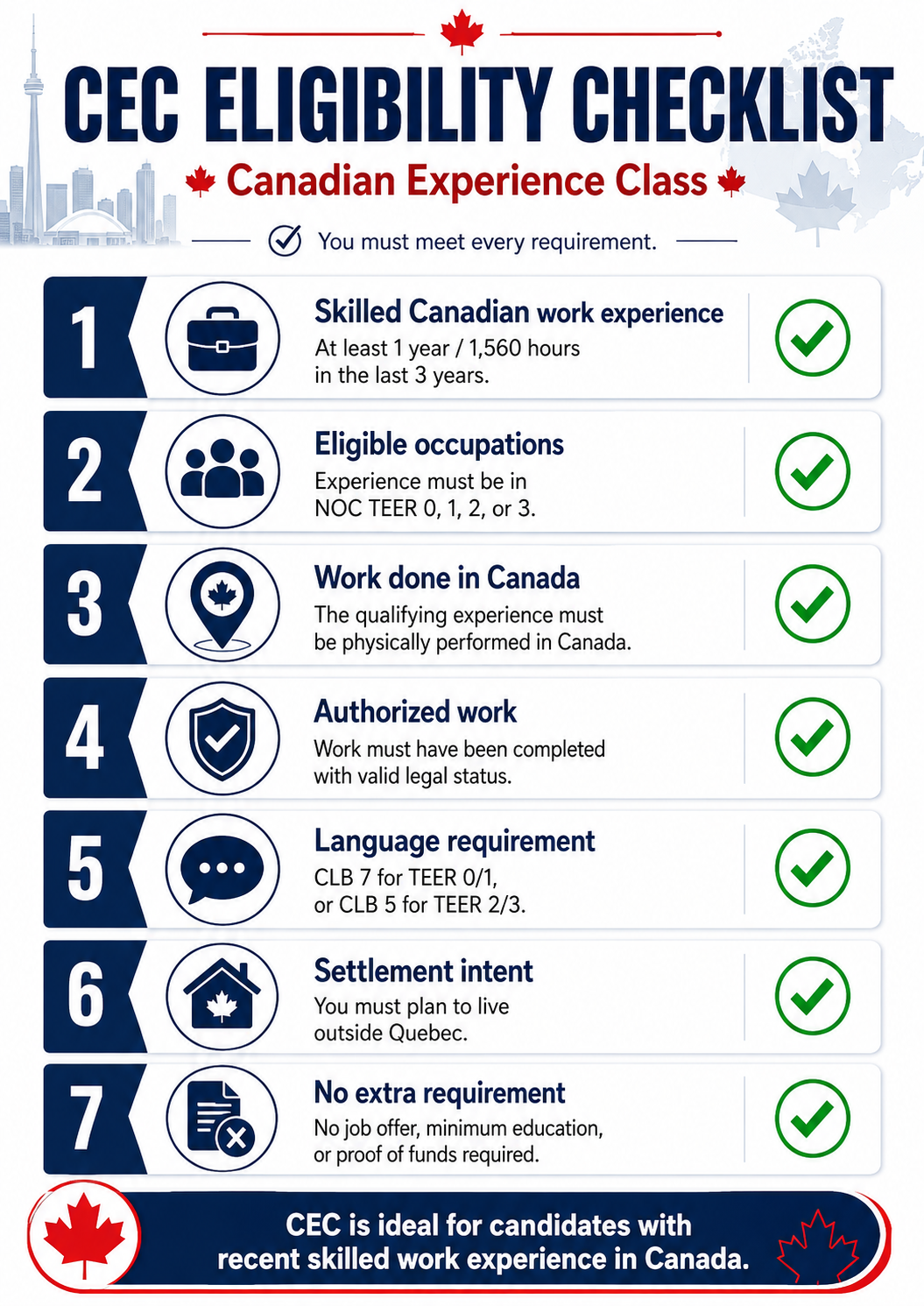
To qualify for CEC, you need: (1) at least 1 year (1,560 hours) of full-time (or equivalent part-time) skilled Canadian work experience, gained within the last 3 years, in an occupation classified under NOC TEER 0, 1, 2, or 3; (2) that experience must have been performed on valid, authorized work status while physically present in Canada; (3) a minimum language score matching your occupation’s TEER level (CLB 7 for TEER 0/1, CLB 5 for TEER 2/3); and (4) you must intend to live outside Quebec. All four conditions must be met — there are no exceptions if even one is missed.

Requirement

Standard

Work experience

1,560 hours (1 year) in the last 3 years

Eligible occupations

NOC TEER 0, 1, 2, or 3

Work location

Physically performed in Canada

Work authorization

Valid, legally authorized status during the work

Language

CLB 7 (TEER 0/1) or CLB 5 (TEER 2/3)

Destination province

Must intend to live outside Quebec

Job offer

Not required

Minimum education

Not required

Proof of funds

Not required

No. CEC applicants are fully exempt from the settlement funds requirement that applies to FSWP and (in most cases) FSTP applicants. This exemption reflects the program’s underlying logic: since you already have Canadian work experience, IRCC treats you as having a demonstrated ability to support yourself financially in Canada.

This is one of the most significant recent changes affecting CEC candidates: as of February 18, 2026, IRCC raised the minimum qualifying work experience for all Express Entry category-based draws from 6 months to 12 months, aligning category-based eligibility with CEC’s standard requirement. This means candidates who previously might have qualified for category-based selection with just 6 months of relevant Canadian experience now need the full 1 year, closing a pathway that had been notably more accessible for newer workers and recent graduates.

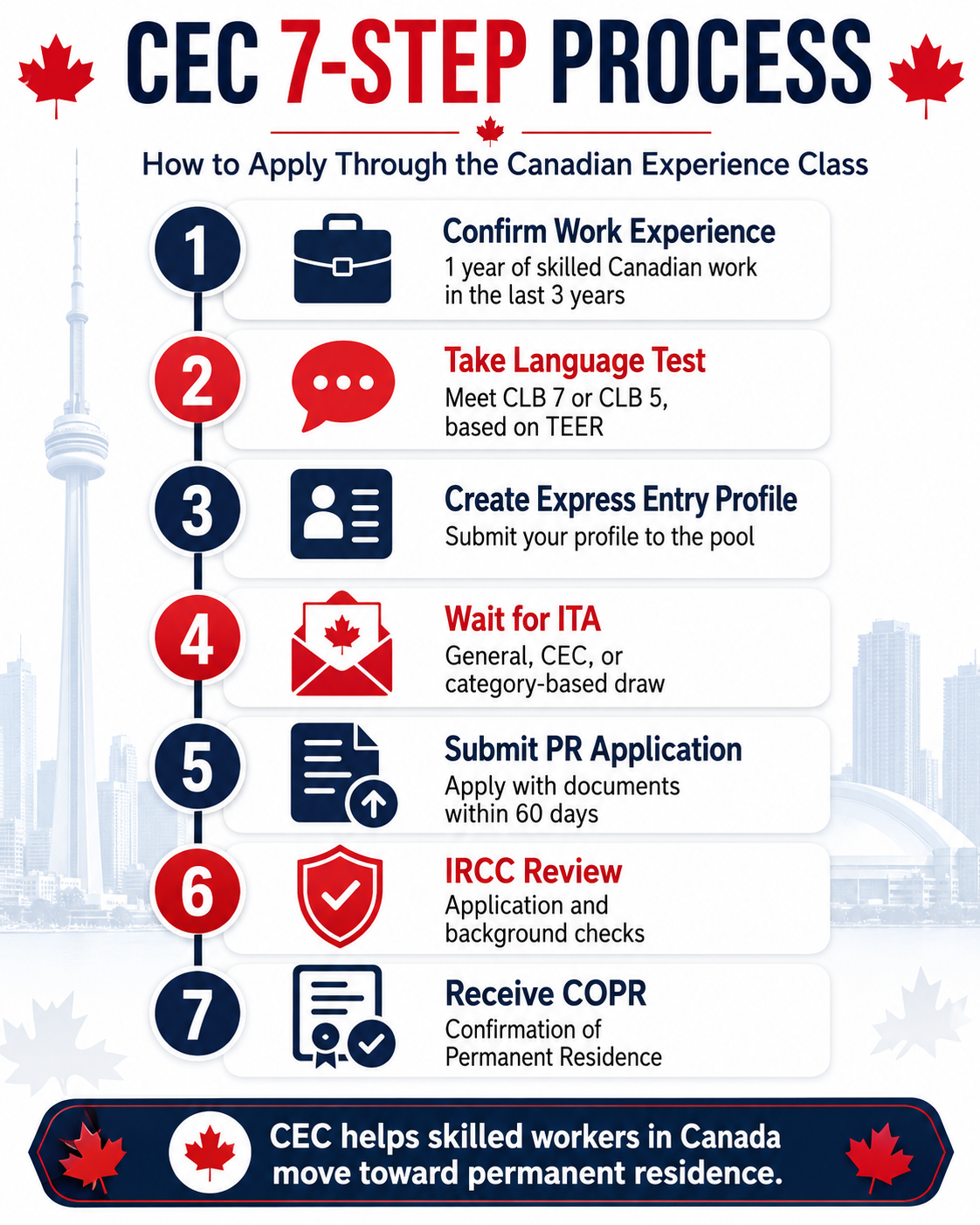
CEC is generally regarded as the fastest-processing of the three Express Entry programs, since applicants have already demonstrated integration into the Canadian workforce. Once invited, applicants have 60 days to submit a complete permanent residence application, and federal processing following a complete submission typically runs around the standard Express Entry timeline of 6 months, though CEC applications often move through the system with fewer complications than FSWP applications involving foreign credential assessment.

Yes. As long as you accumulated your qualifying 1 year of skilled Canadian work experience within the 3 years immediately before you apply, you can submit a CEC application even if you’ve already returned to your home country or moved elsewhere. This is a common and legitimate strategy for former workers or graduates who left Canada after their work permit expired but remain within the qualifying window.

Qualifying experience must be paid, skilled work (NOC TEER 0–3) performed physically in Canada while you held valid work authorization, this includes work on a closed (employer-specific) work permit, an open work permit, or a Post-Graduation Work Permit (PGWP). Remote work performed in Canada for a Canadian employer counts, as long as you were physically present in the country while doing it.

Several common situations don’t qualify: work performed while you were a full-time student (including co-op placements or working off-campus), self-employment in Canada (with a very narrow 2026 exception for certain fee-for-service physicians), work performed remotely from outside Canada for a Canadian employer, and work for a foreign employer, even if physically performed on Canadian soil. Applicants frequently make the mistake of assuming any Canada-based work automatically counts, the combination of paid, skilled, authorized, and physically-in-Canada must all be true simultaneously.

Experience Type

Counts for CEC?

Work on a closed/employer-specific work permit

Yes

Work on an open work permit

Yes

PGWP work experience

Yes

Remote work for a Canadian employer, done in Canada

Yes

Full-time student work (co-op, off-campus)

No

Self-employment (with narrow 2026 exception)

No

Remote work for a Canadian employer, done from abroad

No

Work for a foreign employer, even if performed in Canada

No

The required score depends on your occupation’s skill level: CLB 7 in all four abilities (reading, writing, listening, speaking) for NOC TEER 0 or 1 jobs, and a lower CLB 5 for NOC TEER 2 or 3 jobs. This tiered structure is notably more accessible than the Federal Skilled Worker Program’s flat CLB 7 requirement across every occupation level. Accepted tests are IELTS General Training or CELPIP General for English, and TEF Canada or TCF Canada for French.

No. Unlike FSWP, CEC has no formal minimum education requirement. That said, having Canadian or assessed foreign educational credentials still adds points to your CRS score once you’re in the Express Entry pool, so while education won’t disqualify or qualify you for CEC itself, it’s still worth including if you have it, since it directly affects your ranking against other candidates.

No, not directly. CEC applicants must intend to live outside the province of Quebec. If you plan to settle in Quebec, you would instead need to apply through Quebec’s own separate immigration system, such as the Quebec Experience Program (Programme de l’expérience québécoise, PEQ), which operates independently of federal Express Entry.

The Post-Graduation Work Permit (PGWP) to CEC pathway is the most common route to permanent residence for international graduates: complete a qualifying Canadian post-secondary program, obtain a PGWP, work for at least 1 year in a skilled NOC TEER 0–3 role while the PGWP is valid, then apply through CEC once that experience threshold is met. This pathway benefits from CRS bonus points for Canadian education, which, combined with Canadian work experience points, often puts recent graduates in a strong competitive position, for example, a graduate with a Canadian degree and 2 years of TEER 1 experience can realistically reach a CRS score in the 500s.

CEC requires 1 year of Canadian work experience specifically, has no job offer, education, or proof-of-funds requirement, and generally processes fastest. FSWP accepts foreign work experience for candidates applying from abroad, requires CLB 7 across all abilities, and must additionally clear a separate 67-point eligibility grid. FSTP is trades-specific (NOC 72/73/82), needs 2 years of experience, and requires either a job offer or a provincial certificate of qualification, with a lower CLB 5/4 language bar.


CEC

FSWP

FSTP

Experience location

Canada only

Foreign or Canadian

Foreign or Canadian

Experience length

1 year (3-year window)

1 year (10-year window)

2 years (5-year window)

Job offer required

No

No (optional, adds points)

Yes, or a certificate

Proof of funds

Not required

Usually required

Usually required

Separate points grid

No

Yes (67-point grid)

No

Language minimum

CLB 7 or 5, by TEER

CLB 7, all abilities

CLB 5/4