
+91 9310106988
mail@pioverseas.com
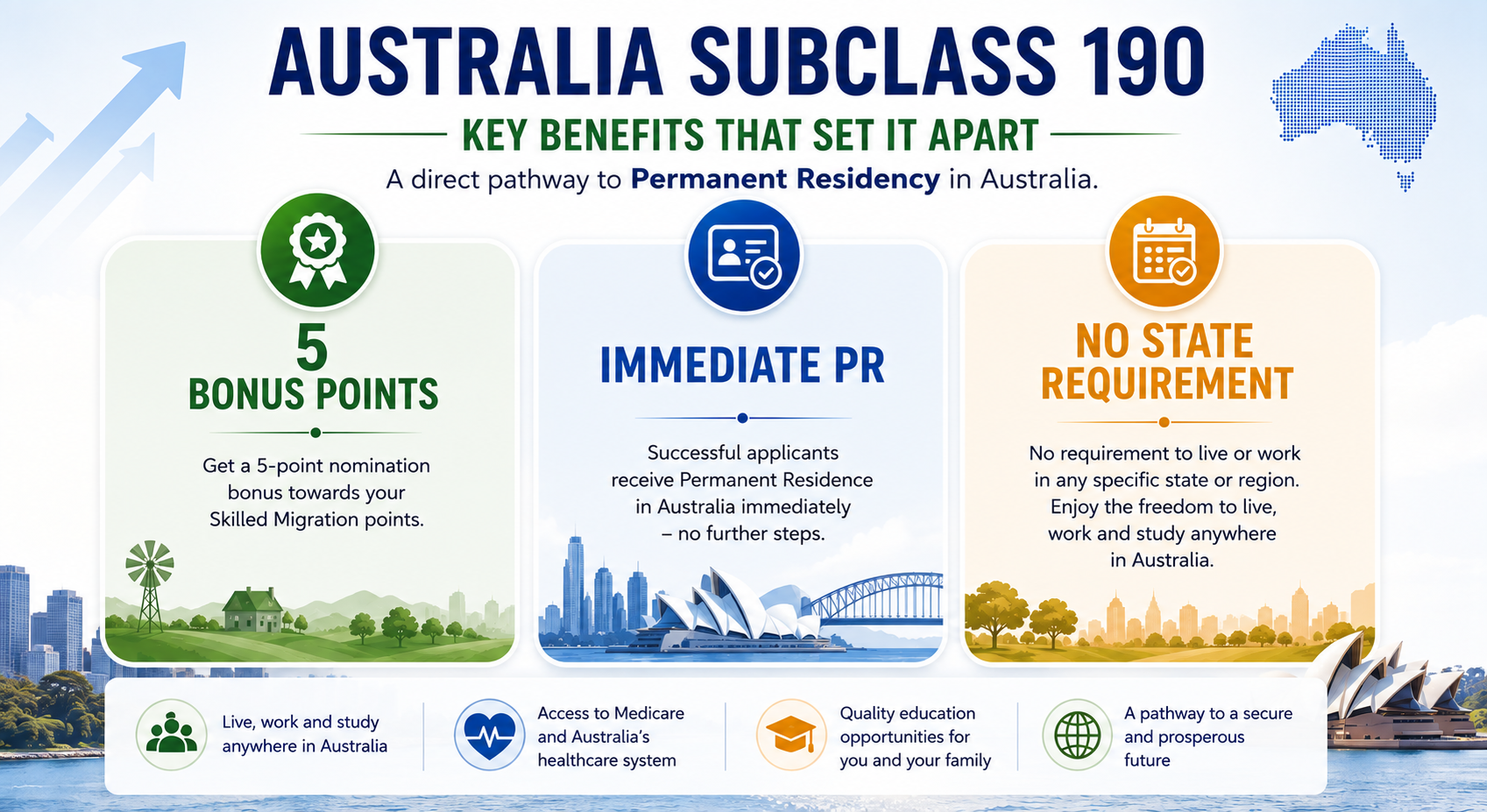
The Subclass 190 (Skilled Nominated) visa is a points-tested permanent residency visa for skilled workers nominated by an Australian state or territory government. Unlike the Subclass 491, which is provisional and requires a later application for PR via Subclass 191, the 190 grants permanent residency immediately on approval — making it one of the most direct and reliable pathways into Australia for skilled migrants who don’t have a strong enough profile for the fully independent Subclass 189.
In exchange for state nomination — which adds a valuable 5 points to your score — you commit to living and working in your nominating state for a minimum of around two years (an informal commitment, not a legal visa condition). Beyond that commitment, a 190 visa holder has exactly the same rights as a 189 holder: the freedom to live, work, and study anywhere in Australia, full Medicare access, and a clear pathway to citizenship.
This guide covers eligibility, the points system, which occupation lists apply, how state nomination actually works (including a breakdown by state), the 2-year residency commitment, fees, processing times, and how the 190 compares to the 189 and 491.
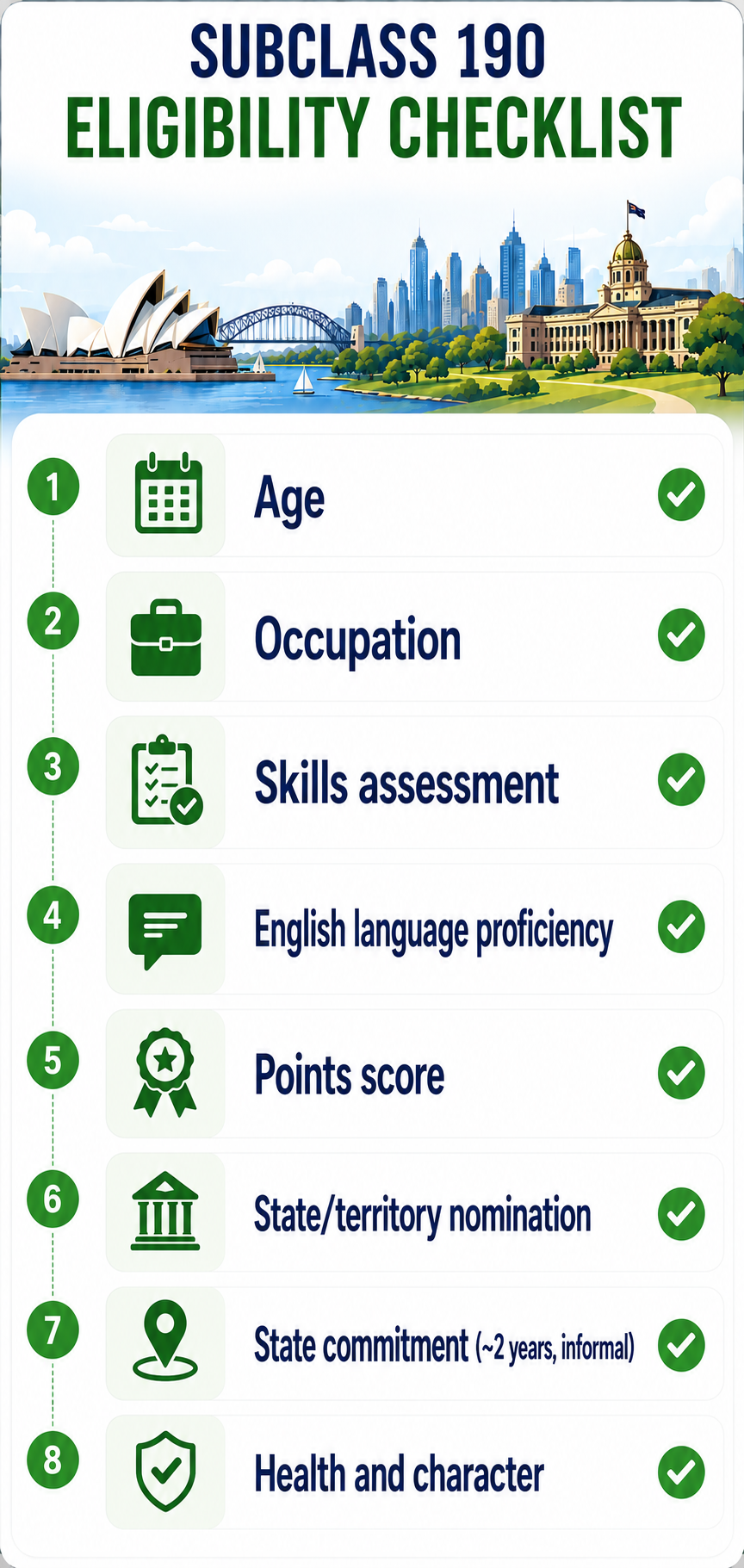
NOTE: To qualify for the Subclass 190 visa, you need a minimum of 65 points (including a 5-point bonus for state nomination), an occupation on your target state’s current nomination list, a positive skills assessment, and nomination by an Australian state or territory government. The visa grants immediate permanent residency, with an informal (not legally binding) expectation to live in the nominating state for at least 2 years.
Key features:
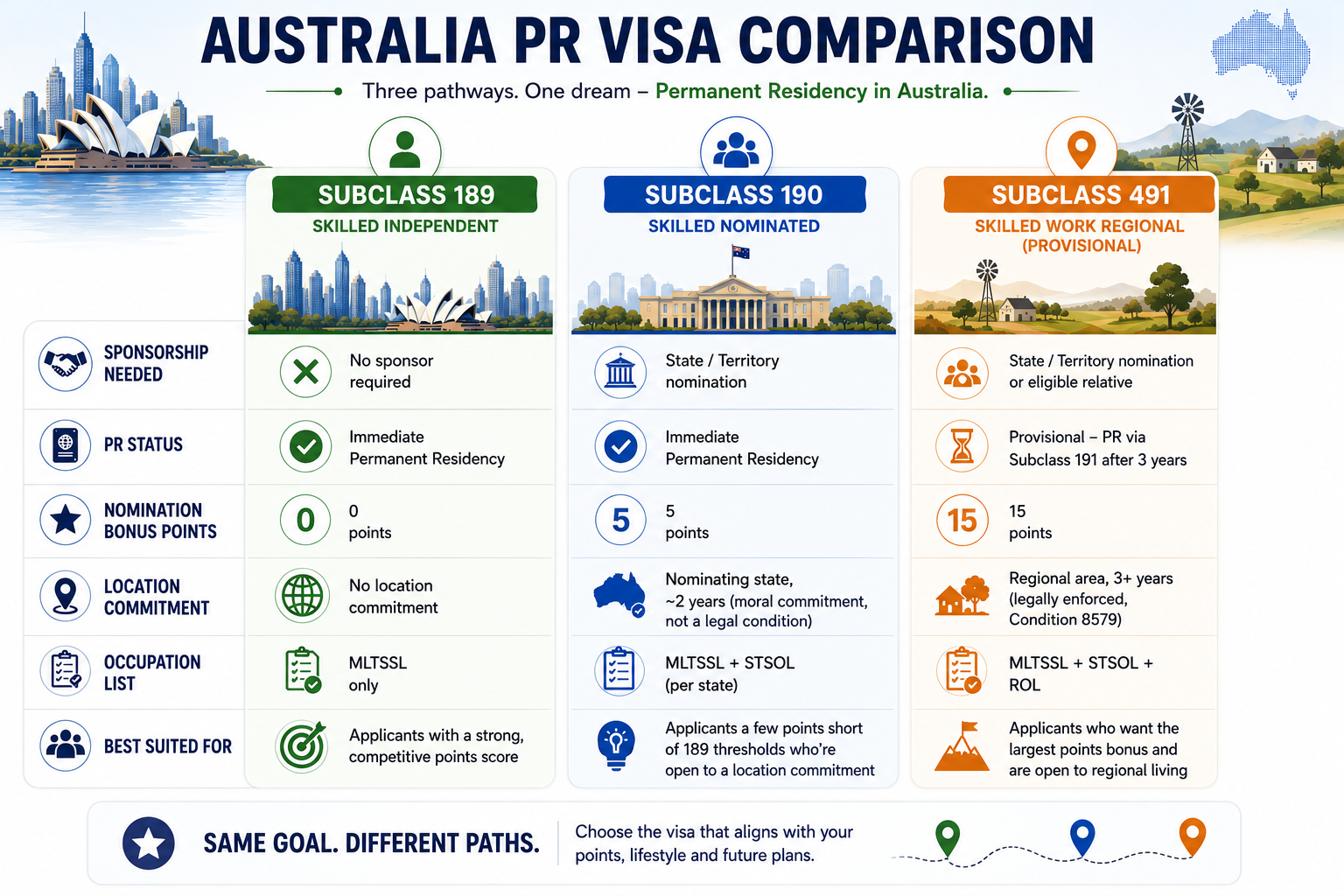
Criteria | Subclass 189 | Subclass 190 | Subclass 491 |
Sponsorship needed | No | State/Territory | State/Territory or eligible relative |
Points bonus | None | +5 | +15 |
Occupation list | MLTSSL only | MLTSSL + STSOL | MLTSSL + STSOL + ROL |
Location commitment | None | Nominating state, ~2 years (moral commitment, not a legal condition) | Regional area, legally enforced (Condition 8579) |
PR status | Immediate | Immediate | Provisional — PR via Subclass 191 after 3 years |
Realistic points needed | Often 85–100+ for professional occupations | Typically lower than 189 once nomination bonus is added | Often the most accessible of the three, given the 15-point bonus |
The 190 uses the same core points test as the 189 and 491, with state nomination adding 5 points to your score.
Factor | Points Available |
Age (25–32 years — highest-scoring band) | 30 |
English language proficiency (Superior) | 20 |
Skilled employment outside Australia (8–10 yrs) | 15 |
Skilled employment in Australia (8–10 yrs) | 20 |
Educational qualification — Doctorate | 20 |
Educational qualification — Bachelor’s/Master’s | 15 |
Australian study requirement | 5 |
Study in a designated regional area | 5 |
Credentialed community language qualification | 5 |
Professional Year in Australia | 5 |
State/territory nomination (190-specific) | 5 |
Skilled spouse or de facto partner | 10 |
Partner with Competent English only | 5 |
Single applicant, or partner is citizen/PR holder | 10 |
NOTE: The 5-point 190 bonus is smaller than the 491’s 15-point bonus, but it comes without the regional-location or provisional-status trade-offs — for applicants who are close to the 189 threshold and want direct PR without relocating to a regional area, 190 is often the more attractive option despite the smaller bonus.
Your occupation must appear on one of the following:
On top of these national lists, each state and territory maintains its own occupation list and nomination criteria, updated periodically based on local labour market needs — so eligibility ultimately depends on whether your specific state is currently nominating your occupation, not just whether it appears on MLTSSL/STSOL nationally.
One of the most important — and most commonly misunderstood — facts about the Subclass 190: nomination comes with a commitment to live and work in your nominating state for a minimum of around two years after your visa is granted. This is a moral/administrative commitment, not a legal visa condition. Unlike the Subclass 491, which carries a genuine, enforceable location condition (8579), the 190 has no formal stay condition attached to the visa itself — you are legally free to move interstate immediately after grant.
That doesn’t mean it’s consequence-free. Not honouring the commitment:
In practice, most 190 holders do stay for the full two years, both to honour the commitment and because many have genuinely relocated their lives there. But if your circumstances change — job loss, family need, a better opportunity interstate — understand that you’re not breaching a visa condition by moving; you’re departing from an expectation the state holds you to informally. We’d still recommend informing your nominating state and discussing your specific situation with a migration adviser before relocating early, since state-level responses to this vary.
After the two-year period, 190 holders are free to live and work anywhere in Australia with no restriction at all.
Every Australian state and territory runs its own 190 nomination stream, with its own occupation list, quota, and application process. For the 2026-27 program year, 35,500 total places are allocated across state and territory nominated visas (190 and 491 combined), with individual state programs (e.g., Victoria, NSW, Queensland) each running their own quotas and priority occupation lists that open, fill, and close on their own schedules throughout the year.
State/Territory | What to Know |
Victoria | One of the most active nominating states; runs its own points-and-priority system (Victoria Skilled Migration Program) on top of the federal points test — meeting the 65-point minimum doesn’t guarantee nomination. |
New South Wales | Nominates via its own occupation list, often prioritizing healthcare, education, and engineering roles. |
Queensland | Nominates for state-wide needs; separate consideration for Brisbane vs. regional Queensland occupations. |
South Australia | Historically accessible for skilled and graduate applicants, with regular updates to its priority list. |
Western Australia | Nominates based on WA’s specific labour market priorities, notably resources, engineering, and healthcare. |
Tasmania | Runs a nomination stream often favourable to applicants with an existing connection to the state. |
Northern Territory | Actively nominates to address territory-specific shortages. |
Australian Capital Territory (ACT) | Runs the Canberra Matrix system, a points-based ranking specific to ACT nomination, distinct from the federal points test. |
Step 1: Check Your Occupation & Points
Confirm your occupation is on MLTSSL or STSOL, and calculate your points including the 5-point nomination bonus.
Step 2: Take an Approved English Test
Sit for IELTS, PTE Academic, or another accepted test.
Step 3: Get Your Skills Assessed
Apply to the relevant assessing authority for a positive skills assessment.
Step 4: Submit an Expression of Interest (EOI)
Register your interest through SkillSelect and indicate your interest in state nomination.
Step 5: Apply for State Nomination
Apply directly to your target state or territory’s nomination program, meeting their specific criteria (which may exceed the federal minimum).
Step 6: Receive Nomination & Invitation to Apply (ITA)
Once nominated, you’ll automatically receive an ITA through SkillSelect.
Step 7: Lodge Your Visa Application
Submit your full application with supporting documents within 60 days of invitation.
Step 8: Health & Character Checks, Then Visa Grant
Complete medical exams and police clearances, and receive your Subclass 190 visa with immediate permanent residency.
Applicant | Fee (AUD) |
Primary applicant | 6,135–6,140 |
Additional applicant (18+) | ~3,070 |
Dependent child (under 18) | ~1,535 |
On top of the government fee, budget for skills assessment (AUD 500–2,000, higher for some authorities), English test (AUD 400–450), medical examinations, and police clearance certificates. Figures vary slightly by source, so confirm the exact current amount via the official Visa Pricing Estimator.
Processing generally takes 6 to 10 months from application lodgement once nominated, though this varies by state, occupation demand, and application completeness. State nomination itself is often the longer variable — some states process nominations within weeks, others take several months depending on program demand and quota availability.
Because the 190 grants immediate PR, holders can:
If you are willing to know more about the Australia Subclass 190 Visa process, you can certainly contact us by writing us an email at mail@pioverseas.com and one of our experts will help you out in every possible way. Call us at +91-9310-10-6988 or you can also receive a call back from our expert once you fill out the inquiry form. You can also talk to our experts directly through our live chat feature and clear your doubts instantaneously.
We at Pi Overseas have a team of dedicated experts that cater to every need of the clients. We have a proven track record in the immigration industry which was achieved in a very short span of time.