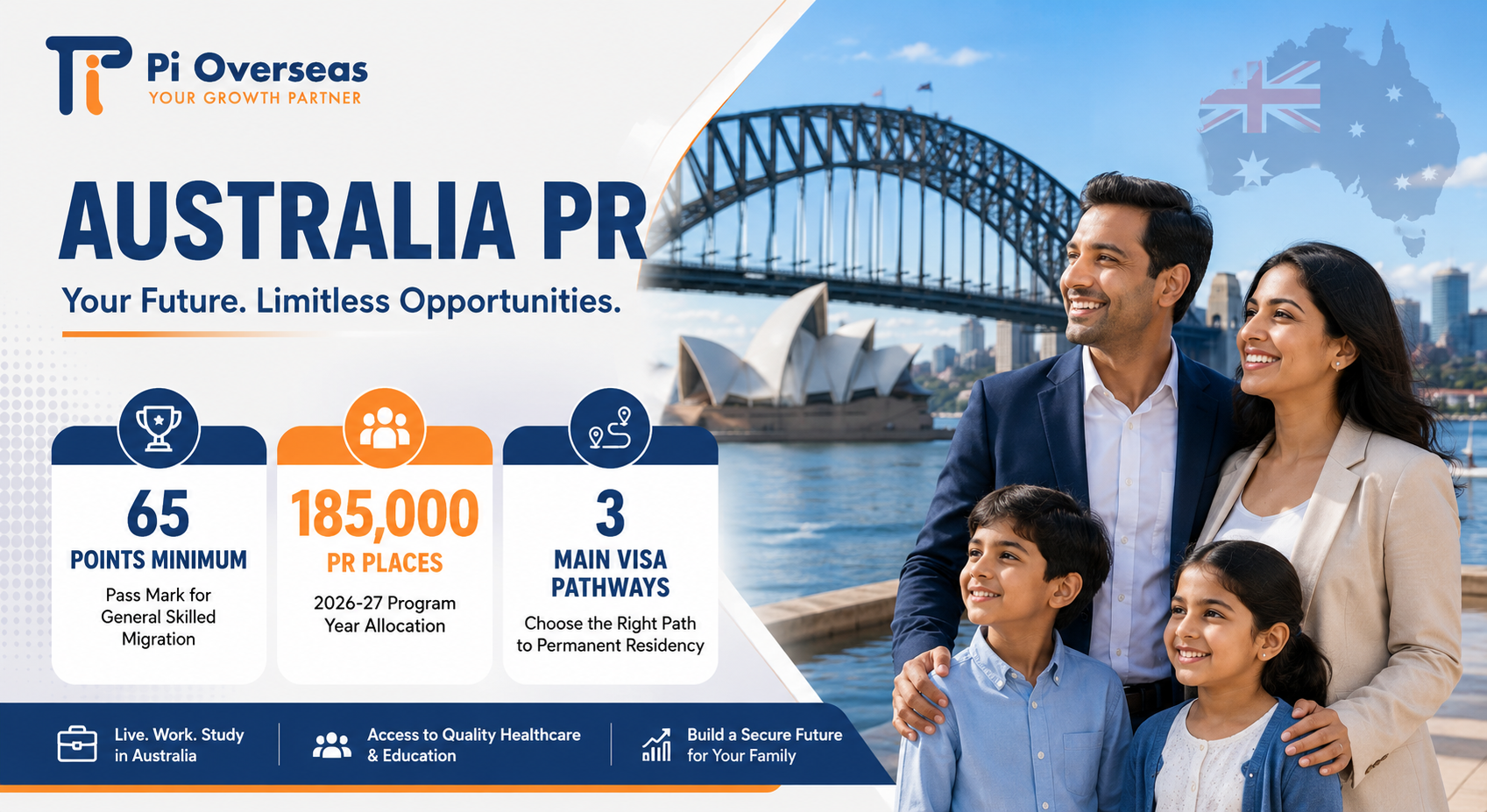
Australia Immigration PR Visa: Points System & Eligibility

Australia remains one of the most sought-after destinations for Indian professionals looking to build a long-term career abroad, and Australia immigration continues to run primarily through a points-tested skilled migration system. If you’re exploring an Australia PR visa, the path typically runs through one of three main skilled pathways — Subclass 189, 190, or 491 — each requiring a minimum points score, a positive skills assessment, and an occupation that appears on Australia’s current skilled occupation lists.

This guide walks through the complete Australia PR eligibility criteria, the points system, current visa fees, processing timelines, and the exact step-by-step process to migrate to Australia from India in 2026-27 — along with the recent changes to Australia’s skilled occupation lists and employer-sponsored visa category that many older guides still get wrong.

Australia PR visa points system and eligibility overview 2026

Quick answer: To qualify for Australia skilled migration, you generally need a minimum of 65 points on the points test, an occupation on the relevant skilled occupation list, a positive skills assessment, and a competent level of English. Australia has allocated 185,000 permanent migration places for 2026-27, with the largest share going to the Skilled stream. Visa processing for skilled/PR categories currently takes roughly 6.5 to 10 months.

Why Migrate to Australia? Key Benefits of Australia Immigration

Before getting into eligibility and process, it’s worth being clear-eyed about why so many skilled Indian professionals choose Australia over other migration destinations:
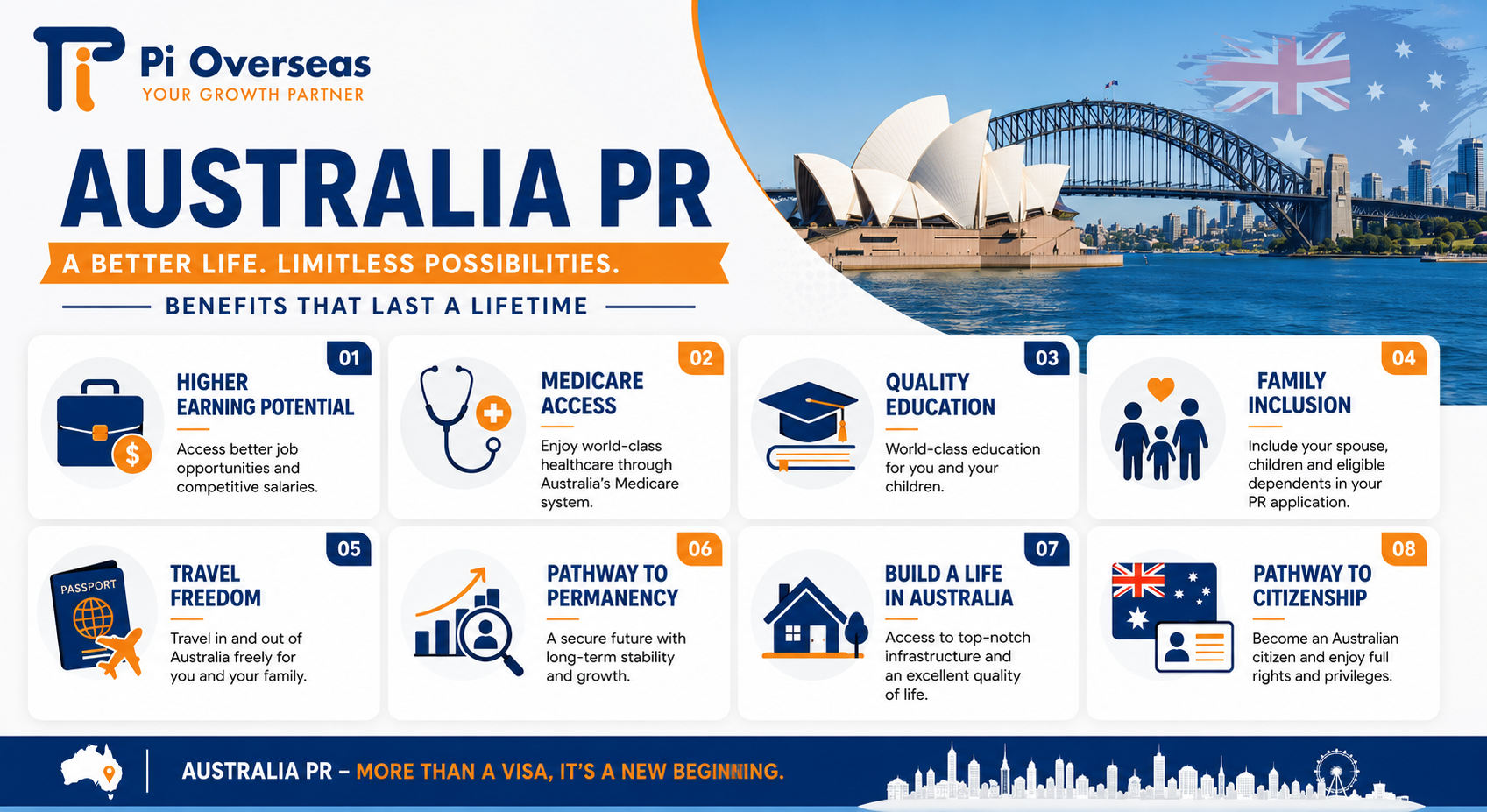
  • Strong salaries across sectors — skilled roles in IT, engineering, healthcare, and finance regularly pay AUD 80,000–180,000+ annually, well above equivalent Indian salaries even after cost-of-living adjustment.
  • Direct pathway to permanent residency — unlike many countries where skilled visas remain temporary indefinitely, Subclass 189 and 190 grant PR immediately on approval.
  • Free public healthcare (Medicare) for PR holders and citizens.
  • Free/subsidised public education for your children.
  • Family inclusion — spouses and dependent children can be included in most PR applications.
  • 5-year travel facility attached to your PR grant, letting you enter and exit Australia freely.
  • Pathway to citizenship — PR holders can generally apply for Australian citizenship after four years of lawful residence (including at least 12 months as a permanent resident), subject to meeting residency and character requirements.
  • A genuinely multicultural society — with a large and well-established Indian diaspora across Sydney, Melbourne, Brisbane, Perth, and Adelaide, making the transition easier for new migrants.
  • Reciprocal access to New Zealand — PR holders may be eligible to visit, and in some cases live and work in, New Zealand, subject to New Zealand’s own immigration rules.

Benefits of Australia PR visa for Indian immigrants

Types of Australia Visas for Indian Nationals

Australia’s immigration system covers several distinct visa streams. Here’s how they map out:

Visa Category

Who It’s For

Common Subclasses

Skilled Migration (PR)

Skilled professionals with an in-demand occupation

189, 190, 491

Employer-Sponsored / Skills in Demand

Workers with a genuine job offer from an Australian employer

Skills in Demand visa (replaced Subclass 482 in Dec 2024), Subclass 186

Student Visa

International students enrolled in an Australian institution

Subclass 500

Visitor Visa

Tourism, short business trips, visiting family

Subclass 600

Family / Partner Visa

Spouses, de facto partners, parents, children of citizens or PR holders

820/801 (Partner), 103 (Parent), 101 (Child)

Business & Investment Visa

Entrepreneurs and investors

Business Innovation and Investment Program

Working Holiday Visa

Young travelers (18–30/35) wanting to work while touring

417, 462

This guide focuses primarily on the skilled migration PR pathway. For other categories, see our dedicated [Australia Student Visa], [Australia Visitor Visa], and [Australia Work Visa] pages.

Australia PR Visa Options: Skilled Migration Explained

The General Skilled Migration (GSM) program is the backbone of Australia skilled migration, and it’s built around three main visa subclasses, plus a newer employer-sponsored route.
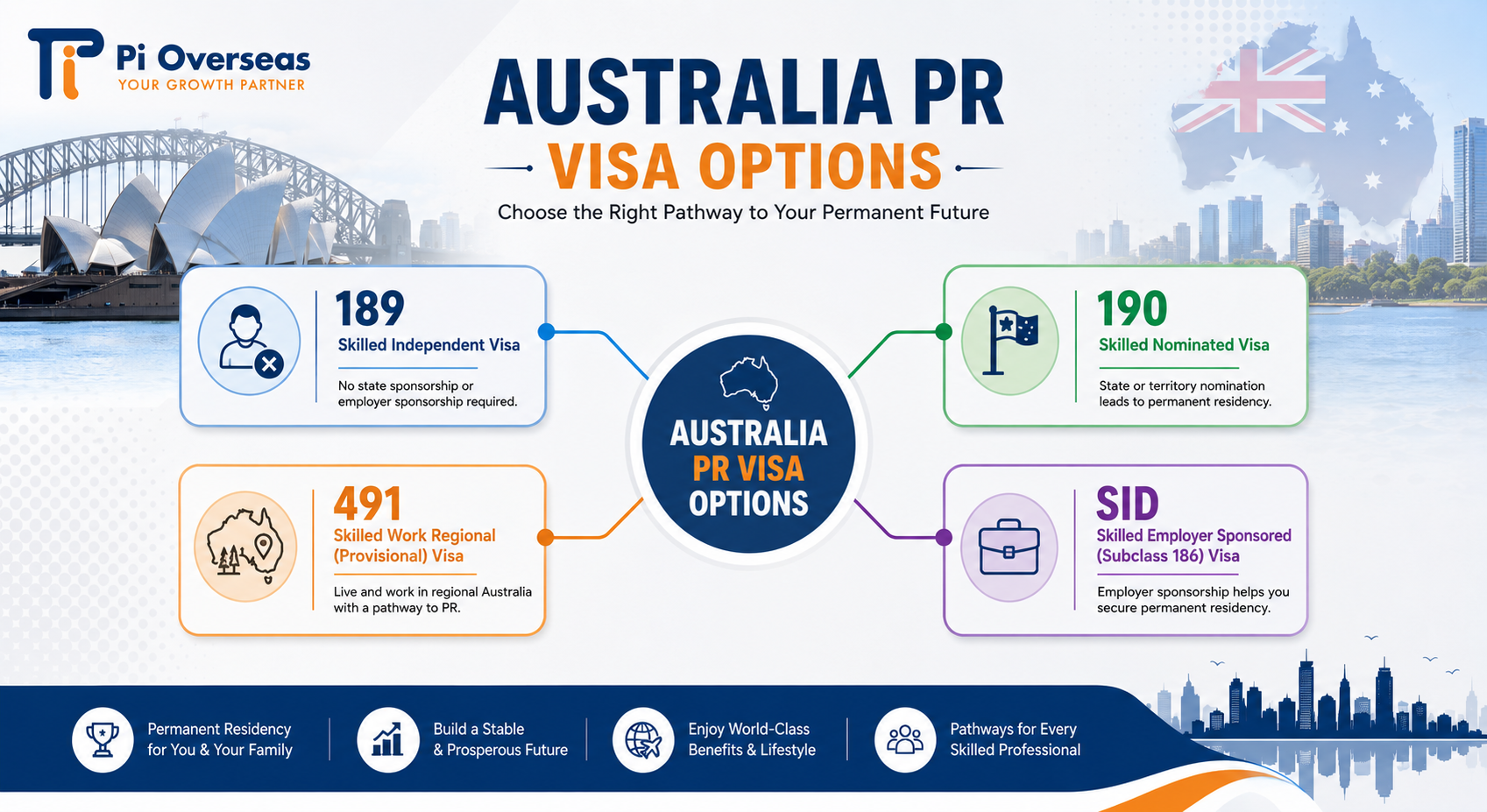
Australia skilled migration visa pathways Subclass 189, 190, 491 and Skills in Demand visa

Subclass 189 – Skilled Independent Visa

A permanent visa that does not require sponsorship from an employer, state, or family member. You’re invited to apply purely based on your points score and occupation demand under SkillSelect. This is the most sought-after pathway because it gives you complete freedom to live and work anywhere in Australia.

Subclass 190 – Skilled Nominated Visa

A permanent visa requiring nomination from an Australian state or territory government. Each state maintains its own occupation list and nomination criteria based on local labour market needs. In exchange for nomination (which typically adds 5 points to your score), you commit to living in that state for a period, usually around two years.

Subclass 491 – Skilled Work Regional (Provisional) Visa

A 5-year provisional visa for skilled workers willing to live and work in regional Australia, either through state/territory nomination or sponsorship by an eligible relative. After meeting income and residence requirements over a minimum period (generally three years), 491 holders become eligible to apply for the Subclass 191 permanent visa.

Skills in Demand (SID) Visa — Replacing the Old Subclass 482

This is one of the most important updates in Australian immigration policy in recent years, and one that many older guides online still haven’t caught up with: the Temporary Skill Shortage (TSS) Subclass 482 visa was replaced by the Skills in Demand (SID) visa on 7 December 2024. It requires employer sponsorship and runs on three pathways:

  • Core Skills pathway — for occupations on the Core Skills Occupation List (CSOL), with a minimum salary threshold.
  • Specialist Skills pathway — for high-earning specialists above a higher salary threshold, without requiring a CSOL-listed occupation.
  • Essential Skills pathway — targeted at lower-paid essential sectors like aged care and agriculture (introduced progressively).

The SID visa offers up to 4 years of full working rights and, in many cases, a pathway to permanent residency via the Subclass 186 (Employer Nomination Scheme).

Comparison: Australia Visa Subclasses at a Glance

Criteria

Subclass 189

Subclass 190

Subclass 491

Skills in Demand (SID)

Visa type

Permanent

Permanent

Temporary (5 yrs), PR pathway

Temporary, PR pathway

Sponsorship needed

No

State/Territory

State/Territory or eligible relative

Australian employer

Points test required

Yes (min. 65)

Yes (min. 65)

Yes (min. 65)

No

Occupation list

MLTSSL

MLTSSL/STSOL (per state)

Regional Occupation List

Core Skills Occupation List (CSOL)

Location restriction

None

Sponsoring state

Regional Australia only

Employer’s location

Medicare access

Yes

Yes

Yes

No (unless reciprocal healthcare agreement applies)

PR pathway

Direct PR

Direct PR

PR pathway via Subclass 191 after 3 years

PR pathway via Subclass 186 (employer-dependent)

Australia PR Points System Explained

Australia’s points-tested skilled migration visas (189, 190, 491) require a minimum score of 65 points to be eligible to submit an Expression of Interest (EOI). In practice, however, recent SkillSelect invitation rounds have often required scores well above the minimum — so treat 65 as the eligibility floor, not a realistic target.
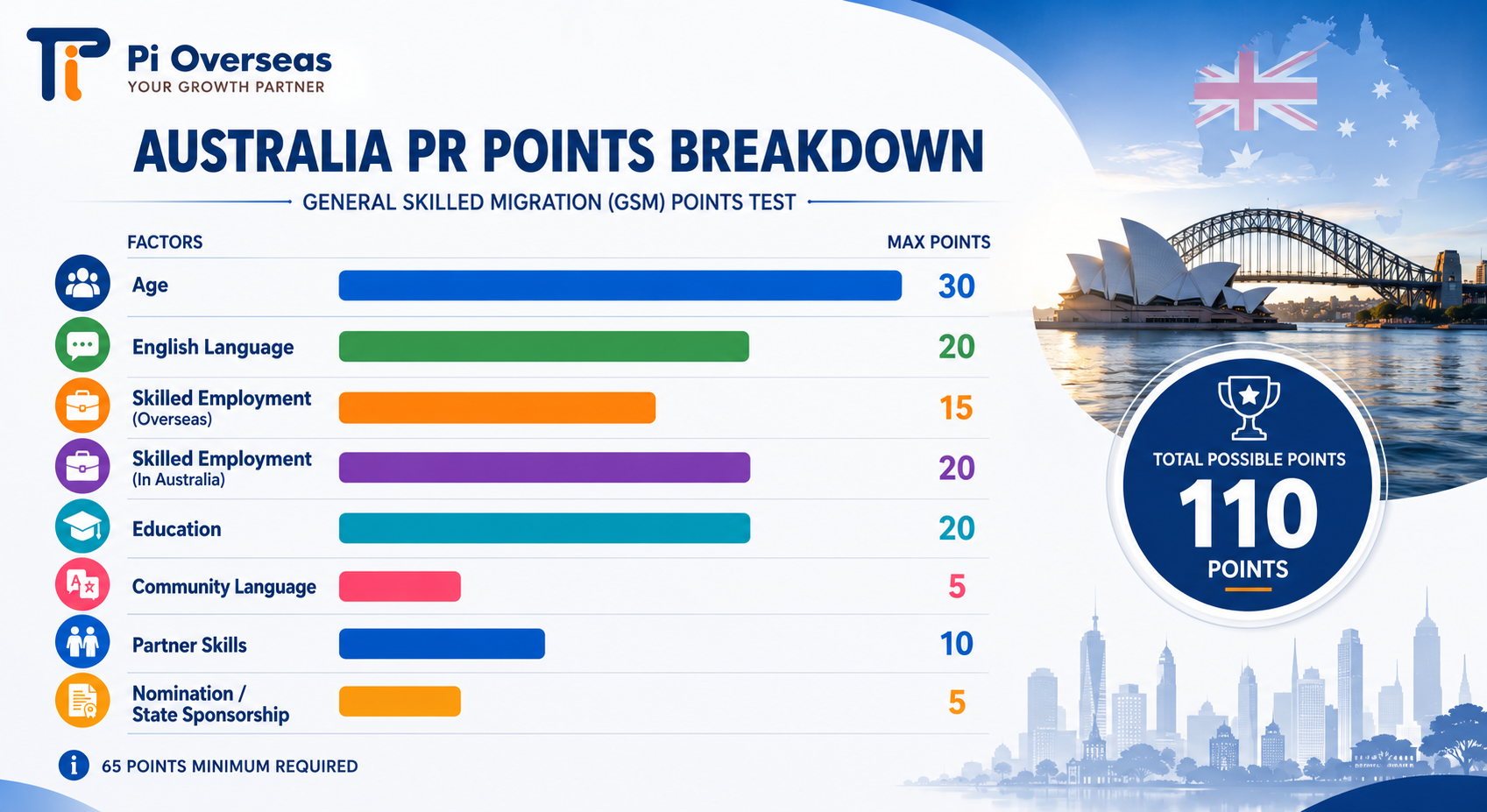
Australia Immigration Points Table

Australia PR points calculator breakdown by category

Factor

Points Available

Age(25–32 years — the highest-scoring band)

30

English language proficiency (Superior/8 bands)

20

Skilled employment experience outside Australia (8–10 years)

15

Skilled employment experience in Australia (8–10 years)

20

Educational qualification — Doctorate

20

Educational qualification — Bachelor’s/Master’s degree

15

Australian study requirement

5

Study in a designated regional area

5

Credentialed community language qualification

5

Professional Year in Australia

5

State/territory nomination (Subclass 190)

5

Regional/family sponsorship (Subclass 491)

15

Skilled spouse or de facto partner

10

Partner with “competent” English (skills not required)

5

Single applicant, or partner is an Australian citizen/PR holder

10

Age carries the single largest weight in the points system — applicants between 25 and 32 receive the maximum 30 points, which is why age is often the deciding factor in whether it’s worth applying now versus waiting to build more experience or a higher English score.

Australia’s Skilled Occupation Lists: CSOL, MLTSSL, STSOL & ROL Explained

One area where a lot of migration content online is now outdated: Australia no longer runs on a single “Skilled Occupation List” (SOL). Since December 2024, the system works as follows:

  • MLTSSL (Medium and Long-term Strategic Skills List) — roughly 212 occupations with the most direct path to PR via Subclass 189, 190, and 491.
  • STSOL (Short-term Skilled Occupation List) — roughly 215 occupations addressing more immediate labour needs, mainly relevant for Subclass 190 and 491, with more limited PR pathways.
  • ROL (Regional Occupation List) — roughly 77 additional occupations available specifically for the regional Subclass 491 visa.
  • CSOL (Core Skills Occupation List) — introduced 7 December 2024 with 456 occupations, this is the list used for the new Skills in Demand visa and the Subclass 186 (Direct Entry) employer-sponsored PR pathway.

Each occupation carries a 6-digit ANZSCO code, and your eligibility depends on which list your specific occupation and ANZSCO code appear on — this determines which visa subclasses are actually open to you.

Eligibility Requirements for Australia PR Visa

To qualify for Australia immigration through the skilled migration stream, you’ll generally need to meet the following:

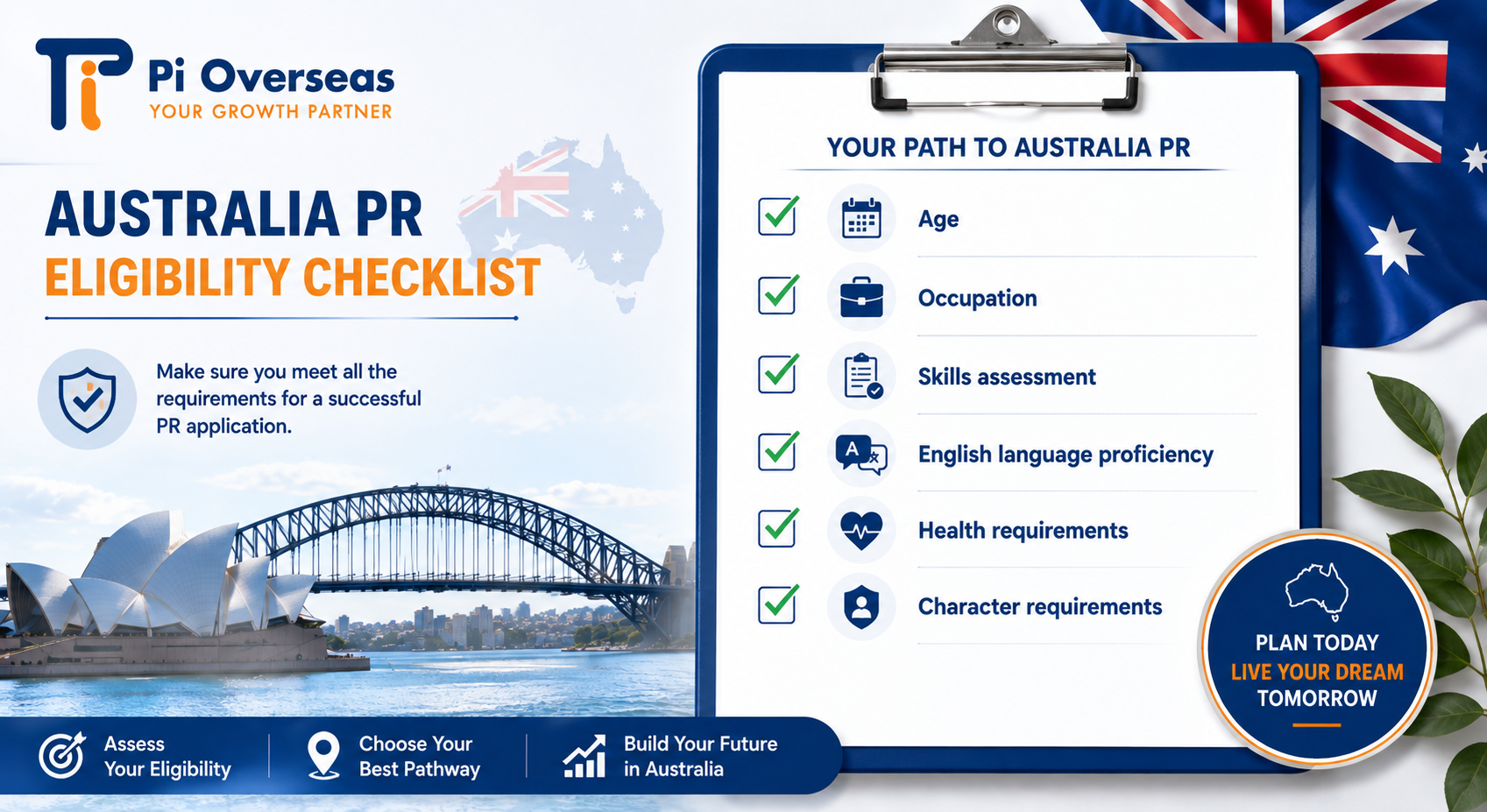
  • Age: Typically under 45 years at the time of invitation (younger applicants score significantly higher on the points test)
  • Occupation: Must appear on the relevant skilled occupation list (MLTSSL, STSOL, ROL, or CSOL depending on visa type)
  • Skills assessment: A positive skills assessment from the relevant assessing authority for your occupation (e.g., ACS for IT, Engineers Australia, VETASSESS, ANMAC for nursing)
  • English language proficiency: Proof via an approved test — IELTS, PTE Academic, TOEFL, or equivalent
  • Points score: Minimum 65 points under the points test (competitive scores are often higher)
  • Health requirements: Meeting Australia’s medical examination standards
  • Character requirements: Police clearance certificates from all countries of residence

How to Apply for Australia PR from India: Step-by-Step Process

Here’s the complete Australia PR visa process, from initial eligibility check to visa grant:
Step by step process to apply for Australia PR visa from India

Step 1: Check Your Eligibility & Calculate Your Points

Confirm your occupation is on the relevant skilled occupation list and calculate your points score using the age, education, experience, and English criteria above.

Step 2: Take an Approved English Language Test

Sit for IELTS, PTE Academic, or another accepted test and achieve the score required for your target visa category and points band.

Step 3: Get Your Skills Assessed

Apply to the relevant assessing authority for your occupation. This step alone can take anywhere from a few weeks to a few months depending on the authority and occupation, so start it early.

Step 4: Submit an Expression of Interest (EOI)

Create and submit your EOI through the Department of Home Affairs’ SkillSelect system, selecting your visa subclass(es) of interest.

Step 5: Receive an Invitation to Apply (ITA)

If your profile and points score are competitive in a given invitation round, you’ll receive an ITA for your chosen visa subclass.

Step 6: Lodge Your Visa Application

You typically have 60 days from the date of invitation to submit your full visa application with all supporting documents.

Step 7: Health & Character Checks

Complete medical examinations and provide police clearance certificates as requested.

Step 8: Visa Grant

Once approved, you’ll receive your Australia PR visa grant notification, along with your 5-year travel facility.

Australia PR Visa Fees (2026)

Visa application fees are paid directly to the Australian Department of Home Affairs and are separate from any consultancy/service fees. The Department of Home Affairs increased visa application charges across nearly all categories effective 1 July 2026 (under the Home Affairs Legislation Amendment (2026 Measures No. 1) Regulations 2026), so figures you may see elsewhere online dated before mid-2026 are now out of date.
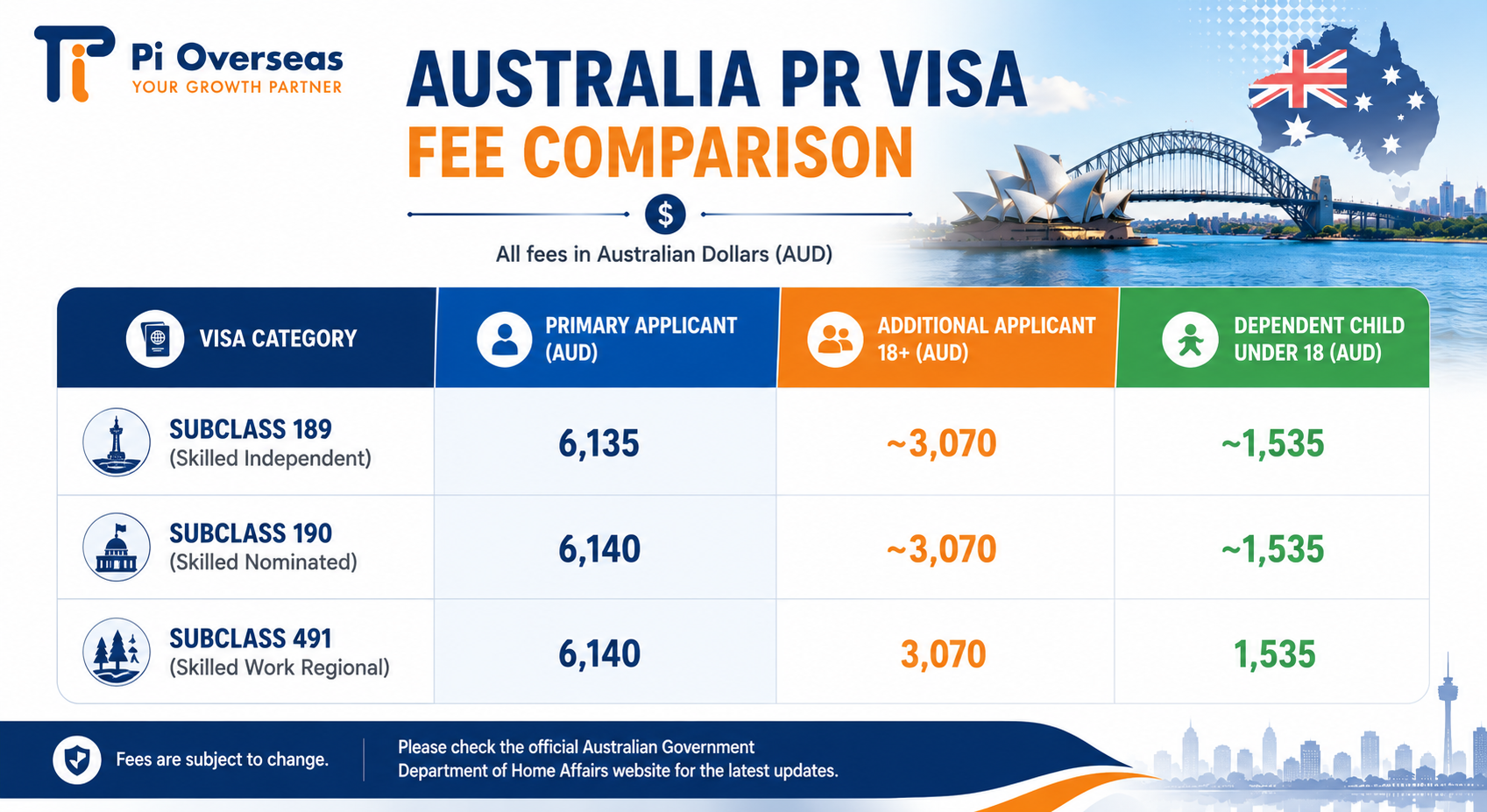
Australia PR visa fees 2026 for Subclass 189 190 491

Visa Category

Primary Applicant (AUD)

Additional Applicant 18+ (AUD)

Dependent Child under 18 (AUD)

Subclass 189 (Skilled Independent)

6,135

~3,070

~1,535

Subclass 190 (Skilled Nominated)

6,140

~3,070

~1,535

Subclass 491 (Skilled Work Regional)

6,140

3,070

1,535

On top of the government visa fee, budget for:

  • Skills assessment fee: Varies by authority, roughly AUD 500–1,500 depending on occupation and assessing body
  • English test fee: Roughly AUD 200–350 depending on test type
  • Second English instalment: A further charge (reported at roughly AUD 5,090 per adult) applies if functional English isn’t demonstrated at the time of grant — a cost many applicants don’t budget for
  • Medical examination fee: Varies by country/clinic
  • Police clearance certificates: Minimal cost, varies by country

All-in, most single applicants now budget upwards of ₹4.5–9 lakh for a Subclass 189/190/491 application, with costs rising further for accompanying partners or children — always confirm the exact current total using the official Visa Pricing Estimator at the time of application.

Australia Visa Processing Time

Visa Type

Typical Processing Time

Visitor visa

20–30 days

Student visa

1–3 months

Training visa

3–4 months

Skills in Demand (employer-sponsored) visa

2–8 months

Family and partner visas

12–30 months

Skilled visas (189/190/491 — EOI to invitation)

Varies by occupation demand and points competitiveness

PR visa (invitation to grant)

6.5–10 months

Note: Processing times fluctuate with application volume and occupation demand — treat these as general benchmarks rather than guarantees.

In-Demand Jobs & Salaries in Australia

Australia continues to face genuine skill shortages across several sectors, all of which are strongly represented across MLTSSL, STSOL, and CSOL:
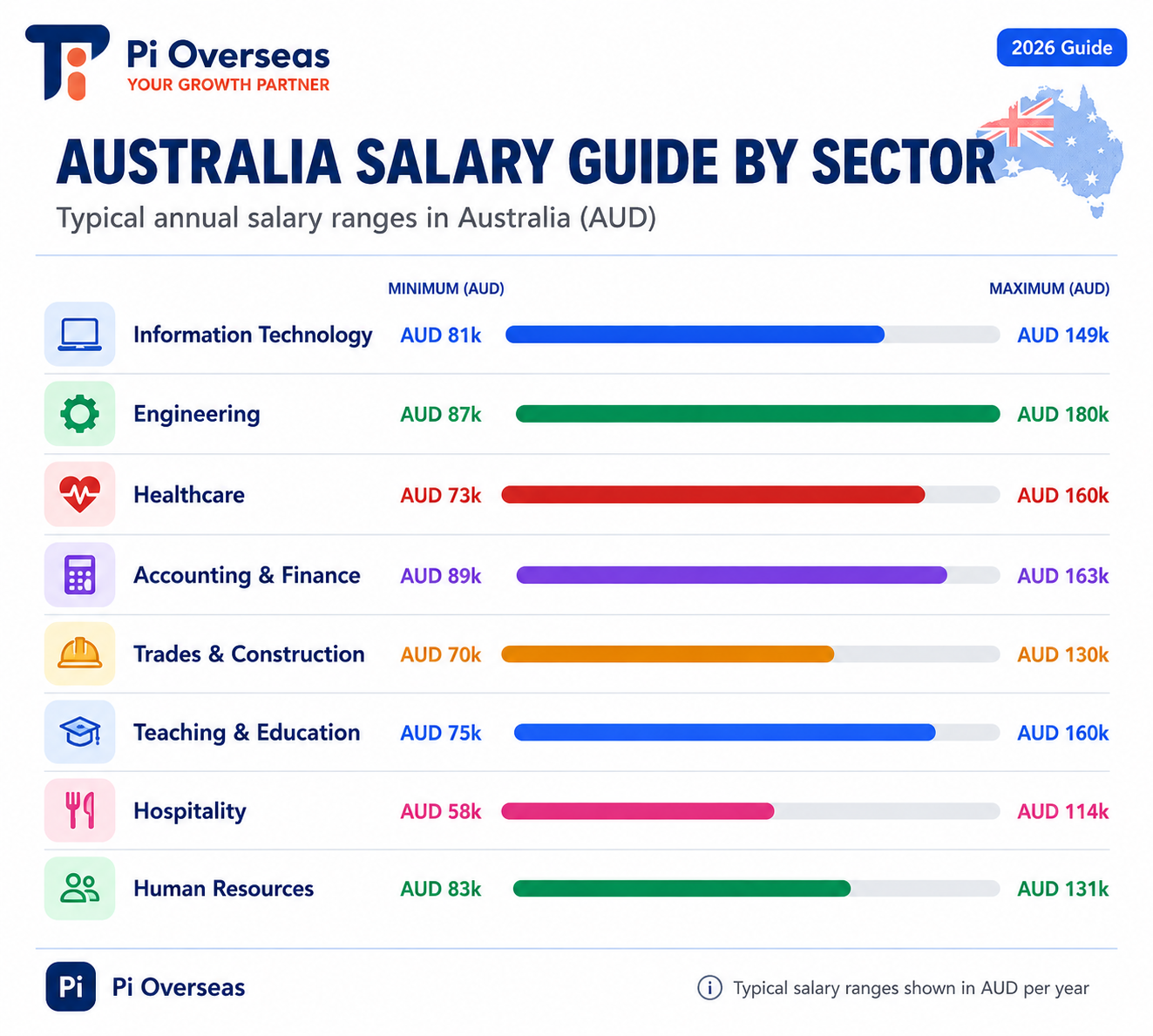
In-demand jobs and average salaries in Australia by sector

Sector

Typical Annual Salary Range (AUD)

Information Technology

81,000 – 149,000

Engineering

87,000 – 180,000

Healthcare

73,000 – 160,000

Accounting & Finance

89,000 – 163,000

Trades & Construction

70,000 – 130,000

Teaching & Education

75,000 – 160,000

Hospitality

58,000 – 114,000

Human Resources

83,000 – 131,000

Roles in especially high demand include registered nurses, software engineers, civil and electrical engineers, aged care workers, electricians, and secondary school teachers — several of which sit on both the MLTSSL and CSOL, giving applicants in these fields multiple visa pathway options.

Australia’s 2026-27 Permanent Migration Program

Staying current on Australia’s annual migration planning levels is one of the clearest freshness signals you can put on this page — and it’s genuinely useful information for applicants gauging their odds.

Australia has allocated 185,000 total permanent migration places for 2026-27, with the breakdown as follows:

Category

2026-27 Allocation

Total Permanent Migration Intake

185,000

Skilled Stream

132,240

Employer-Sponsored (Subclass 494/186)

58,040

Skilled Independent (Subclass 189)

21,090

State and Territory Nominated Visas

35,500

The continued emphasis on the skilled stream — and the relatively higher allocation toward employer-sponsored and state-nominated pathways compared to the fully independent Subclass 189 — is a signal worth calling out to applicants: securing a state nomination or employer sponsorship may currently offer a faster route to PR than relying solely on Subclass 189, depending on your occupation and points score.

Common Reasons Australia PR Applications Get Rejected — and How to Avoid Them

Even well-qualified applicants can run into avoidable rejections. The most common causes:

  • Incomplete or inconsistent documentation — mismatched names, dates, or unexplained employment gaps across documents. Fix: have every document professionally reviewed against your EOI before lodging.
  • Failing to meet the points threshold after verification — some applicants overestimate their own English test band or work experience calculation. Fix: get an independent points assessment rather than self-calculating.
  • Negative or delayed skills assessment — choosing the wrong assessing authority or ANZSCO code for your role. Fix: confirm the correct authority and occupation code before applying.
  • Health or character issues not disclosed upfront. Fix: full transparency in your application; undisclosed issues are treated far more harshly than disclosed ones.
  • Missing the 60-day application window after receiving an ITA. Fix: have all supporting documents ready before you even submit your EOI, not after receiving the invitation.
  • Occupation ceiling reached for your specific occupation in a given program year. Fix: monitor SkillSelect occupation ceilings and apply as early in the program year as possible.

Why Choose Pi Overseas for Your Australia Immigration Journey

  • 15+ years of experience specifically in Australia immigration casework
  • 90%+ Australia visas success rate
  • End-to-end support: eligibility assessment, documentation, skills assessment guidance, EOI submission support, and application review
  • Transparent, structured process with a dedicated complaint-resolution system for a smooth client experience
  • Free initial eligibility check and points assessment

If you are willing to know more about the Australia PR process, you can certainly contact us by writing us an email at mail@pioverseas.com and one of our experts will help you out in every possible way. Call us at +91-9310-10-6988 or you can also receive a call back from our expert once you fill out the inquiry form. You can also talk to our experts directly through our live chat feature and clear your doubts instantaneously.

We at Pi Overseas have a team of dedicated experts that cater to every need of the clients. We have a proven track record in the immigration industry which was achieved in a very short span of time. Our experts will help and guide you through every step of the filing process and keep you posted throughout the whole cumbersome process of visa filing.

Let’s Start Your Visa Journey — Contact Us Today

Frequently Asked Questions

The most significant recent shifts include: the 2025–26 Migration Program was set at 132,200 skilled places, down from 137,100 the prior year, tightening overall competition; English test requirements changed for tests taken on or after August 7, 2025; EOI validity is now 2 years; and the effects of the December 2024–July 2025 reform wave (SID visa, CSOL, genuine position testing) are now fully embedded in the system, meaning any pre-2024 guide describing “TSS” or “482” as active visa categories is now describing a defunct pathway.

You need a minimum of 65 points under Australia’s points-tested system to be eligible to submit an Expression of Interest for Subclass 189, 190, or 491. However, recent invitation rounds have often required scores above the minimum, so a higher score significantly improves your chances.

Yes. Spouses/de facto partners and dependent children can generally be included in your PR application and will receive the same permanent residency status if the application is approved.

Yes. While younger applicants score more points on the age factor, applicants up to 45 can still qualify for skilled visas, and there’s no upper age limit for several employer-sponsored, business, or Global Talent visa pathways.

Yes, you need to demonstrate English proficiency through an approved test — IELTS, PTE Academic, TOEFL, or an equivalent accepted test — with the required band score depending on your target visa and desired points.

Australia’s immigration system runs on three broad categories: skilled migration (points-tested visas for professionals, subclasses 189, 190, 491), employer-sponsored migration (the Skills in Demand visa, which replaced the old TSS/482 visa in December 2024), and family/partner migration (spouse, partner, parent, and child visas). There’s also a smaller business and investment stream. Most people researching “Australia immigration” are looking at the skilled migration pathway, since it doesn’t require a job offer or family connection, eligibility rests on your occupation, qualifications, and points score.

Yes. Australia doesn’t require a job offer for every visa pathway. Through the General Skilled Migration (GSM) program, Subclass 189 (Skilled Independent), 190 (State Nominated), and 491 (Skilled Regional). You can qualify purely on your points score, skills assessment, and English ability, with no employer needed. A job offer only becomes mandatory for employer-sponsored routes like the Subclass 482 (Skills in Demand) or 186 (Employer Nomination Scheme) visas. So if your occupation sits on the Core Skills Occupation List (CSOL) and you meet the point’s threshold, moving without a job lined up is entirely realistic.

The strongest ongoing demand is in healthcare and nursing, engineering (civil, electrical, mechanical), information technology (cybersecurity and software engineering), early childhood and secondary teaching, and skilled trades such as electricians, plumbers, and carpenters. Jobs and Skills Australia’s national shortage data consistently flags trades and technicians as the single largest shortage category, with healthcare and education close behind due to an ageing population and ongoing regional workforce gaps. If your qualification and experience align with any of these fields, you’re in a strong position for a points-tested or state-nominated visa.

For most skilled professionals, the most accessible route is the Subclass 491 Skilled Work Regional visa, because it adds bonus points for regional nomination or family sponsorship, making it easier to reach a competitive score than the 189 or 190. Alternatives that don’t rely purely on points include employer sponsorship (482/186), the Global Talent visa for highly accomplished professionals, or partner/family visas if you have an eligible sponsor. The “easiest” path really depends on your occupation, points score, and whether you’re open to living in a regional area.

It’s possible, but not guaranteed for everyone. If you enter on a provisional visa like the Subclass 491 or an employer-sponsored 482, you typically need to meet residency and work conditions for a set period; often around three years, before becoming eligible to transition to permanent residency (via Subclass 191 or 186). Applicants who go directly through the points-tested 189 or 190 visa can, in some cases, secure PR faster since these are direct-entry permanent visas from the start, provided invitation and processing timelines go smoothly.

Following the fee increase effective 1 July 2026, the government visa application fee is approximately AUD 6,135–6,140 for the primary applicant under Subclass 189, 190, or 491, plus additional fees for accompanying family members. Including skills assessment, English test, and medical fees, most single applicants now budget roughly ₹4.5–9 lakh in total, depending on family size and chosen pathway.

Yes. This is one of the more distinctive features of Australia’s system compared to many other countries, the 189, 190, and 491 visas are all designed for candidates without an employer relationship. Selection is based entirely on your occupation, skills assessment, English ability, qualifications, and points score, making these the primary routes for skilled professionals who don’t yet have (and don’t need) an Australian employer lined up.

The general cut-off for most points-tested skilled visas (189, 190, 491) is 45 years old at the time you’re invited to apply. Applicants aged 25–32 receive the maximum age points, with the score gradually declining after 32 and dropping to zero at 45. There are exceptions though, partner visas, some employer-sponsored streams, business/investor visas, and certain regional or high-income pathways don’t carry the same strict age cap.

The Skills in Demand visa replaced the Temporary Skill Shortage (TSS)/Subclass 482 visa on December 7, 2024. It runs across three streams: Core Skills (uses the new Core Skills Occupation List, or CSOL), Specialist Skills (for high-earning senior roles regardless of occupation list), and Essential Skills (for specific essential sectors). If you’re researching an older guide that still refers to “TSS” or “482,” it’s describing a visa category that no longer accepts new applications; the SID visa is now the correct employer-sponsored route.

Subclass 189 is a fully independent permanent visa — no state nomination, no family sponsorship, no job offer required, but it’s also the most competitive, and only occupations on the MLTSSL are eligible. Subclass 190 requires nomination from an Australian state or territory (adding 5 points) and accepts occupations on either the MLTSSL or STSOL, granting permanent residence immediately. Subclass 491 is a provisional (not permanent) 5-year regional visa, requiring state/territory nomination or eligible family sponsorship (adding 15 points), accepting MLTSSL, STSOL, or ROL occupations, with a pathway to permanent residence via Subclass 191 after 3 years of regional living and meeting an income threshold.


189

190

491

Sponsorship/nomination

None required

State/territory nomination

State/territory nomination or family sponsorship

Residency status granted

Permanent, immediately

Permanent, immediately

Provisional (5 years)

Eligible occupation lists

MLTSSL only

MLTSSL or STSOL

MLTSSL, STSOL, or ROL

Nomination points added

N/A

5

15

Path to permanent status

Direct

Direct

Via Subclass 191 after 3 years regional + income test

Regional living required

No

Depends on state

Yes

There’s no single “best” skill, but occupations in persistent national shortage, nursing, aged and disability care, secondary teaching, civil/electrical engineering, ICT security, and construction trades, tend to have the lowest competitive points thresholds and the highest invitation rates. IT and accounting roles are also in demand but face stiffer competition, often requiring higher points scores. Choosing a skill that’s both in shortage and matches your genuine qualifications gives you the best shot at a smoother PR pathway.

Registered nurses, aged care workers, civil and electrical engineers, secondary school teachers, software engineers, cybersecurity specialists, and trades workers (electricians, plumbers, chefs, carpenters) are among the most sought-after skilled workers in Australia today. Demand is strongest outside the major metro centres, where regional employers and state governments actively nominate skilled migrants to fill persistent local gaps.

According to national shortage assessments, roughly three in ten occupations assessed are currently in shortage, with the heaviest concentration in trades and technical roles, followed by healthcare, engineering, and education. Specific examples include electricians, motor mechanics, registered nurses, aged care workers, civil engineers, and early childhood/secondary teachers. Shortages can vary by state, an occupation might be in high demand in regional Queensland but well-supplied in central Sydney, so it’s worth checking state-specific nomination lists too.

Australia has well over 100 visa subclasses, grouped into broad categories: skilled migration (189, 190, 491, 482, 186), family and partner visas, student visas, visitor/tourist visas, working holiday visas, business and investor visas, and humanitarian visas. Most people researching migration only need to focus on a handful of these, typically the skilled and employer-sponsored categories — rather than the full list.

The points test is a scoring system used for the three General Skilled Migration (GSM) visas, subclasses 189, 190, and 491; awarding points across factors including age (max 30), English ability (max 20), skilled employment (max 20), education (max 20), Australian study (5), partner skills (up to 10), and state/family nomination (5–15, depending on visa). You need a minimum of 65 points just to be eligible to submit an Expression of Interest (EOI), but 65 is a pool mark, not a guaranteed invitation score; actual invited candidates typically score much higher.

Points Factor

Maximum Points

Age (peak: 25–32)

30

English proficiency (Superior)

20

Skilled employment (combined cap)

20

Educational qualifications

20

Australian study requirement

5

Specialist education (STEM at Master’s/Doctorate level)

10

Partner skills

5–10

State/territory nomination (190)

5

State/family nomination (491)

15

While 65 points is the technical minimum to enter the pool, it is not competitive for most occupations in 2026. Most successful subclass 189 applicants are currently invited at 85–95 points or higher, given intense competition and a reduced allocation of 132,200 total skilled migration places for the 2025–26 program year (down from 137,100 the year before). Scores in the 65–75 range are generally only realistic for 190 (state-nominated) or 491 (regional) pathways, where the added nomination points (5 or 15) can close a meaningful gap.

The full journey, from starting a skills assessment to receiving a visa grant; typically takes 12–24 months for competitive applicants. Broken into stages: skills assessment takes 2–6 months, time waiting in the EOI pool for an invitation varies from weeks to years depending on your points score, and post-invitation visa processing currently runs (as of March 2026 data, 75% of cases): ~7 months for 189, ~6 months for 190, ~11 months for 491, and ~2 months for the new SID Core Skills stream.

Stage

Typical Duration

Skills assessment

2–6 months

EOI pool wait time

Weeks to years (points-dependent)

Post-invitation processing: 189

~7 months

Post-invitation processing: 190

~6 months

Post-invitation processing: 491

~11 months

Post-invitation processing: SID (Core Skills)

~2 months

Total realistic timeline (competitive applicant)

12–24 months


No; not for the points-tested skilled visas. Subclasses 189, 190, and 491 are all based on your occupation, qualifications, and points score, not an employer relationship; you can apply and be invited without ever having an Australian job offer. A job offer is required for employer-sponsored migration specifically, the Skills in Demand (SID) visa, which replaced the old TSS/482 visa in December 2024.

The CSOL is a newer, separate 456-occupation list, introduced December 2024, that governs the Skills in Demand visa’s Core Skills stream and the 186 (Employer Nomination Scheme) Direct Entry stream specifically. It did not replace MLTSSL, STSOL, or ROL, those three lists remain fully in effect and continue to govern eligibility for the points-tested General Skilled Migration visas (189, 190, 491). This is one of the most commonly confused points in current Australian immigration content, since many articles imply the CSOL replaced everything.

List

Occupations

Governs

MLTSSL

212

Subclass 189, 190, 491, 186 (Direct Entry, older basis)

STSOL

215

Subclass 190, 491

ROL

77

Subclass 491 only

CSOL (new, Dec 2024)

456

SID visa (Core Skills stream), 186 Direct Entry

Genuine position testing is a rule that took effect July 1, 2025, requiring employers (not applicants) to demonstrate they genuinely attempted to hire an Australian worker before nominating an overseas candidate for employer-sponsored migration (the SID visa). This adds a real compliance step for sponsoring businesses, but it doesn’t apply to the points-tested skilled visas (189, 190, 491), since those don’t involve employer sponsorship at all.

Australia’s family stream includes Partner visas (subclasses 820/801 onshore, 309/100 offshore, for spouses and de facto partners), Parent visas (several subclasses, including contributory and non-contributory streams with very different costs and wait times), Child visas, and the Prospective Marriage visa (subclass 300) for engaged couples planning to marry in Australia. Partner visas are generally the fastest-moving family category; parent visas, particularly non-contributory streams — can involve multi-year to multi-decade queues due to capped annual places.

Generally, you need to have held permanent residence for at least 4 years, including 12 months as a permanent resident immediately before applying, and meet a general residence requirement of not being absent from Australia for more than 12 months total in that 4-year period (including no more than 90 days’ absence in the final 12 months). You’ll also need to pass the Australian citizenship test and meet identity and character requirements.

The points system scores applicants on age, English language proficiency, skilled work experience (in and outside Australia), educational qualifications, partner skills, state/regional sponsorship, and other factors like Australian study or professional year completion. Maximum available points vary by category, with age (up to 30 points) typically carrying the most weight.

The Temporary Skill Shortage (TSS) Subclass 482 visa was replaced by the Skills in Demand (SID) visa on 7 December 2024. It uses the new Core Skills Occupation List (CSOL) and offers three pathways: Core Skills, Specialist Skills, and Essential Skills.

Skilled and PR visa processing generally takes 6.5 to 10 months from invitation to grant, though this varies significantly by visa subclass, occupation demand, and how complete the initial application is.

Australia previously used a single Skilled Occupation List (SOL), but this has since been replaced by multiple lists depending on visa type: MLTSSL, STSOL, and ROL for points-tested visas, and the newer Core Skills Occupation List (CSOL) — introduced in December 2024 — for the Skills in Demand visa and Subclass 186 Direct Entry.

You can live, work, and study anywhere in Australia (subject to any state-nomination location commitments), access Medicare, sponsor eligible family members, and travel in and out of Australia freely for five years under your travel facility. After meeting residency requirements (generally four years, including at least 12 months as a PR holder), you may become eligible to apply for Australian citizenship.