The Canada Super Visa is a special type of visa that allows parents and grandparents of Canadian citizens and permanent residents to visit Canada for extended periods of time. Unlike a regular visitor visa, which is typically valid for up to six months, a Super Visa is valid for up to ten years and allows multiple entries into Canada.
The application process for a Super Visa typically involves submitting an application form, supporting documents, and paying the required fees. The processing time for a Super Visa can vary depending on the volume of applications being processed by Immigration, Refugees, and Citizenship Canada (IRCC).
It’s important to note that the Super Visa is not a pathway to permanent residency in Canada, and applicants should be prepared to demonstrate that they intend to return to their home country at the end of their stay in Canada.
Eligibility for Canada Super Visa
Given below are Super Visa Canada requirements from India, the applicant must meet the following:
- They must be the parent or grandparent of a Canadian citizen, permanent resident of Canada or registered Indian under the Indian Act (over 18 years of age and live in Canada).
- They must be admissible to Canada, which means they must not have any criminal or medical issues that would make them inadmissible.
- They must provide a letter of invitation from their child or grandchild in Canada, which must include a promise of financial support during their stay in Canada.
- They must provide evidence of private medical insurance coverage for at least one year from any insurance company approved by the Office of the Superintendent of Financial Institutions (OSFI).
- They must undergo a medical examination.
- They must provide proof of ties to their home country, such as ownership of property or business, or evidence of family ties, employment, and financial support.
- They must provide evidence that they intend to leave Canada at the end of their authorized stay.
Duration for Canada Super Visa
The Canada Super Visa is valid for up to 10 years and allows multiple entries into Canada during that time. However, each entry is limited to a maximum stay of 5 years.
This means that a Super Visa holder can stay in Canada for up to five years at a time, and then leave and re-enter Canada as many times as they like during the 10-year period. However, each entry will be subject to the discretion of the border officer at the port of entry, who will determine the length of stay authorized for that particular entry.
Canada Super Visa fees
The cost of a Canada Super Visa application includes several fees, which may vary depending on the applicant’s nationality and country of residence. The following are the typical fees involved:
- Processing fee: CAD $100 per person
- Biometric fee (if applicable): CAD $85 per person or CAD $170 for family applying together.
- Medical exam fee (if applicable): varies depending on the country and the doctor conducting the exam
- Private medical insurance: The cost of private medical insurance for a Super Visa can vary depending on the age and health of the applicant, as well as the duration of coverage required. Generally, applicants can expect to pay several hundred dollars per year for medical insurance.
It’s important to note that these fees are subject to change, and applicants should check the Immigration, Refugees, and Citizenship Canada (IRCC) website for the most up-to-date fee information.
Additionally, applicants should be prepared to provide evidence of financial support, such as a letter of invitation from their child or grandchild in Canada, and evidence of their income and assets. The IRCC may also request additional documents or information during the application process, which could affect the overall cost of the Super Visa application.
Documents Requirement for Canada Super Visa
To apply for a Super Visa for Canada, you will need to submit several documents to prove your eligibility. Given below is the list of documents that the applicant will need to provide:
- Valid passport: You will need to provide a valid passport that has a minimum validity of 6 months.
- Proof of relationship: You will need to provide documents that prove your relationship with your child or grandchild who is a Canadian citizen or permanent resident. This can include birth certificates, marriage certificates, and other supporting documents.
- Proof of medical insurance: You will need to provide proof of private medical insurance that is valid for at least 1 year and provides a minimum coverage of $100,000 from an insurance company approved by the Office of the Superintendent of Financial Institutions (OSFI).
- Proof of financial support: You will need to provide proof that you have enough funds to support yourself during your stay in Canada. These documents can include bank statements, pay stubs, and other financial-related documents.
- Invitation letter: You will need to provide a letter of invitation from your child or grandchild who is a Canadian citizen or permanent resident. This letter should include details about the purpose of your visit, the duration of your stay, and other relevant information.
- Travel itinerary: You will need to provide a detailed travel itinerary that includes your travel dates, flight details, and accommodation information.
- Police clearance certificate: You may be required to provide a police clearance certificate from any country where you have lived for more than 6 months in the past 10 years.
It’s important to note that the above list of documents is not exhaustive, and additional documents may be required based on your individual circumstances. It’s recommended that you consult with a licensed immigration consultant or lawyer to ensure that you have all the necessary documents for your Super Visa application.
Canada Super Visa Income Requirements
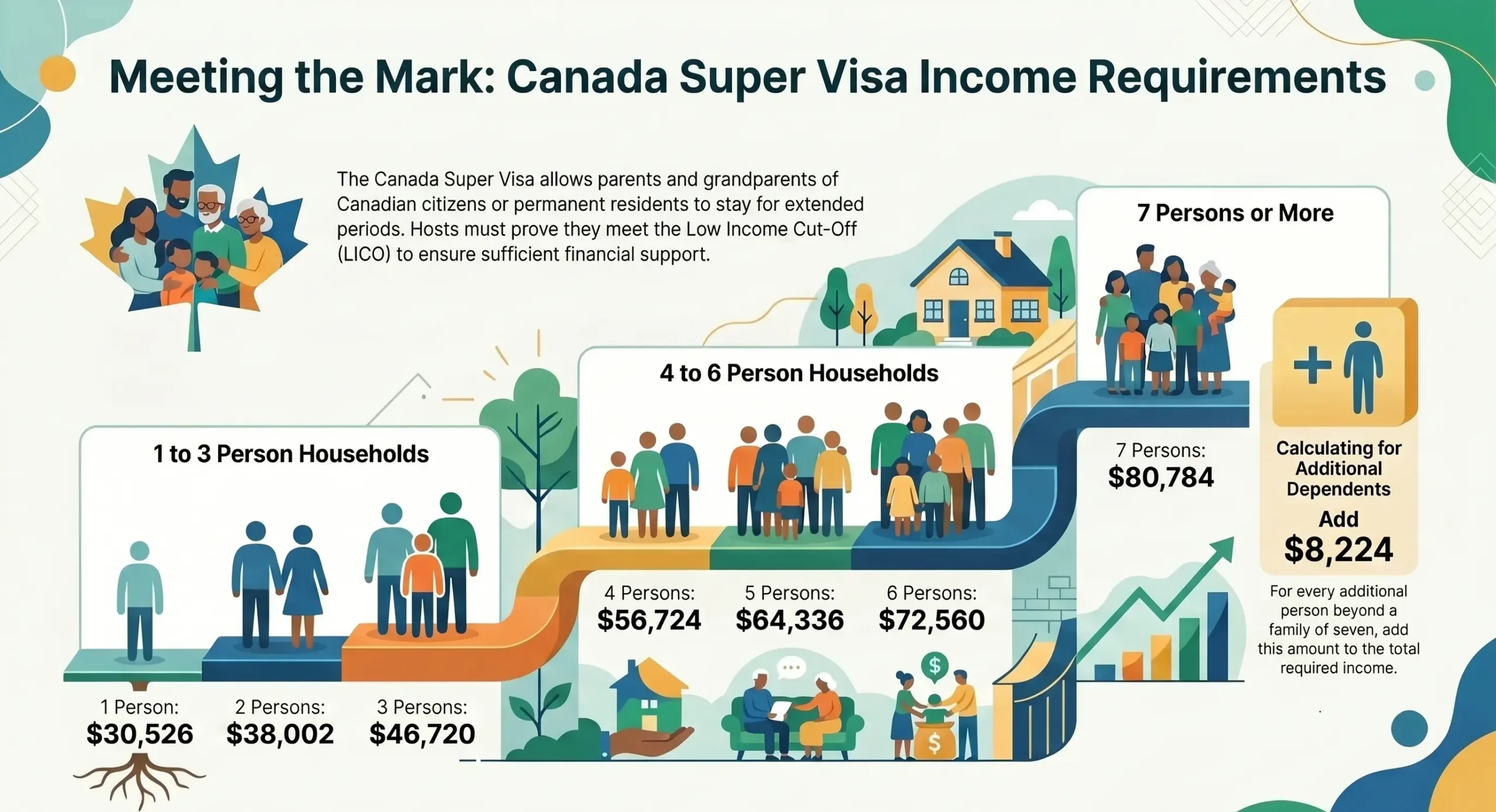
Note: These income requirements are based on the Low Income Cut-Off (LICO) figures and are subject to change. It’s important to note that meeting the income requirements alone does not guarantee the approval of a Super Visa application, as there are other eligibility criteria that must also be met.
Canada Super Visa Application Procedure
The following is a general outline of the Canada Super Visa application procedure:
- Determine eligibility: Before applying for a Super Visa, you must ensure that you meet the eligibility criteria, which include being the parent or grandparent of a Canadian citizen or permanent resident, passing a medical exam, and having valid medical insurance.
- Gather documents: Gather all the required documents, which include a valid passport, proof of relationship with a Canadian citizen or permanent resident, proof of medical insurance, proof of financial support, invitation letter, travel itinerary, and police clearance certificate (if required).
- Apply online or by mail: The application for Canadian Super Visa is mainly done online through the Canadian government’s website. Mailing in a paper application is also an option but it is done for some special situations. Make sure to fill out the application form accurately and completely, and pay the application fee.
- Wait for processing: Once your application is submitted, it will be reviewed by Canadian immigration officials. Processing times can vary, but you can check the current processing times on the Canadian government’s website.
- Attend biometrics appointment: If required, you will need to attend a biometrics appointment at a designated location to have your fingerprints and photo taken.
- Wait for decision: After your application is processed, you will receive a decision letter indicating whether your Super Visa has been approved or not.
- Travel to Canada: If your Super Visa is approved, you can travel to Canada and stay for up to 5 years per visit. You will need to present your Super Visa and other required documents at the Canadian border.
REASON TO CHOOSE PI OVERSEAS
- Consultations at Pi Overseas are provided by professional and authorized immigration consultants
- A step-by-step guide to the eligibility and application process
- Our online process is secure and transparent
- For any process, there is a system addressing complaints for a smooth consumer experience.
- Having processed thousands of applications
- We assess every case multiple times before submitting it
- Qualifications and other skills are evaluated by our certified experts for error-free proceedings.
If you are willing to know more about the Canada Super Visa process, you can certainly contact us by writing us an email at mail@pioverseas.com and one of our experts will help you out in every possible way. Call us at +91-9310-10-6988, or you can also receive a call back from our expert once you fill out the inquiry form. You can also talk to our experts directly through our live chat feature and clear your doubts instantaneously.
We at Pi Overseas have a team of dedicated experts who cater to every need of the clients. We have a proven track record in the immigration industry, which was achieved in a very short span of time. Our experts will help and guide you through every step of the filing process and keep you posted throughout the whole cumbersome process of visa filing.
