
+91 9310106988
mail@pioverseas.com
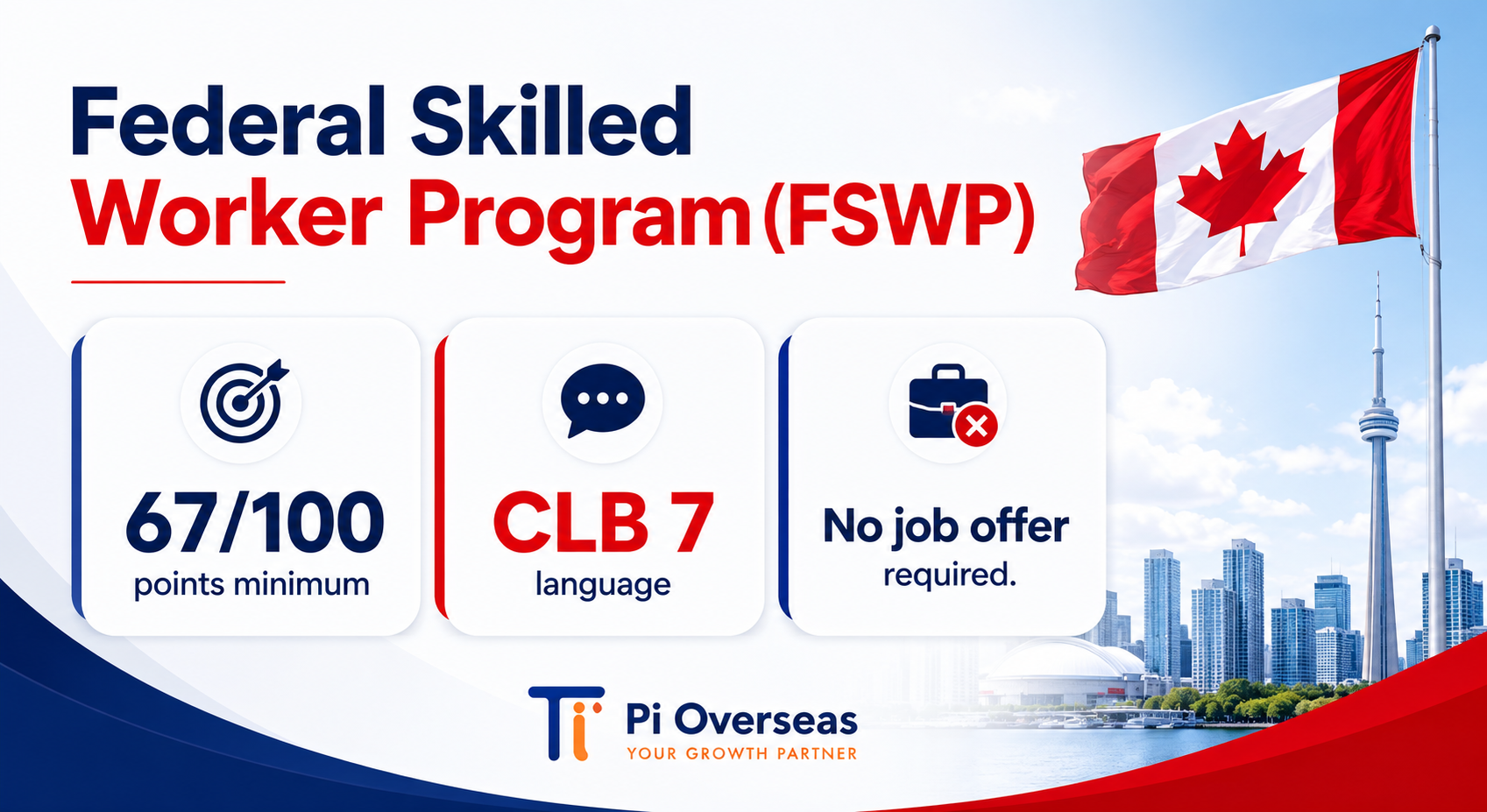
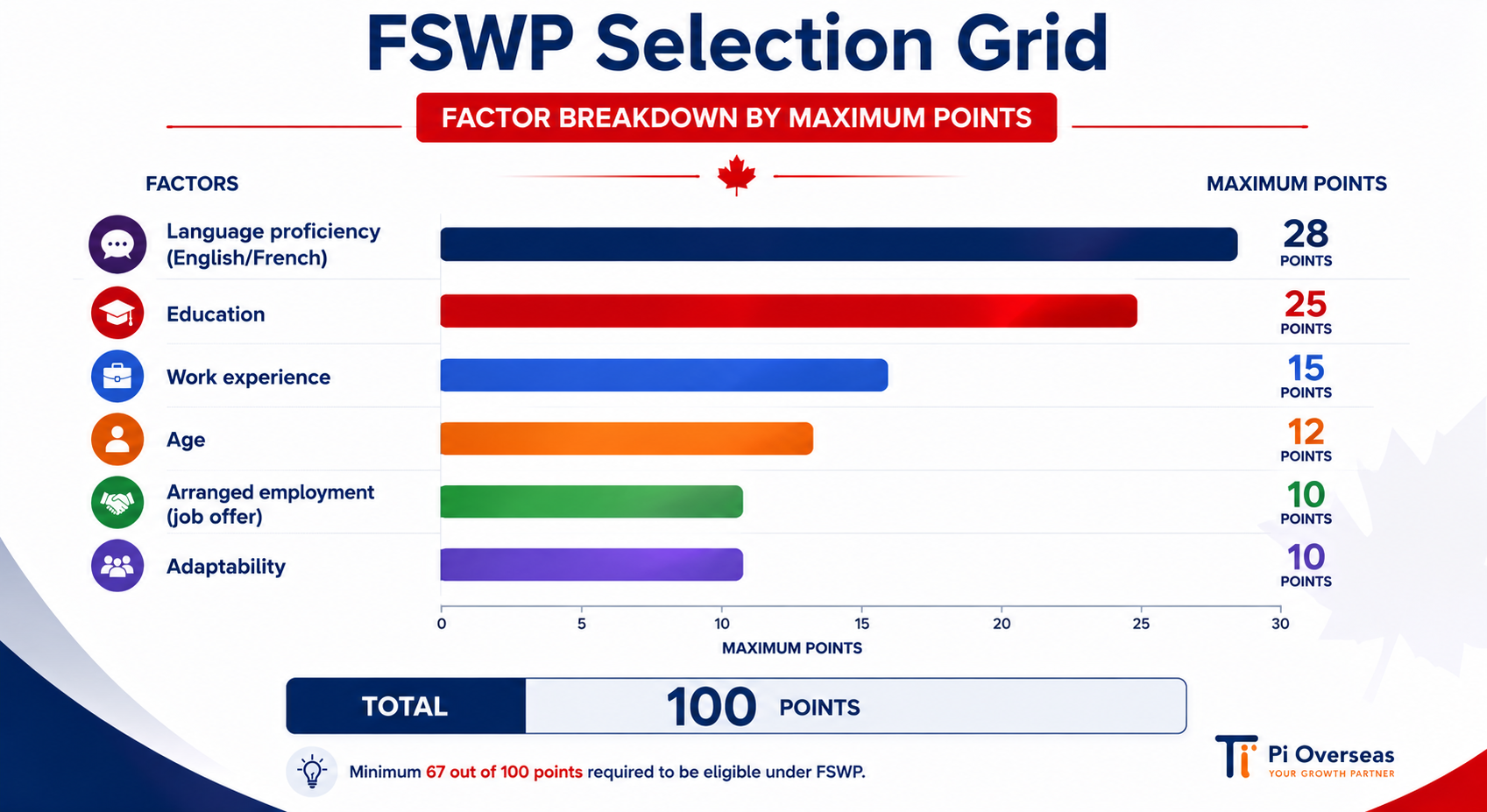
The Federal Skilled Worker Program (FSWP) is one of three federal economic immigration programs managed through Express Entry, and it’s the pathway most suited to skilled professionals who don’t yet have Canadian work experience or a job offer. Introduced in 1967 as the world’s first objective points-based immigration system, FSWP remains a core route to Canadian permanent residency today — assessed against a 100-point selection grid, with a minimum of 67 points required to qualify.
This guide covers current FSWP eligibility requirements, the full points grid, eligible occupations, processing times, and an important recent change to how job offers factor into your overall Express Entry ranking.
NOTE: To qualify for FSWP, you need at least 1 year of continuous, full-time skilled work experience in the past 10 years (NOC TEER 0, 1, 2, or 3), a language score of at least CLB 7 in English or French across all four abilities, and a minimum of 67 out of 100 points on the FSWP selection grid. Unlike some other pathways, FSWP doesn’t require a Canadian job offer or prior Canadian work experience — though it does require you to intend to settle outside Quebec.
In April 2026, IRCC published its Forward Regulatory Plan 2026-2028, proposing to repeal the Federal Skilled Worker Program entirely — along with CEC and FSTP — and replace all three with a single, unified Federal High Skilled Class.
This is a proposal, not a confirmed change. IRCC held a public consultation on the proposed reforms from 23 April to 24 May 2026, which drew over 17,000 responses from individuals, employers, and organizations. That feedback is currently under analysis, and IRCC has not yet published a final decision or implementation date. Formal amendments to the Immigration and Refugee Protection Regulations would still be required before anything takes effect, and most immigration law sources estimate implementation is unlikely before 2027 at the earliest. IRCC has confirmed that candidates currently eligible under FSWP will continue to be assessed under today’s rules until any change is formally implemented, and invitations already issued will be honoured regardless of the outcome.
Practically, this means: if you’re eligible under FSWP today, there’s no advantage to waiting for the proposed new system — apply under the current rules described below.
See our [Express Entry guide covering the Federal High Skilled Class proposal] for the complete picture of what’s being proposed across all three federal programs.
Key features:
Read our dedicated [Quebec Skilled Worker Program] guide if you’re specifically targeting Quebec.
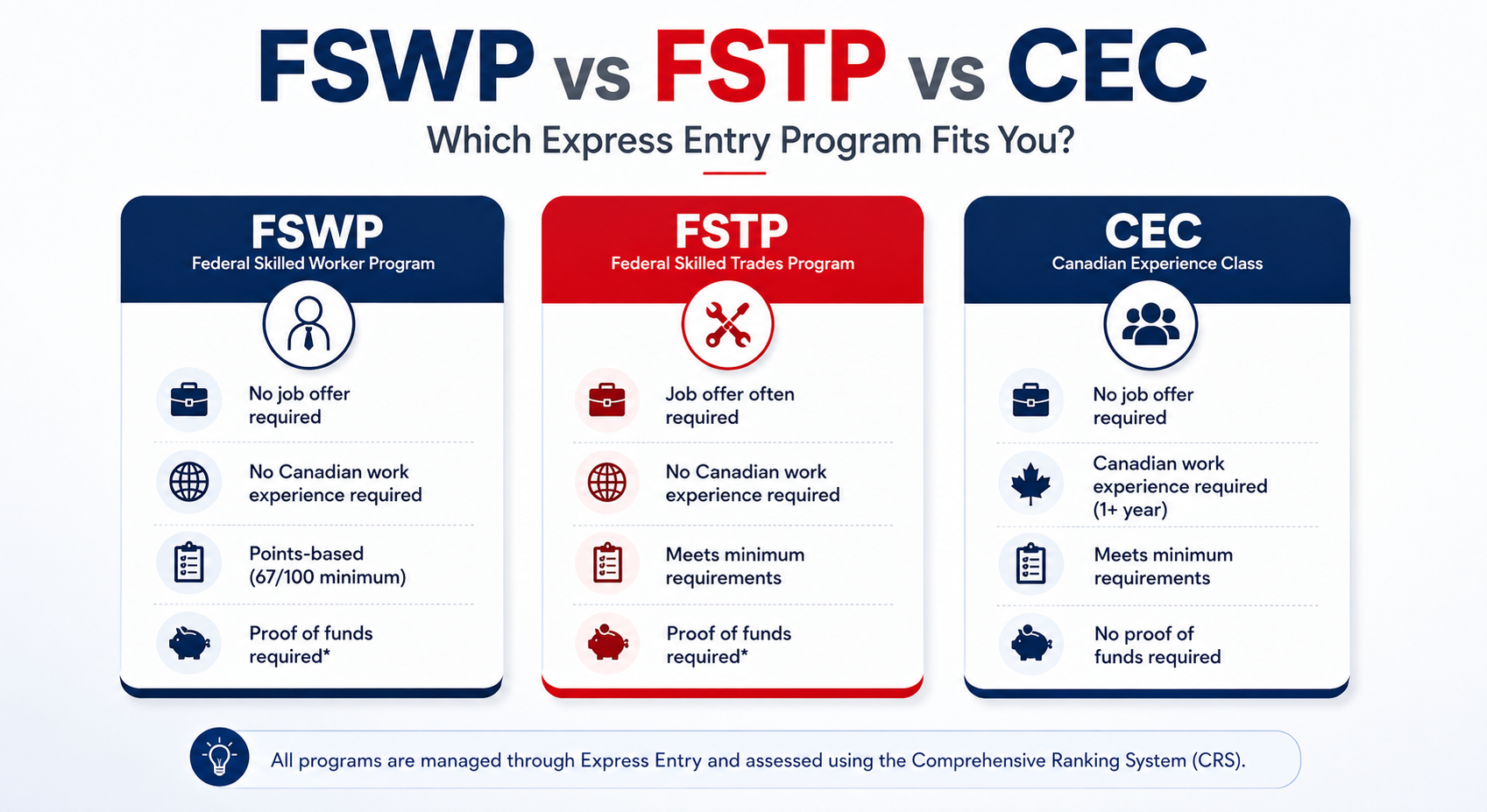
Criteria | FSWP | FSTP | CEC |
Job offer required | No | Often required | No |
Canadian work experience required | No | No | Yes (1+ year) |
Selection method | 100-point grid, 67-point minimum | Minimum requirements, no points grid | Minimum requirements, no points grid |
Proof of funds | Required (unless exempt) | Required (unless exempt) | Not required |
Best suited for | Skilled workers with foreign work experience and no Canadian ties | Qualified tradespeople | Those with existing Canadian work experience |
See our [Federal Skilled Trades Program] and [Canadian Experience Class] guides for full details on the other two pathways.
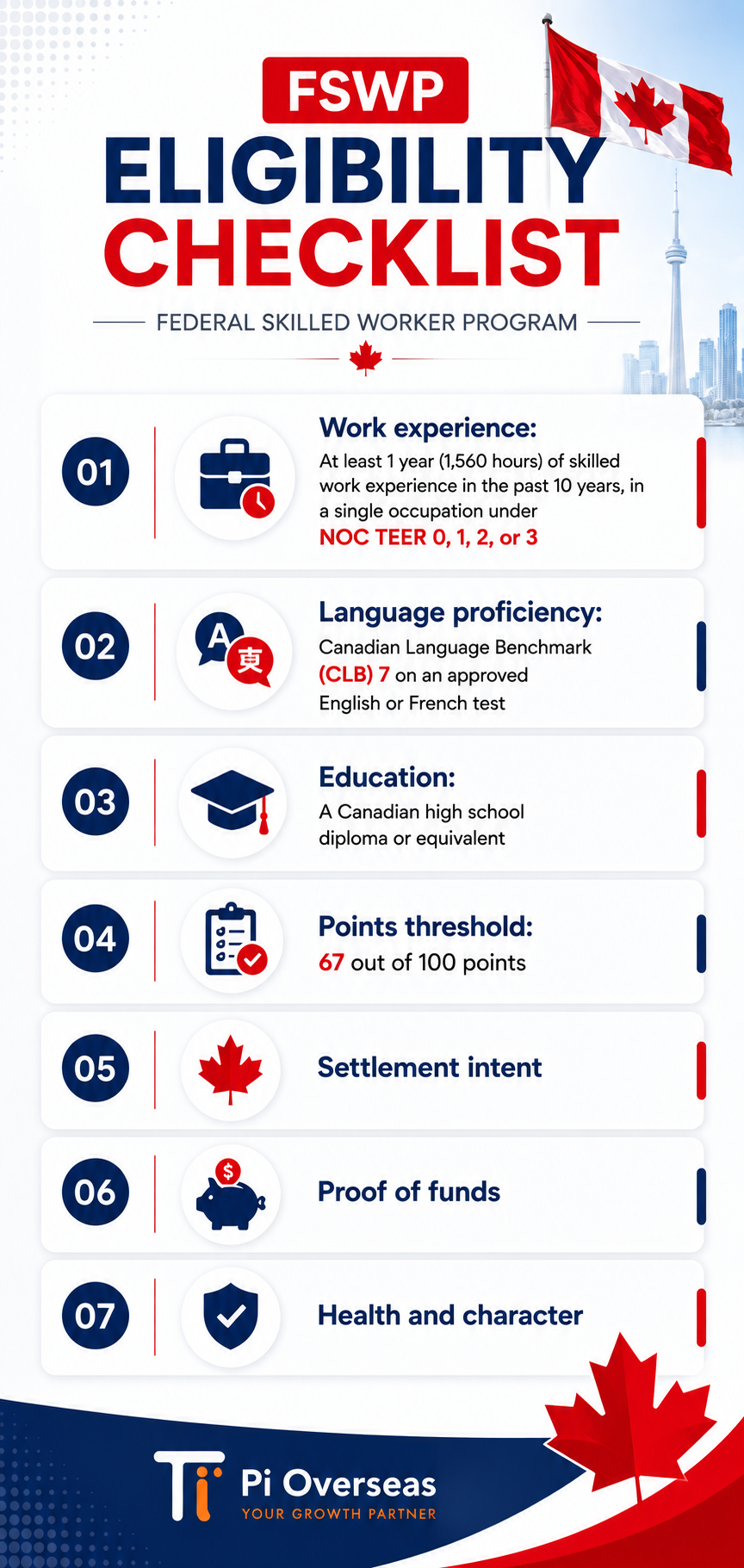
Work experience: At least 1 year (1,560 hours) of continuous, full-time (or equivalent part-time) skilled work experience in the past 10 years, in a single occupation classified under NOC TEER 0, 1, 2, or 3.
Language: A minimum of CLB 7 in all four abilities (reading, writing, listening and speaking) on an approved English or French test.
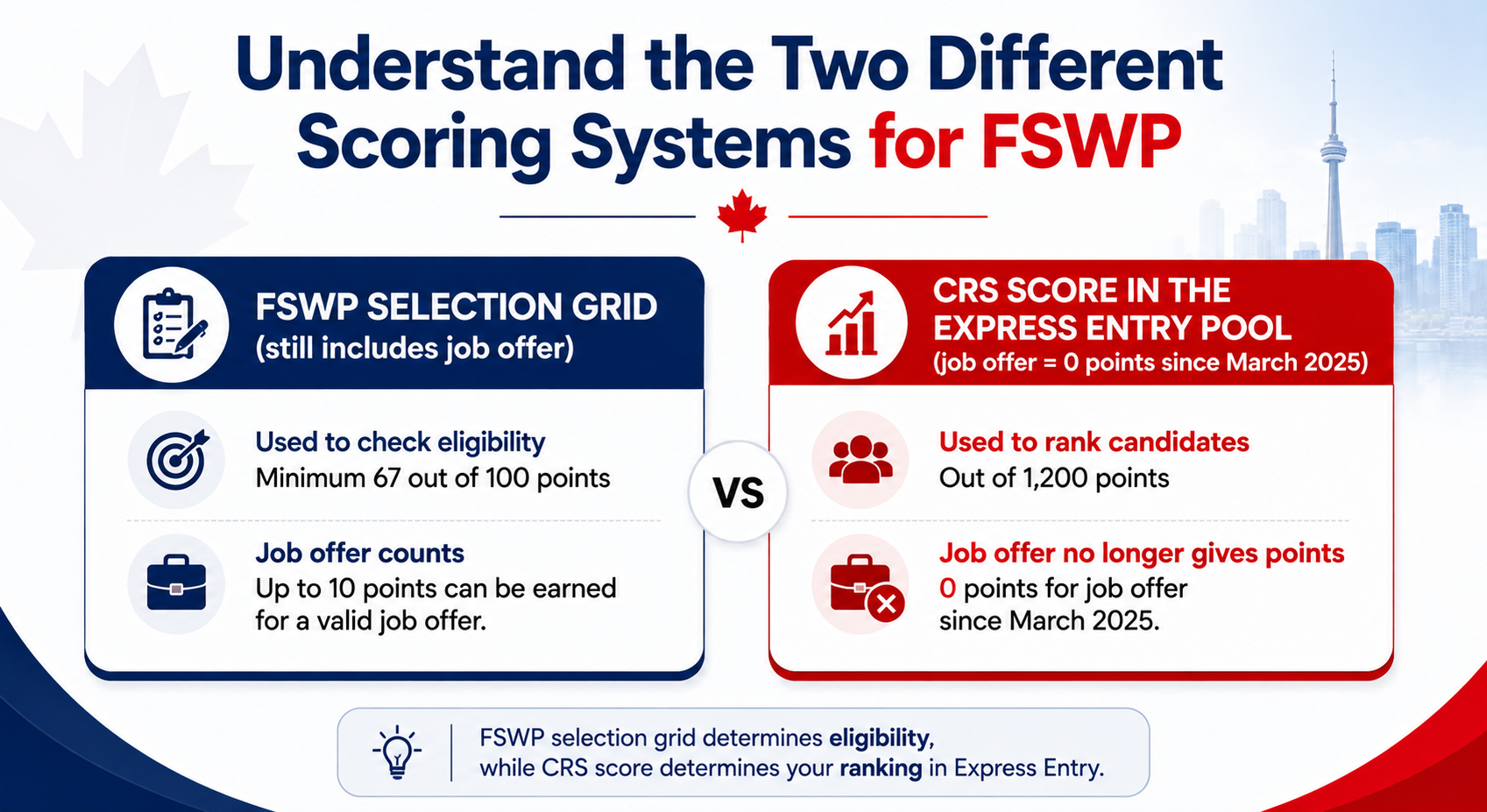
FSWP’s selection grid still includes arranged employment as one of its six factors (see below) — but it’s important not to confuse the FSWP selection grid with your CRS score in the Express Entry pool. As of 25 March 2025, IRCC removed job offer points from the Comprehensive Ranking System (CRS) entirely, including the previous 200-point bonus for senior management roles and the 50-point bonus for other skilled occupations. This is a CRS-level change, separate from your FSWP eligibility assessment.
What this means practically: a job offer can still help you meet FSWP’s minimum eligibility grid, and it exempts you from the proof of funds requirement — but it no longer boosts your ranking against other candidates once you’re in the Express Entry pool. If you’re weighing whether to pursue a Canadian job offer purely to improve your competitive position, a provincial nomination (worth 600 CRS points) is now a far more impactful lever.
IRCC has proposed reintroducing CRS points for job offers in high-wage occupations as part of its 2026-27 Departmental Plan, but as of now this remains under public consultation, not implemented.
See our [full CRS score breakdown] for the complete CRS breakdown and current proof of funds figures.
Factor | Maximum Points |
Language proficiency (English/French) | 28 |
Education | 25 |
Work experience | 15 |
Age | 12 |
Arranged employment (job offer) | 10 |
Adaptability | 10 |
Total | 100 |
You need a minimum of 67 points across these six factors to be eligible to enter the Express Entry pool as an FSWP candidate — this is separate from, and assessed before, your CRS ranking score once you’re in the pool.
Arranged Employment (max 10 points): You receive the full 10 points if you have a valid, full-time job offer from a Canadian employer, supported by a positive Labour Market Impact Assessment (LMIA) where required, or if you’re already working in Canada in a managerial, professional, or technical/skilled role under a valid work permit tied to that employer.
Adaptability (max 10 points): Awarded across several sub-factors, up to a combined maximum of 10:
(Sub-factors combine but are capped at 10 total — you can’t exceed the maximum by stacking multiple qualifying categories.)
If you’re an academic professional already working in Canada — including as a post-secondary teaching or research assistant, university professor, or lecturer — you may be able to receive a targeted invitation through Express Entry’s Researchers with Canadian work experience category-based round, introduced in 2026. This category targets candidates who have gained at least one year of Canadian research or teaching experience within the past three years, and it’s designed to help Canada retain skilled researchers already contributing to its academic and innovation sectors.
A few things worth being precise about here are given below:
See our guide to [Express Entry category-based rounds] for the current list of category-based selection priorities.
FSWP covers a broad range of professions across 376 occupations classified under NOC 2021 TEER 0, 1, 2, or 3 — spanning management, professional, technical, and skilled trade-adjacent roles. If you’ve previously been told your occupation isn’t eligible based on the older “Skill Type 0, A, B” classification, it’s worth rechecking against the current TEER system, introduced with the NOC 2021 update — the terminology has changed even where the underlying eligibility hasn’t.
Step 1: Confirm Your Eligibility
Check your work experience, language ability, and education against the minimum FSWP requirements.
Step 2: Take a Language Test
Sit for an approved test and confirm you meet the CLB 7 minimum in all four abilities.
Step 3: Get Your Credentials Assessed
Obtain an ECA if your education was completed outside Canada.
Step 4: Calculate Your FSWP Points
Score yourself against the 100-point grid and confirm you meet the 67-point minimum.
Step 5: Create Your Express Entry Profile
Submit your profile, including work experience, language results, and education details.
Step 6: Receive Your CRS Score and Wait for a Draw
Your Express Entry profile is ranked using the CRS (separate from your FSWP eligibility score) across general, program-specific, or category-based rounds.
Step 7: Receive Your Invitation to Apply (ITA)
If ranked highly enough, you’ll receive an ITA.
Step 8: Submit Your Complete Application
Lodge your full application with all supporting documents within 60 days of your ITA.
Once you receive an ITA and submit a complete application, processing times vary based on application volume and individual case complexity. Check IRCC‘s current processing time tool for the most accurate, up-to-date estimate specific to FSWP applications, since these figures shift regularly and shouldn’t be quoted as a fixed number.
Creating an Express Entry profile and submitting an FSWP eligibility grid assessment is free — government fees apply once you receive an ITA and submit your full application. As of the fee increase on 30 April 2026, a single adult applicant pays $990 processing fee + $600 Right of Permanent Residence Fee = $1,590 total, plus $85 in biometrics fees. Dependent children pay a separate, lower processing fee and are exempt from the RPRF.
Fee | Amount |
Principal applicant processing fee | $990 |
Right of Permanent Residence Fee | $600 |
Dependent child | $270 |
Total, primary applicant | $1,590 |
See our [full Express Entry fee breakdown by family size] for third-party costs (language test, ECA, medical exam) and payment timing options.
If you are willing to know more about the Canada FSWP Application process, you can certainly contact us by writing us an email at mail@pioverseas.com and one of our experts will help you out in every possible way. Call us at +91-9310-10-6988 or you can also receive a call back from our expert once you fill out the inquiry form. You can also talk to our experts directly through our live chat feature and clear your doubts instantaneously.
We at Pi Overseas is one of the best Canada Immigration Consultancy and have a team of dedicated experts that cater to every need of the clients. We have a proven track record in the immigration industry which was achieved in a very short span of time. Our experts will help and guide you through every step of the filing process and keep you posted throughout the whole cumbersome process of visa filing.