Canada Global Talent Stream (GTS)

Canada Global Talent Stream (GTS) is a program initiated by the Canadian government in 2017 to help Canadian employers hire highly skilled foreign workers quickly and efficiently. The GTS is part of the Temporary Foreign Worker Program (TFWP) and aims to help innovative companies fill highly skilled positions when they are unable to find suitable Canadian candidates.

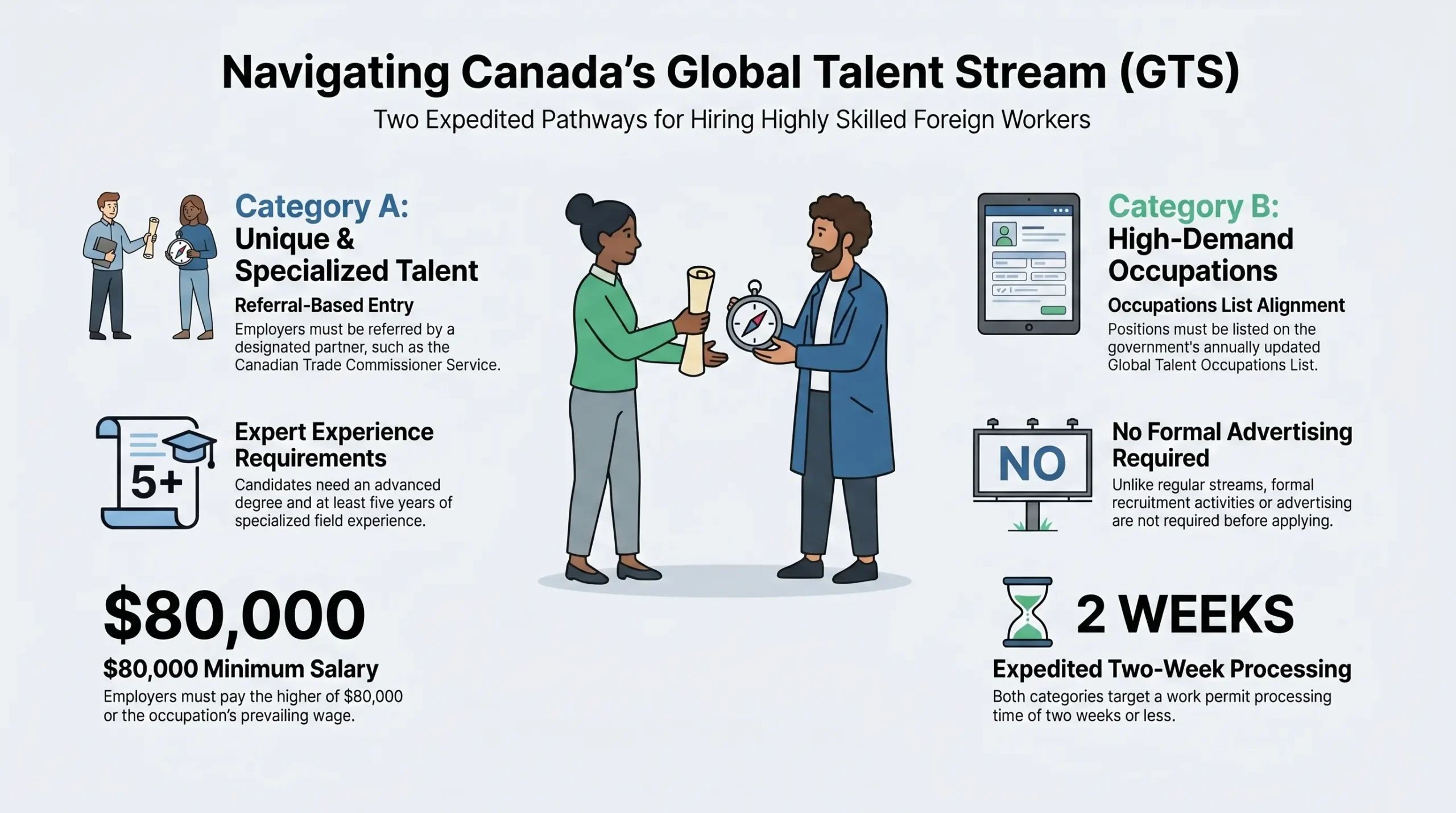
The GTS is designed to accelerate the work permit application process for highly skilled foreign workers in designated occupations. The GTS offers two categories of highly skilled foreign workers: Category A and Category B.

The GTS aims to provide faster processing times for work permit applications, with a target of two weeks or less. Additionally, GTS work permit applications offer a faster LMIA process (10 business days), which is not available for many other work permit applications. The GTS also allows highly skilled foreign workers to be eligible for upto three-year work permits and can facilitate the transition to permanent residency in Canada.
Overall, the GTS is a valuable program for Canadian employers seeking to attract highly skilled foreign workers and for foreign workers looking for opportunities to work in Canada.

What are the categories of Canada GTS program?

The Global Talent Stream (GTS) program has two categories for highly skilled foreign workers:

Category A: This category is for employers who have been referred to the GTS by one of the program’s designated partners, including the Canadian Trade Commissioner Service and Innovation, Science and Economic Development Canada’s Accelerated Growth Service. This category is designed to help Canadian employers hire highly skilled foreign workers with unique and specialized skills not readily available in Canada. The criteria for Category A include:

  • The position must require an advanced degree in an area of specialization or equivalent experience.
  • The foreign worker must have at least five years of experience in the specialized field. Employers are required to pay whichever amount is higher: either a minimum annual salary of $80,000, or the prevailing wage for the specific occupation if that exceeds $80,000. This requirement applies to the first two distinct specialized roles requested under Category A.
  • The employer must submit a detailed job offer letter outlining the job duties, qualifications, and salary.

Category B: This category is for Canadian employers who are seeking to fill highly skilled positions in occupations that are in high demand in Canada. The occupations eligible for Category B are identified on the Global Talent Occupations List, which is updated annually by the Canadian government. The criteria for Category B include:

  • The position must be listed on the Global Talent Occupations List.
  • The employer must submit a detailed job offer letter outlining the job duties, qualifications, and salary.
  • Employers are encouraged to show efforts to hire Canadians or permanent residents, but unlike regular LMIA streams, are not required to conduct formal recruitment activities or advertising before applying.

Both categories of the GTS provide expedited processing times for work permit applications, with a target of two weeks or less. Additionally, GTS work permit applications offer faster Labour Market Impact Assessment (LMIA), which is not available for many other work permit applications. The GTS also allows highly skilled foreign workers to be eligible for upto three-year work permits and can facilitate the transition to permanent residency in Canada.

Global Talent Stream (GTS) Canada Categories

What are the requirements for Canada GTS process?

To be eligible for the GTS, both the employer and the foreign worker must meet certain requirements. The key requirements are given below:

Employer Requirements:

  • Be a Canadian employer that is either:
    1. referred by a designated referral partner; or
    2. seeking to hire a highly skilled foreign worker for a position that is listed on the Global Talent Occupations List.
  • Have a proven track record of good workplace and labour practices.
  • Commit to creating jobs for Canadians and/or permanent residents. Also, all GTS employers must develop and submit a formal Labour Market Benefits Plan (LMBP) in collaboration with ESDC.
  • Provide information about the job being offered, including the job description, the wage being offered, and the benefits being provided.

Foreign Worker Requirements:

  • Have a job offer from a Canadian employer that is either:
    1. referred by a designated referral partner; or
    2. seeking to hire a highly skilled foreign worker for a position that is listed on the Global Talent Occupations List.
  • Meet the minimum requirements for the job being offered, including education, work experience, and language proficiency.
  • Provide evidence of their qualifications, such as transcripts, diplomas, and certificates.
  • Obtain a work permit and any other required permits or visas.

How to apply for the Global Talent Stream?

To apply for the Global Talent Stream (GTS), the employer must first determine whether they meet the program’s eligibility requirements. If the employer is eligible, they can follow these steps to apply for the GTS:

  • Identify the position to be filled: The employer must identify the position they wish to fill and ensure that it is listed on the Global Talent Occupations List. The list is updated regularly and includes occupations that are in high demand in Canada.
  • Get a Labour Market Impact Assessment (LMIA): The employer must apply for a Labour Market Impact Assessment (LMIA) from Employment and Social Development Canada (ESDC) to show that there are no Canadian citizens or permanent residents available to fill the position. This LMIA is a GTS application that is submitted through the online portal of Service Canada’s LMIA. Also, GTS LMIA applications do not require the employer to advertise and conduct a recruitment process before applying for LMIA. GTS-eligible employers are eligible for a two-week processing time for LMIA applications.
  • Submit the GTS application: Once the LMIA has been approved, the employer can apply for the GTS by submitting an online application through Service Canada via the LMIA Online portal. The application must include all required documentation, such as the job offer letter, LMIA confirmation, and the foreign worker’s information and qualifications.
  • Pay the processing fee: The employer must pay the GTS processing fee of CAD $1,000 for each position they are hiring for.
  • Receive a work permit: Once the GTS application is approved, the foreign worker can apply for a work permit. GTS-eligible foreign workers can receive their work permit within two weeks, which is significantly faster than the regular work permit processing time.

It is important to note that the GTS application process can be complex and may require the assistance of an immigration lawyer or consultant. Employers should ensure they have a good understanding of the program’s requirements before applying to avoid delays or refusals.

Processing Time

The Global Talent Stream (GTS) is designed to offer a fast-track application process for employers and highly skilled foreign workers. The GTS processing time can vary depending on the specific circumstances of each application, but generally, the program aims to provide faster processing times than the regular work permit application process.

Employer-specific LMIA processing times for the GTS are have a service standard of 10 business days. Once the LMIA is approved, the employer can then apply for the GTS work permit, which can be processed within two weeks.

The GTS program also offers priority processing for certain occupations, such as those related to artificial intelligence, information technology, and science, technology, engineering, and mathematics (STEM) fields. Priority processing means that applications for these occupations are placed at the front of the queue and are processed faster than other GTS applications.

It’s important to note that processing times can vary depending on the volume of applications received and the complexity of the case. Employers and foreign workers should plan ahead and apply as early as possible to ensure the timely processing of their GTS application.

Canada GTS Visa Cost

The cost to come to Canada through the Global Talent Stream (GTS) can vary depending on several factors, such as the type of work permit being applied for, whether the foreign worker is applying from within or outside of Canada, and any additional costs for immigration consultants or lawyers.

Here are some of the key fees and costs associated with the GTS program:

  1. Labour Market Impact Assessment (LMIA) fee: The employer must pay a $1,000 fee for each LMIA application they submit.
  2. Work permit application fee: The fee for a work permit application is $155 CAD.
  3. Biometrics fee: All foreign workers are required to provide biometric information when applying for a work permit, which involves a fee of $85 CAD.
  4. Immigration consultant or lawyer fees: Employers and foreign workers may choose to hire an immigration consultant or lawyer to assist with the GTS application process. These fees can vary depending on the specific services required.

It’s important to note that these fees are subject to change. Employers and foreign workers should consult the official Immigration, Refugees, and Citizenship Canada (IRCC) website for the most up-to-date information on GTS fees and costs.

REASON TO CHOOSE PI OVERSEAS:

  • Consultations at Pi Overseas are provided by professional and authorized immigration consultants
  • A step-by-step guide to the eligibility and application process
  • Our online process is secure and transparent
  • For any process, there is a system addressing complaints for a smooth consumer experience.
  • Having processed thousands of applications
  • We assess every case multiple times before submitting it
  • Qualifications and other skills are evaluated by our certified experts for error-free proceeding.

If you are willing to know more about Canada (GTS) PR Visa process, you can certainly contact us by writing us an email at mail@pioverseas.com and one of our experts will help you out in every possible way. Call us at +91-9310-10-6988 or you can also receive a call back from our expert once you fill out the inquiry form. You can also talk to our experts directly through our live chat feature and clear your doubts instantaneously.

We at Pi Overseas have a team of dedicated experts that cater to every need of the clients. We have a proven track record in the immigration industry which was achieved in a very short span of time. Our experts will help and guide you through every step of the filing process and keep you posted throughout the whole cumbersome process of visa filing.

Let’s Start Your Visa Journey — Contact Us Today

Frequently Asked Questions

GTS has drawn significantly more attention in 2026 partly because of disruption to the U.S. H-1B visa program, including a new $100,000 USD supplemental fee on certain H-1B petitions and a wage-weighted selection lottery that has made hiring foreign tech talent into the U.S. notably more expensive and uncertain. For employers and workers who might previously have defaulted to H-1B, Canada’s GTS has become a comparatively fast, lower-cost alternative for bringing in specialized tech talent, particularly given its 2-week processing target and lack of a lottery system.

The Global Talent Stream is a fast-track work permit pathway under Canada’s Temporary Foreign Worker Program, created through the Global Skills Strategy to help innovative Canadian companies hire highly skilled foreign workers quickly. It offers expedited Labour Market Impact Assessment (LMIA) processing, typically around 10 business days, compared to 48–60 business days under standard LMIA streams; paired with a 2-week work permit processing target. It’s entirely employer-driven: a Canadian company must sponsor the application, not the worker applying independently.

Yes. Spouses, common-law partners, and dependent children of a GTS work permit holder can apply to accompany them to Canada, and their applications benefit from the same expedited processing timeline as the main applicant under the Global Skills Strategy service standard. A spouse or partner is typically eligible for an open work permit, allowing them to work for almost any Canadian employer while the primary applicant works under their GTS-sponsored position.

The employer pays a $1,000 CAD LMIA processing fee per position to Service Canada, the same fee as standard LMIA streams, despite the much faster processing. On top of this, employers should budget for legal/consultant fees to prepare the Labour Market Benefits Plan and supporting documentation, and the standard work permit application fee paid by the worker (currently in the low hundreds of CAD). There’s no minimum salary floor unique to GTS beyond the requirement to meet or exceed the prevailing wage for the occupation and region.

Eligibility for Canada’s Global Talent Stream depends on two parties: the employer and the worker. The employer must qualify under Category A (hiring unique, specialized talent, with a referral from a designated partner like NRC-IRAP or the Business Development Bank of Canada) or Category B (hiring for a role on the Global Talent Occupations List, mostly tech and digital positions). The worker must genuinely meet the education, experience, and licensing requirements of that specific role, and the job must pay at or above the prevailing wage. There’s no individual points test or application pool, eligibility flows entirely from a valid employer-sponsored LMIA.

Who Qualifies: A Two-Sided Checklist

Party

Requirement

Employer (Category A)

Referred by a designated partner organization; hiring for genuinely unique/specialized talent

Employer (Category B)

Position matches a role on the Global Talent Occupations List (NOC code specific)

Employer (both categories)

Willing to commit to a Labour Market Benefits Plan; offers wage at/above prevailing rate

Worker

Meets the education, experience, and licensing requirements for the specific role offered

Worker

Genuine job offer already secured — cannot apply independently without an employer

 Key point: unlike Express Entry, there’s no CRS score, age bracket, or general “profile” that makes someone individually eligible. Eligibility is entirely tied to a specific job offer from a qualifying Canadian employer.

Yes. The Global Talent Stream is not an LMIA-exempt pathway. It’s actually a special, expedited category of LMIA itself. The Canadian employer must still apply to Employment and Social Development Canada (ESDC) for a Labour Market Impact Assessment, but under the GTS it’s processed in around 10 business days, compared to 48–60 business days for a standard LMIA, and doesn’t require the formal recruitment/advertising step that standard LMIA applications do.

Why This Matters

Some employers confuse GTS with genuinely LMIA-exempt work permit categories (like intra-company transfers, CUSMA/USMCA professional categories, or International Experience Canada); these skip the LMIA process entirely but are limited to narrow eligibility scenarios (specific nationalities, existing multinational relationships, youth programs). GTS still requires an LMIA; it’s simply a much faster version of one, tied to a $1,000 CAD LMIA processing fee paid by the employer, the same fee as standard streams.


Global Talent Stream

LMIA-Exempt Categories (e.g., CUSMA, ICT)

LMIA required

Yes (expedited, ~10 business days)

No

Recruitment/advertising required

No

No (not applicable)

Eligibility scope

Category A/B roles only

Narrow — treaty nationality, multinational transfer, youth programs

Speed

~4–6 weeks total (LMIA + work permit)

Often 2–4 weeks total

Disclaimer: This is general information, not immigration or legal advice. Global Talent Stream eligibility criteria, occupation lists, and LMIA requirements are set jointly by ESDC and IRCC and can change. Always confirm current details on the official Global Talent Stream page before applying.

  • Category A is for employers hiring workers with unique and specialized talent who will generate significant economic benefit for Canada, but the employer must first be referred by a designated referral partner, such as the National Research Council’s Industrial Research Assistance Program (NRC-IRAP), the Business Development Bank of Canada, or certain provincial innovation agencies.
  • Category B is for hiring into a role listed on IRCC’s Global Talent Occupations List, which is dominated by tech and digital roles (software developers, data scientists, engineering managers) and doesn’t require a referral partner.


Category A

Category B

Basis of eligibility

Unique/specialized individual talent

Role on the Global Talent Occupations List

Referral required

Yes, from a designated partner organization

No

Best for

Highly specialized, hard-to-classify roles

Standard tech/digital roles matching a listed NOC code


ESDC’s published service standard for the GTS LMIA is 10 business days, met roughly 80% of the time, and IRCC targets a further 10 business days (2 weeks) for the work permit itself once a positive LMIA is issued. In practice, expect the full process; LMIA plus work permit, to take around 4–6 weeks in ideal conditions. As of a June 2026 ESDC processing update, the Global Talent Stream continued hitting its 10-day standard even as other LMIA categories slowed, reflecting its priority status within the broader system.

Stage

Target Time

LMIA (via GTS)

10 business days (vs. 48–60 for standard LMIA)

Work permit (post-LMIA)

10 business days / 2 weeks

Total end-to-end (ideal case)

4–6 weeks

Note: Timelines fluctuate with application volume and completeness. Confirm current processing times on ESDC’s and IRCC’s official processing time tools before setting hiring expectations.

Yes, entirely. Unlike Express Entry or the Provincial Nominee Program, the GTS requires a specific Canadian employer to sponsor the application; there’s no individual “profile” system or points-based pool. The employer applies for the LMIA, commits to a Labour Market Benefits Plan, and only once that’s approved does the foreign worker apply for the work permit. Workers cannot apply for GTS independently without an employer already lined up.

Not directly. The GTS is a temporary work permit route, not a permanent residence program. It doesn’t grant PR on its own. However, it pairs naturally with a PR pathway afterward: Canadian work experience gained on a GTS work permit can qualify a worker for the Canadian Experience Class (CEC) stream of Express Entry, or strengthen a Provincial Nominee Program application, once they’ve accumulated enough qualifying work experience. Many tech workers use GTS as the temporary bridge into Canada’s workforce, then transition to PR through Express Entry.

The Labour Market Benefits Plan is a mandatory commitment the employer makes as part of a GTS application, outlining how hiring the foreign worker will benefit the Canadian labour market, commonly through creating jobs for Canadians, transferring skills and knowledge, or making investments in training and R&D. It’s assessed alongside the LMIA and is one of the more document-intensive parts of the application, often requiring specific, measurable commitments rather than general statements of intent.

The Global Talent Occupations List (used for Category B) is dominated by technology and digital roles like software developers and programmers, data scientists, computer and information systems managers, engineering managers, and similar high-skill digital occupations. Each listed occupation is tied to a specific NOC (National Occupational Classification) code, and the job being offered must genuinely match both the duties and skill level of that code to qualify. The list is reviewed periodically by IRCC and ESDC, so confirming a specific role’s current listing status before applying is essential.

No. Unlike standard LMIA applications, which generally require employers to conduct formal recruitment and advertise the position to Canadians and permanent residents first, GTS applications are exempt from this recruitment requirement. This is one of the program’s biggest practical advantages for employers needing to move quickly on a specific candidate, though employers are still generally expected to show some effort or rationale around hiring Canadians where relevant.

GTS work permits can be issued for up to 3 years, longer than many standard employer-specific work permits. The exact duration depends on the LMIA validity period and the specific job offer terms. Workers can generally apply to extend or transition their status before the permit expires, including moving toward permanent residence if they’ve built up qualifying Canadian work experience in the meantime.

The core difference is speed and process: GTS offers roughly 10-business-day LMIA processing versus 48–60 business days for standard LMIA streams, and skips the mandatory recruitment/advertising step. In exchange, GTS is narrower in scope — it only covers unique/specialized talent (Category A) or roles on the specific Global Talent Occupations List (Category B), and requires the employer to commit to a Labour Market Benefits Plan, which standard LMIA applications don’t require.


Global Talent Stream

Standard LMIA

LMIA processing time

~10 business days

48–60 business days

Recruitment/advertising required

No

Yes

Labour Market Benefits Plan required

Yes

No

Eligible roles

Category A (unique talent) or Category B (listed occupations)

Broader range of occupations

Wage requirement

Must meet/exceed prevailing wage

Must meet/exceed prevailing wage

The most common issues are an incomplete or vague Labour Market Benefits Plan that doesn’t make specific, measurable commitments; a job offer that doesn’t clearly match the duties and skill level of the claimed NOC code (for Category B) or doesn’t sufficiently demonstrate uniqueness (for Category A); a wage offer that falls below the prevailing wage for the role and region; and, for Category A, a referral that doesn’t come from a properly designated referral partner. Given the tight processing targets, incomplete applications are also more likely to blow past the 10-day standard entirely, since the clock effectively restarts once ESDC requests additional information.