Federal Skilled Trades Program (FSTP)

An immigration pathway to becoming a Canadian permanent resident based on their qualifications in a skilled trade is the Federal Skilled Trades Program (FSTP). Express Entry, one of the federal immigration programs, manages this program for Canada PR Visas.

A skilled foreign trader is invited to work and settle in Canada under the Canada Federal Skilled Trades Program. Read on to learn more about the FSTP program and how you can obtain permanent residence if you possess experience in a skilled trade that is on the list of in-demand occupations in Canada.

Under the Canadian Express Entry system, the Federal Skilled Trades (FST) program is one of three federal immigration programs.

Programs under the Express Entry System:

  • Federal Skilled Trades Program or FSTP
  • Canadian Experience Class or CEC
  • Federal Skilled Worker Program or FSWP

Express Entry is open to candidates with a minimum of two years’ experience in a skilled trade listed under the NOC.

Canadian permanent residency is not guaranteed by submitting an Express Entry profile. You will be invited to apply for a PR visa only if you meet the standard requirements set by the Canadian Government after submitting your application. Your CRS score greatly influences your invitation.

Canada PR Visa through FSTP: Advantages

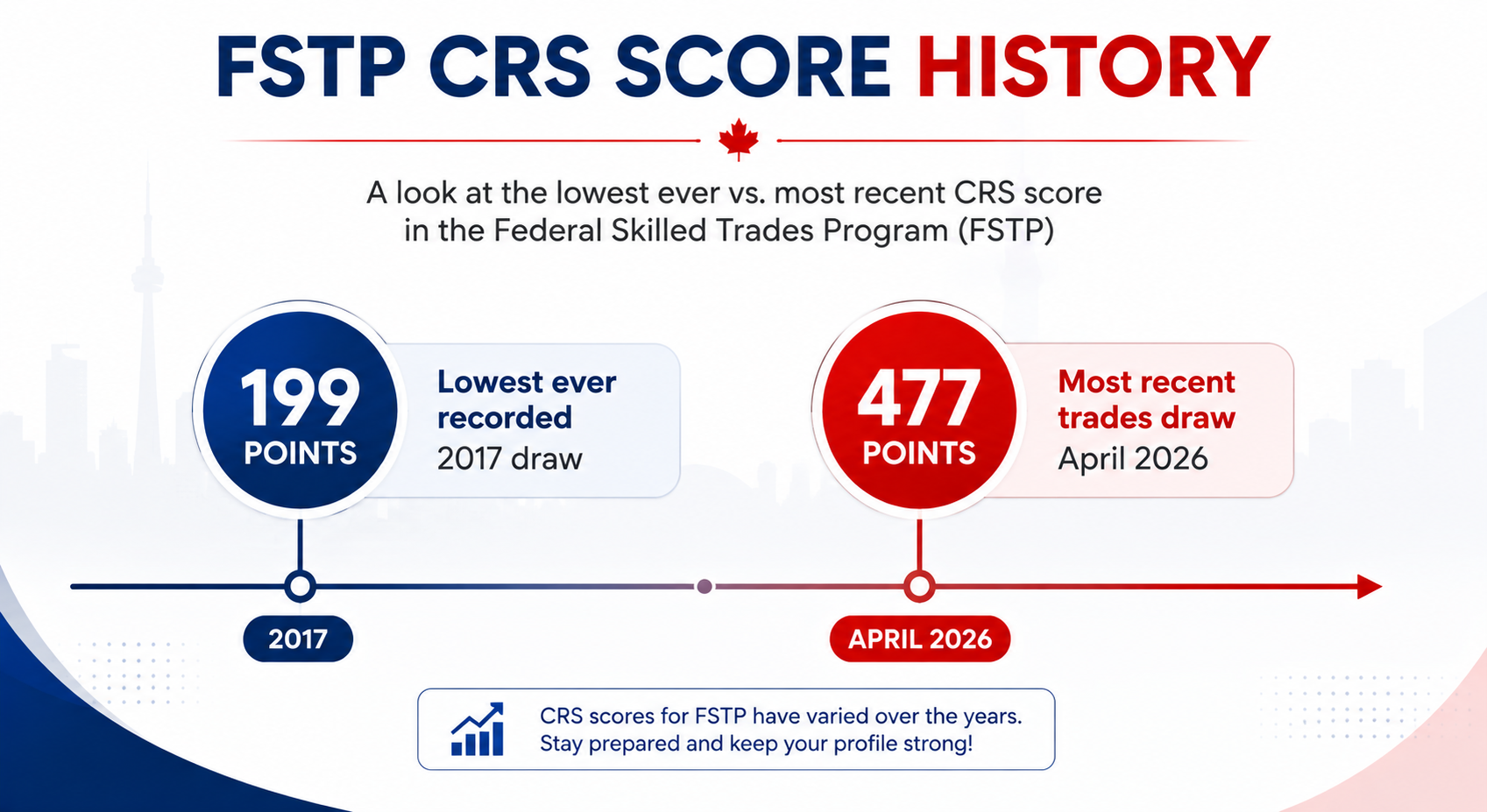
  • For FSTP candidates, a low CRS score of 199 points is required.
  • Chances are improved with a valid job offer.
  • Low IELTS score.

What are the minimum requirements for FSTP?

The minimum eligibility requirements to apply for a Canada PR visa through FSTP are given below:

FSTP Eligibility Criteria

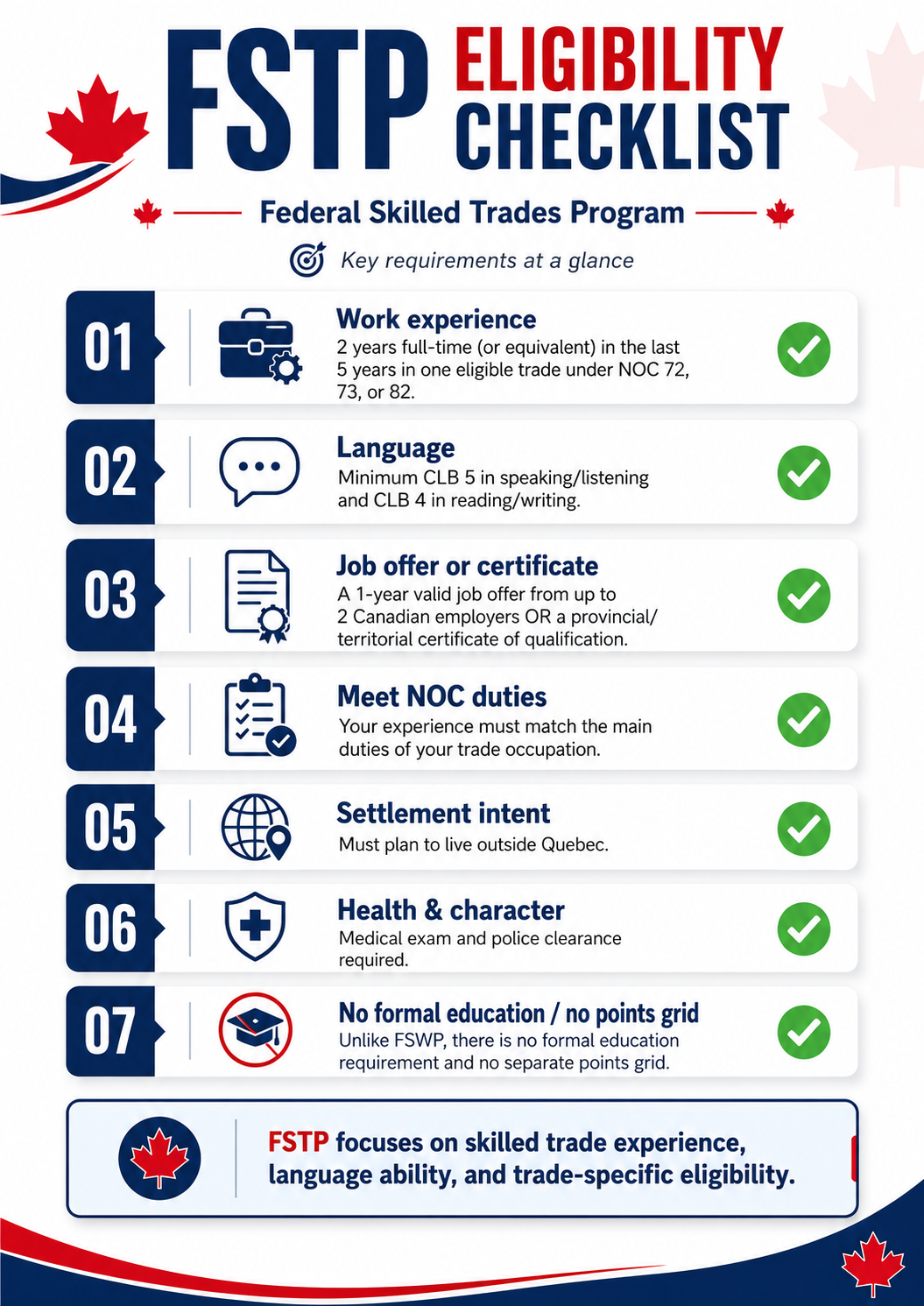
  1. For speaking and listening, a CLB level of 5 is required; for reading and writing, a CLB level of 4 is required.
  2. In the last 5 years, you must have worked in a skilled occupation for a minimum of 2 years.
  3. Meet all job requirements for that skilled trade as outlined in the National Occupational Classification except for a certificate of qualification.
  4. Hold a full-time job offer in this skilled trade for a period of at least one year from upto two Canadian employers OR hold a provincial or territorial qualification certificate in the skilled trade.

Federal Skilled Trades Program: Eligibility Criteria

Factor of EligibilityRequirements to Meet
AgeNot specified
Work Experience
2 years working experience in a skilled trade profession.
In the last five years, an equivalent amount of part-time work has been performed
LanguageTheir fluency in the English language (passed in IELTS General examination, CELPIP-General, and PTE Core)
French language fluency (passed in TEF Canada and TCF Canada)
Arranged EmploymentA Canadian employer has offered a permanent and full-time job
Arranged employment through a  Labour Market Impact Assessment (LMIA).
AdaptabilityNot specified

Federal Skilled Trades Program: Document Requirements

For the Federal Skilled Worker Program, the following documentation is required:

  • Your identification proof, like your passport
  • Their identification proof of family member (if they are moving as well)
  • The General Application Form for Immigration
  • Fee payment slip
  • Diploma, degrees, official transcripts
  • IELTS exam and the CELPIP test results.
  • Offer letter from a Canadian employer.
  • Reference letter from the previous employer
  • Proof of skilled job performance.
  • Pension fund or employment contract as proof of work experience.
  • Medical certificate from a verified practitioner
  • Clean police certificate
  • Proof of funds for permanent settlement in Canada
  • Marriage Certificate when migrating with a spouse

Procedure: Federal Skilled Trades Worker Program

Immigrating to Canada through the FSTP program requires expertise and preparation that can be swayed easily with the help of an expert. Here is how to do it.

Step 1: To complete the FSTP application, you will need the following documents.

  • Passport
  • Language Test Results
  • Provincial Nomination (optional)
  • Written Job Offer from Employer

Step 2: Submit Your Application – The highest CRS scores will receive an ITA to apply for permanent residence based on an Express Entry pool draw every 2 weeks.

Step 3: Accept the Invitation to Apply – In order to prove that the information you provided is accurate and true, you will need to submit supporting documents through your Express Entry account.

Canada PR Visa through FSTP: Process

CANADA PR VIA FSTP

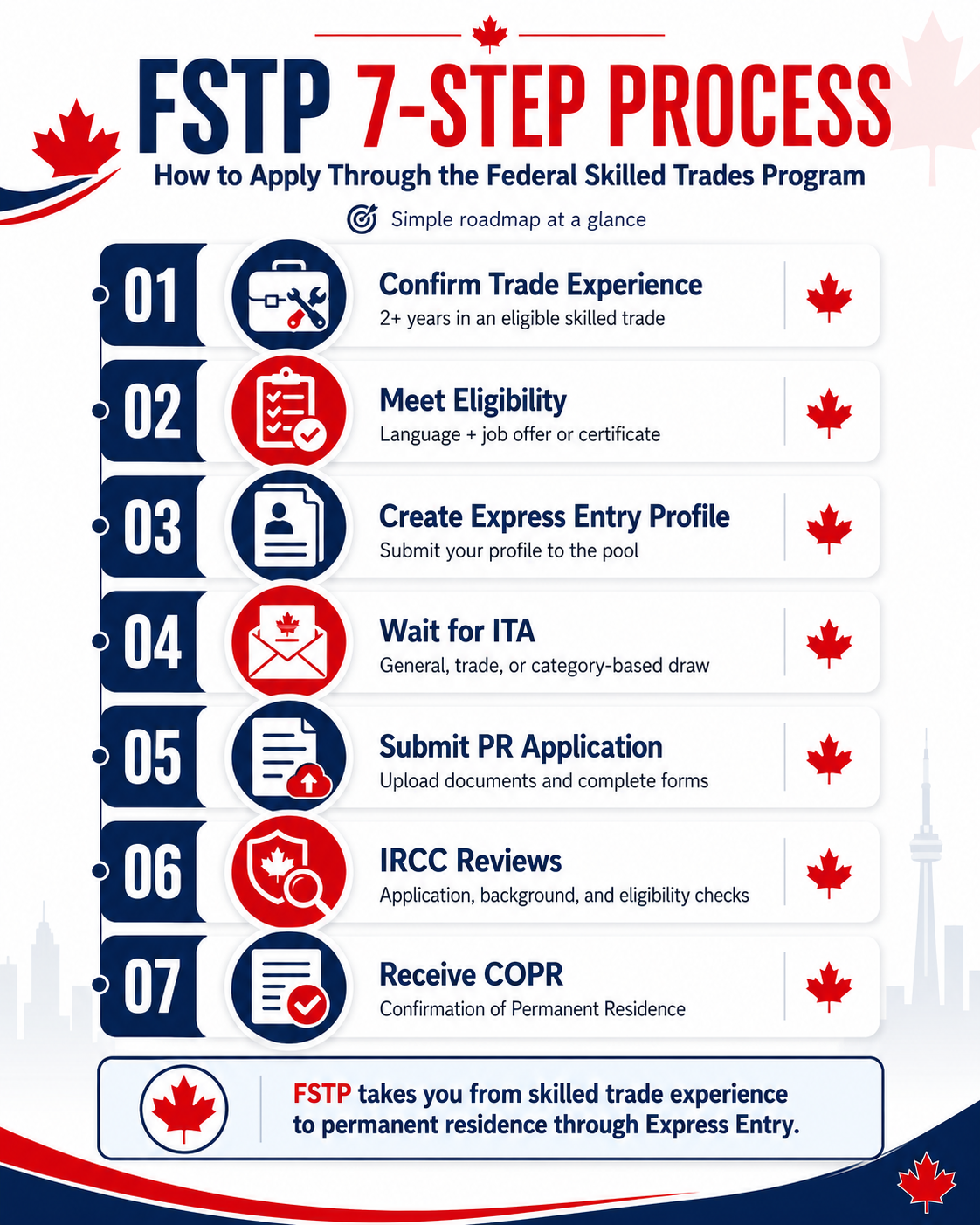
By following the steps below, you can apply for a Canada PR Visa through the Federal Skilled Trades Program:

Step 1: The applicant must have two years of relevant work experience in a skilled trade recognized by the IRCC.

Step 2: FSTP requirements must be met.

Step 3: Get your profile submitted to the express entry pool by creating an express entry profile.

Step 4: ITA receiving in the draw through express entry.

Step 5: Your PR Visa application must be submitted to the IRCC with the proper documents.

Step 6: Application review by IRCC.

Step 7: Confirmation of Permanent Residence (COPR) status

Process Costs

Costs involved in the FSTP through the Express Entry (EE) pathway:

ProcessCost
Main Applicant$950 CAD
Spouse/common-law partner$950 CAD
Each dependent child$260 CAD
Right of Permanent Residence fee (Main Applicant)$575 CAD
Right of Permanent Residence fee (spouse/common-law partner)$575 CAD
The biometrics fee (main applicant) 85 CAD
The biometrics fee (two or more people) in one FSTP visa application170 CAD.

Dependent children are exempted from the PR fee.

Reason to Choose Pi Overseas:

  • Consultations at Pi Overseas are provided by professional and authorized immigration consultants
  • A step-by-step guide to the eligibility and application process
  • Our online process is secure and transparent
  • For any process, there is a system addressing complaints for a smooth consumer experience.
  • Having processed thousands of applications
  • We assess every case multiple times before submitting it
  • Qualifications and other skills are evaluated by our certified experts for error-free proceeding.

If you are willing to know more about the Canada PR Visa process, you can certainly contact us by writing us an email at mail@pioverseas.com and one of our experts will help you out in every possible way. Call us at +91-9310-10-6988 or you can also receive a call back from our expert once you fill out the inquiry form. You can also talk to our experts directly through our live chat feature and clear your doubts instantaneously.

We at Pi Overseas have a team of dedicated experts that cater to every need of the clients. We have a proven track record in the immigration industry which was achieved in a very short span of time. Our experts will help and guide you through every step of the filing process and keep you posted throughout the whole cumbersome process of visa filing.

Let’s Start Your Visa Journey — Contact Us Today

Frequently Asked Questions

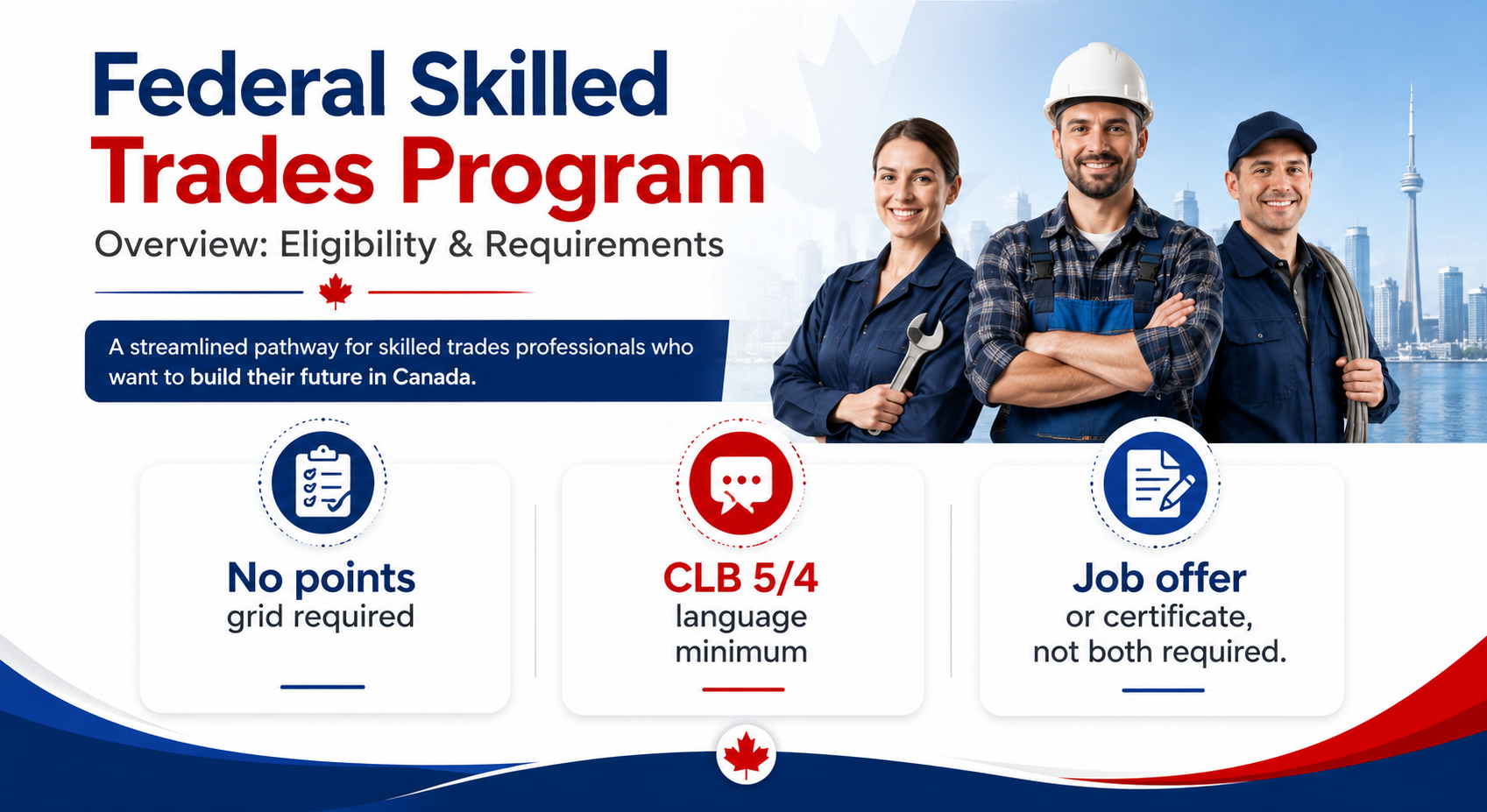
The Federal Skilled Trades Program is one of three federal economic programs managed through Express Entry, designed specifically for tradespeople, unlike the Federal Skilled Worker Program (FSWP), which covers broader professional and technical occupations. FSTP has no points grid and no formal education requirement; instead, eligibility rests on trade-specific work experience, meeting NOC job requirements for the trade, and either a valid job offer or a certificate of qualification from a Canadian province or territory.

You’re eligible for the Federal Skilled Trades Program if you have 2 years of full-time work experience in an eligible trade (NOC major groups 72, 73, or 82) within the last 5 years, meet the job requirements for that trade as set out in the NOC, hold either a valid job offer (1+ year, from up to 2 Canadian employers) or a certificate of qualification from a Canadian province/territory, and achieve a minimum language score of CLB 5 speaking/listening and CLB 4 reading/writing. There’s no formal education requirement and no separate points grid, unlike the Federal Skilled Worker Program’s 67-point system.

Requirement

Standard

Work experience

2 years, last 5 years, in eligible trade

Eligible NOC groups

72 (industrial/electrical/construction), 73 (maintenance/equipment operation), 82 (supervisors/technical, resources & agriculture)

Job offer OR certificate

One of the two required

Language

CLB 5 speaking/listening, CLB 4 reading/writing

Education

None required

Points grid

None — unlike FSWP’s 67-point system

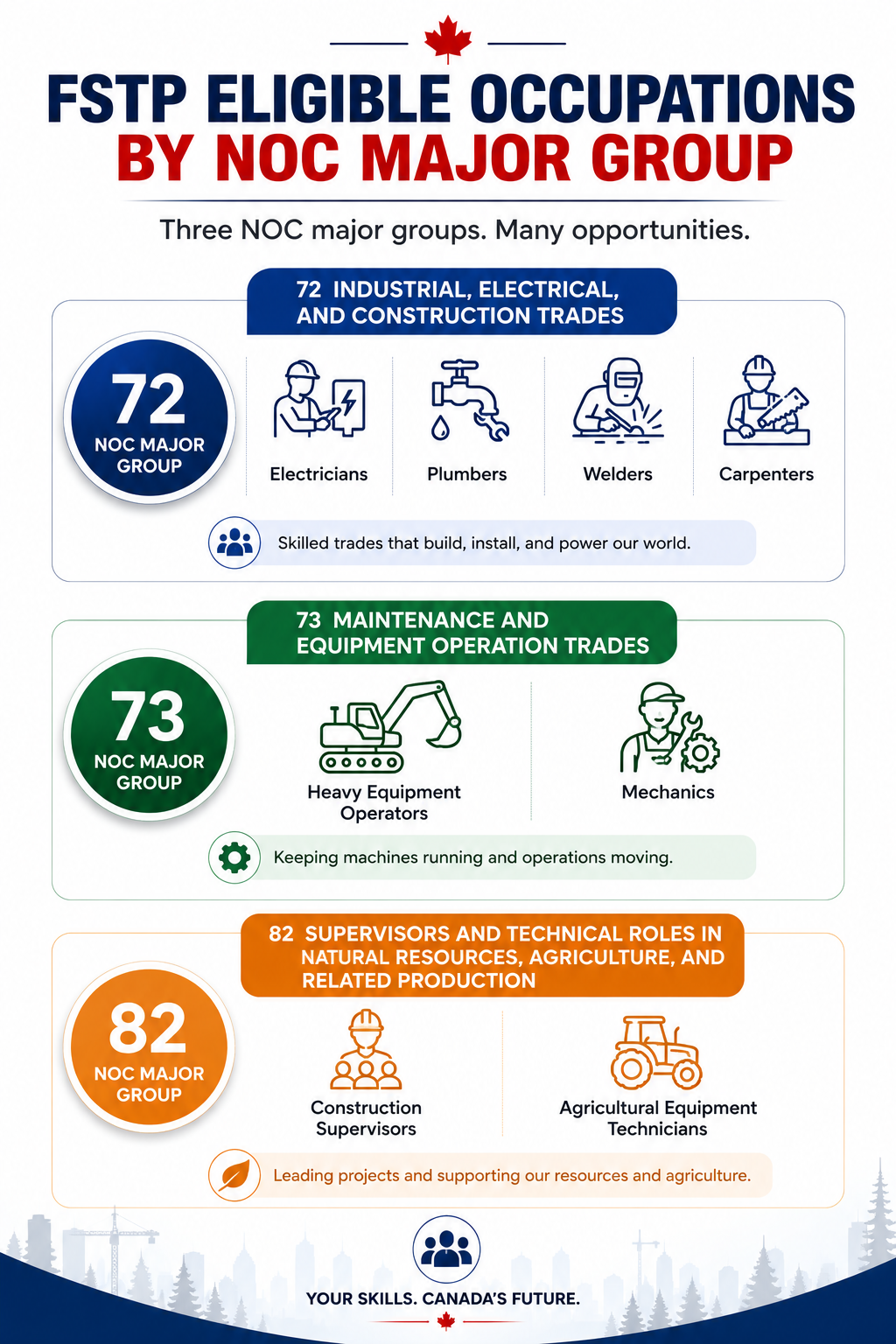
FSTP covers occupations classified under NOC TEER 2 and TEER 3, within three specific major groups: Major Group 72 (industrial, electrical, and construction trades — electricians, plumbers, welders, carpenters), Major Group 73 (maintenance and equipment operation trades — heavy equipment operators, mechanics), and Major Group 82 (supervisors and technical occupations in natural resources, agriculture, and related production). This is a narrower, trade-specific list compared to FSWP’s much broader TEER 0–3 eligibility.
NOC Major Group

Covers

Example Occupations

72

Industrial, electrical, construction trades

Electricians, plumbers, welders, carpenters

73

Maintenance and equipment operation trades

Heavy equipment operators, mechanics

82

Supervisors/technical roles, natural resources & agriculture

Construction supervisors, agricultural equipment technicians

Industrial electrician consistently ranks among the highest-paying skilled trades in Canada in 2026, with wages commonly reported between $42–$48 per hour ($85,000–$100,000+ per year), particularly in Alberta, Ontario, and Saskatchewan. Close behind are millwrights, steamfitters/pipefitters, elevator mechanics, and heavy equipment technicians, all Red Seal trades tied to industrial maintenance, energy, and infrastructure sectors where labour shortages are pushing wages well above the national average.

Trade

Typical Pay Range (CAD)

Industrial electrician

$42–$48/hr (~$85,000–$100,000+/yr)

Millwright / industrial mechanic

$35–$50/hr, often $100,000+/yr with overtime

Steamfitter / pipefitter

$26–$48/hr

Elevator mechanic

Among the highest-paid due to specialized licensing

Plumber (Red Seal, gasfitter-certified)

$32–$50/hr, experienced Red Seal plumbers often exceed $110,000/yr

Welder (specialized: underwater, pressure)

$33–$43/hr base, significantly higher for specialized certifications

This depends on what “easiest” means to you. For fastest entry into paid work, roles like construction labourer, HVAC helper, electrical helper, and flagger require minimal certification and can have you earning within days to a few months, often while training toward a full apprenticeship. For easiest full trade to learn and certify in, electrician is frequently cited by tradespeople themselves as more approachable than physically demanding trades like carpentry or flooring, despite requiring a multi-year apprenticeship like any Red Seal trade.

“Easiest” Meaning

Best-Fit Trades

Fastest paid entry (days–months)

Flagger, construction labourer, HVAC helper, electrical helper

Shorter full certification path

HVAC technician (6–12 month certificate options), painter

Widely reported as more approachable to learn

Electrician (per multiple contractor surveys)


Important for immigration purposes: none of these “easy entry” helper roles satisfy FSTP’s requirement on their own. FSTP needs 2 years of qualifying experience in an eligible NOC 72/73/82 occupation with a certificate or job offer, regardless of how quickly you can start earning in an entry-level role. A fast start can be a stepping stone toward a qualifying trade, but it isn’t a shortcut around FSTP’s core requirements.

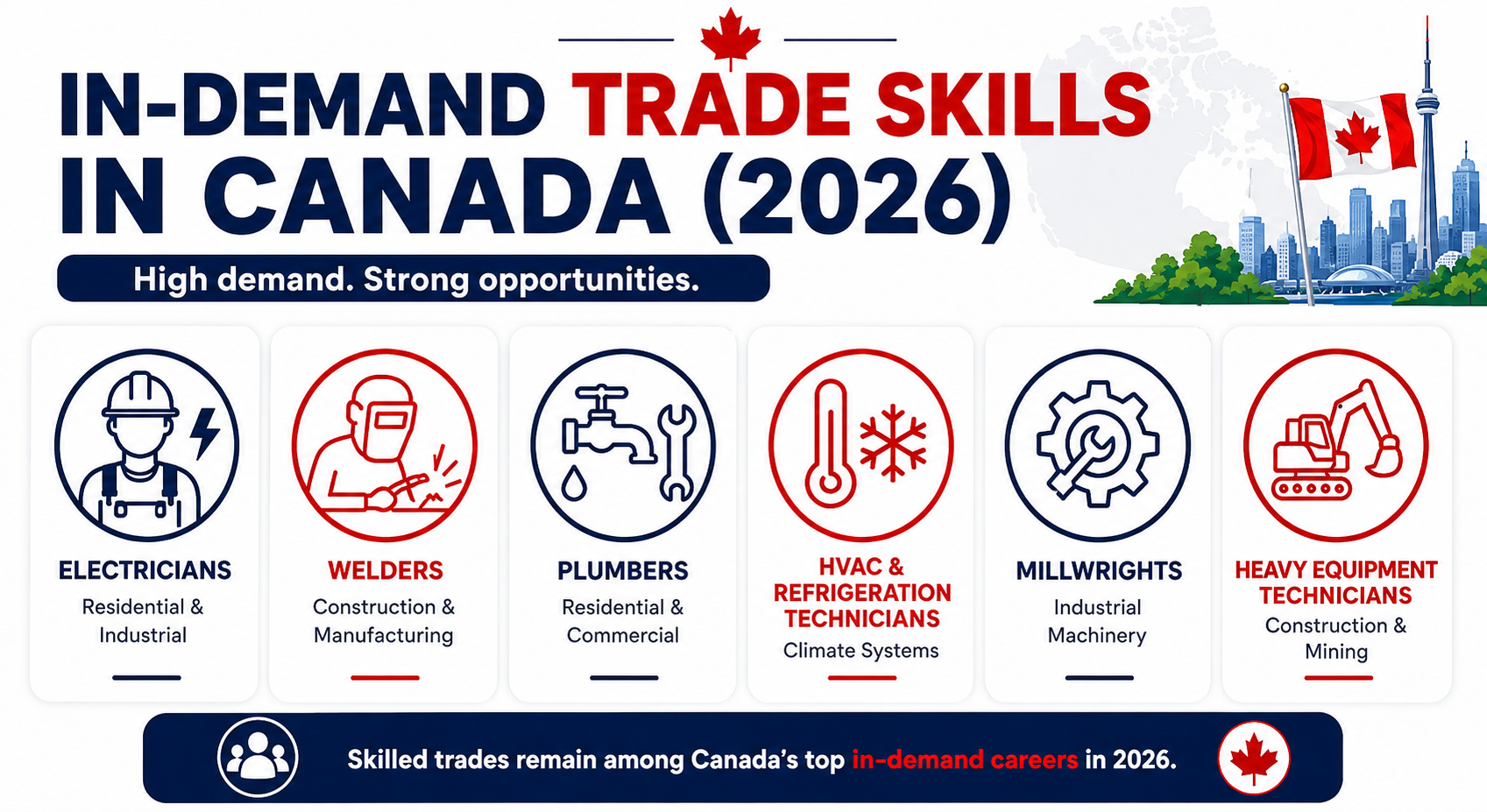
In 2026, the strongest-demand trade skills are electricians (both residential and industrial), welders, plumbers, HVAC/refrigeration technicians, millwrights, and heavy equipment technicians, all driven by infrastructure expansion, renewable energy projects, aging equipment replacement, and a wave of retiring tradespeople. These map closely to FSTP’s eligible NOC groups and are also frequent targets of Express Entry’s trades category-based draws.

In-Demand Trade

Driving Factor

Electricians

Renewable energy, urban expansion, industrial automation

Welders

Infrastructure, manufacturing reshoring, oil & gas

Plumbers

Residential/commercial construction, gasfitting demand

HVAC/refrigeration technicians

Climate control regulation, energy efficiency mandates

Millwrights

Industrial maintenance, manufacturing

Heavy equipment technicians

Construction, mining, agriculture

Following 2026 fee updates, the government fee is approximately $1,525 CAD for the principal applicant (including the Right of Permanent Residence Fee), $1,525 CAD for an accompanying spouse, and $260 CAD per dependent child. Additional costs to budget for include language testing, a provincial trade certification exam if pursuing that route instead of a job offer, and medical/police clearance requirements common to all Express Entry programs.

For PR purposes specifically, the strongest choices are trades that are both high-demand and clearly FSTP-eligible, electrician, welder, HVAC technician, plumber, and millwright courses lead directly to NOC codes within the FSTP-eligible major groups (72/73), and all have appeared in recent Express Entry trades category-based draws with meaningfully lower CRS cutoffs than general rounds. A course that leads to Red Seal certification is generally the strongest choice, since it’s the most portable, broadly recognized credential and improves your standing for both employer job offers and provincial certificate routes.

How to Choose a Trade Course With PR in Mind

  1. Confirm the resulting occupation is under NOC major group 72, 73, or 82, this is non-negotiable for FSTP eligibility.
  2. Prioritize Red Seal-eligible programs for maximum portability across provinces and stronger employer recognition.
  3. Check recent Express Entry trades category draws for your target occupation’s typical CRS range, some trades are hit more consistently than others.
  4. Weigh course length against your timeline: FSTP requires 2 years of qualifying work experience regardless of course length, so a shorter certificate program (HVAC) versus a longer apprenticeship (electrician, ~4–5 years) affects how soon you can start accumulating that experience.

Red Seal is an interprovincial standard that lets certified tradespeople in specific designated trades work across most Canadian provinces and territories without needing to re-certify in each one. It’s not strictly required for FSTP eligibility; a provincial certificate of qualification (without Red Seal endorsement) or a qualifying job offer can satisfy FSTP’s requirements on their own. However, Red Seal certification is widely recommended for tradespeople planning to work across multiple provinces or seeking maximum employer recognition of their credentials, since it’s the most portable and broadly respected trade credential in Canada.
You need one of the two, not both: either a valid full-time job offer in your trade lasting at least 1 year, from no more than two Canadian employers, OR a certificate of qualification in your trade, issued by a Canadian provincial, territorial, or federal authority. Many trades candidates without a Canadian job offer pursue the certificate route by having their foreign qualifications and experience assessed against provincial trade standards, then completing a certification exam.

FSTP has a notably lower language bar than FSWP: a minimum of CLB 5 for speaking and listening, and just CLB 4 for reading and writing, compared to FSWP’s flat CLB 7 requirement across all four abilities. This reflects the program’s recognition that trades occupations, while highly skilled, don’t always require the same formal-language demands as office-based professional roles. Accepted tests are the same as other Express Entry programs: IELTS or CELPIP for English, TEF Canada or TCF Canada for French.

You need at least 2 years of full-time work experience (or the part-time equivalent) in an eligible trades occupation, completed within the last 5 years, longer than FSWP’s 1-year requirement, reflecting the more hands-on, apprenticeship-based nature of trades work. Your experience must demonstrate you performed the actual duties listed in the NOC for your specific trade, and it’s strongly advisable that this experience come from a jurisdiction where you were legally qualified to practice the trade. Student work experience and volunteer roles do not count.

No. Unlike FSWP, which awards up to 25 points for education on its 67-point grid, FSTP has no formal education requirement at all. What matters instead is demonstrated trade competency, through work experience, an employer’s job offer, or a provincial certificate of qualification. This makes FSTP a genuinely accessible route for skilled tradespeople whose expertise was built through apprenticeship and on-the-job training rather than formal schooling.

All three are Express Entry programs sharing the same CRS ranking system, but each has different eligibility gates. FSTP targets trades specifically (NOC 72/73/82), needs 2 years’ experience, a job offer or certificate, and CLB 5/4, with no education requirement or points grid. FSWP covers broader TEER 0–3 occupations, needs 1 year’s foreign experience, CLB 7, and passing a separate 67-point grid. CEC requires 1 year of Canadian work experience specifically, with language requirements varying by TEER level (CLB 7 for TEER 0/1, CLB 5 for TEER 2/3), and no separate points grid.


FSTP

FSWP

CEC

Eligible occupations

NOC 72, 73, 82 only

NOC TEER 0–3, broad

Any TEER 0–3 with Canadian experience

Work experience needed

2 years, last 5 years

1 year, last 10 years

1 year, last 3 years (Canadian)

Foreign experience counts

Yes

Yes

No — Canadian only

Job offer/certificate required

Yes (one or the other)

No (optional, adds points)

No

Language requirement

CLB 5/4

CLB 7 (all abilities)

CLB 7 or 5 depending on TEER

Separate points grid

No

Yes (67-point grid)

No

Education requirement

None

Up to 25 points on grid

None

Trades candidates benefit from IRCC’s trades category-based draws, which run at meaningfully lower cutoffs than general rounds. The first 2026 trades-specific draw (Draw #408, April 2, 2026) invited 1,500 candidates at a CRS cutoff of 477, well below the low-500s typically required in general/CEC draws. Trades candidates who don’t get invited through a category draw can still receive an invitation through general all-program rounds, but at the higher general cutoff, so a strong trades-category profile is usually the faster route.


Once invited and a complete application is submitted, FSTP follows the standard Express Entry federal processing timeline of around 6 months, the same as FSWP and CEC. Standalone FSTP-specific draws are rare; most FSTP-eligible candidates actually receive their invitation through general all-program draws or the trades category-based draws, rather than a dedicated FSTP-only round, so tracking overall draw activity (not just “FSTP draws” specifically) gives a more accurate picture of your realistic timeline.

Contact the regulatory body for your specific trade in the province or territory where you intend to work, submit your training, qualifications, and work experience for assessment, and, if deemed eligible, sit the certification exam to earn your certificate of qualification. This process runs independently of your Express Entry or FSTP application and can take weeks to several months depending on the trade, province, and how directly your foreign credentials map to Canadian standards, so it’s worth starting well before you plan to submit an Express Entry profile.

Generally yes, unless you already have a valid job offer with authorization to work in Canada, the same exemption structure used across FSWP. If required, settlement funds scale by family size, following the same federal Express Entry table used for FSWP, starting at roughly $15,263 CAD for a single applicant.

Like FSWP and CEC, FSTP is included in IRCC’s April 2026 Forward Regulatory Plan proposing to retire all three individual programs and replace them with a single unified “Federal High-Skilled Class.” Under the early proposal, eligibility across all merged programs would simplify to 1 year of skilled work experience or a validated job offer, plus a minimum CLB 6, which would actually represent a higher language bar than FSTP’s current CLB 5/4 if implemented as currently proposed. Consultations ran through May 2026 with nothing finalized; trades candidates who currently qualify under FSTP’s existing rules shouldn’t delay applying based on this unconfirmed proposal.