
+91 9310106988
mail@pioverseas.com
Item | Current position |
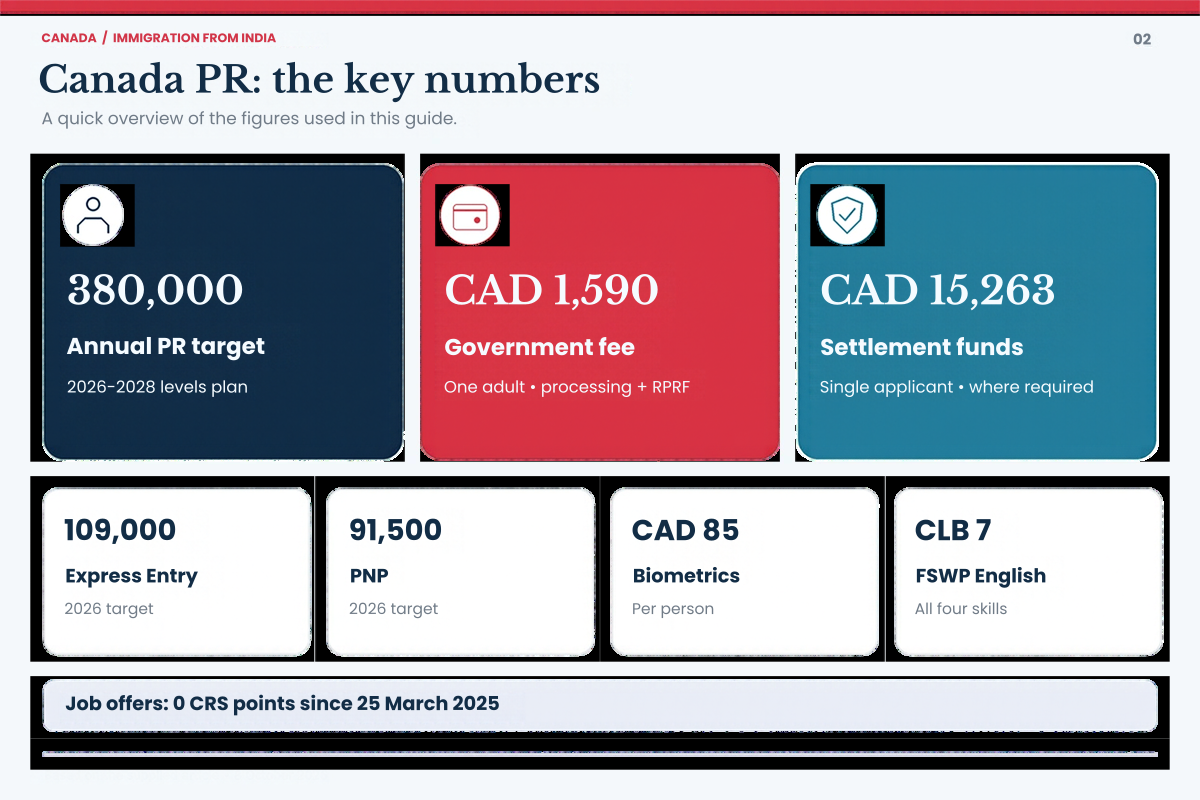
Annual PR target | 380,000 a year from 2026 to 2028 |
Express Entry share of that target | 109,000 in 2026 |
PNP share | 91,500 in 2026, up from 55,000 in the earlier plan |
IRCC fee, one adult | CAD 990 processing + CAD 600 right of permanent residence fee = CAD 1,590 |
Fee for each dependent child | CAD 270 |
Biometrics | CAD 85 per person, CAD 170 maximum per family |
Settlement funds, single applicant | CAD 15,263 (not needed for the Canadian Experience Class) |
Minimum English for the Federal Skilled Worker Program | CLB 7 in all four skills |
Job offer needed? | No. A job offer has added no CRS points since 25 March 2025 |
Time to decide a file | IRCC’s target is about six months for Express Entry |
There is no single best route. The right one depends on where you work, what language you can prove and whether you have any Canadian connection.
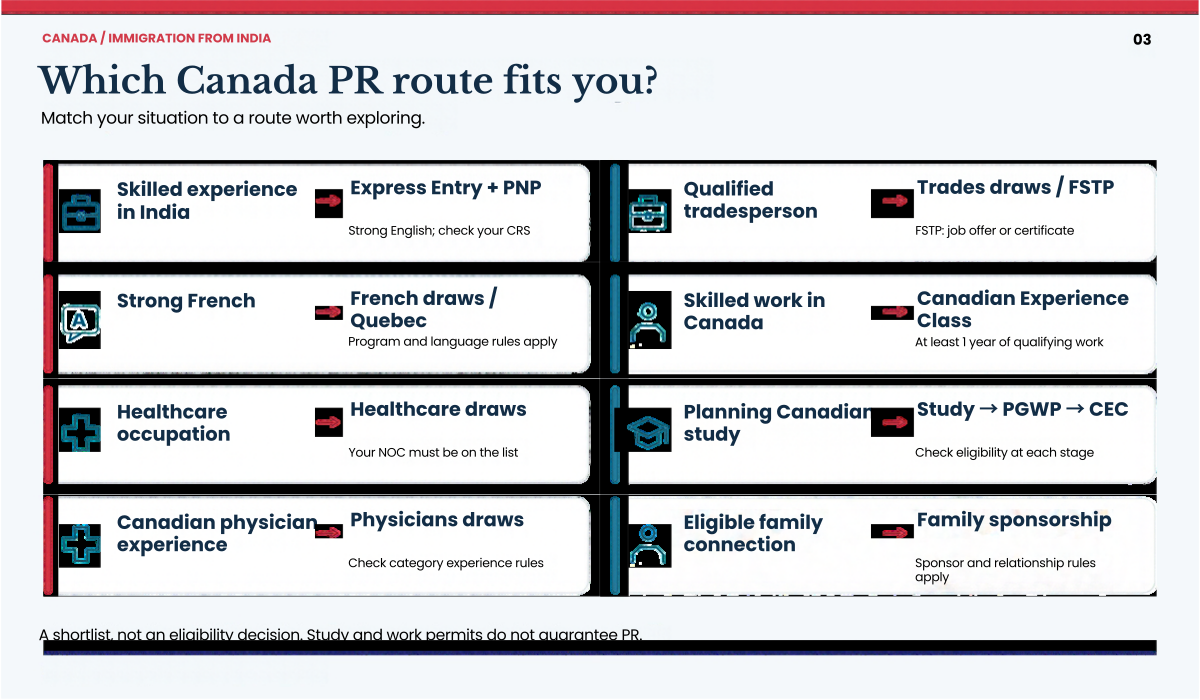
| Your situation | Route to look at first | What to know |
| Working in India, degree, three or more years of skilled experience, strong English, no Canadian link | Express Entry plus a PNP | Score alone has not been enough for general profiles in 2026. French or a nomination changes the picture |
| You speak French at a good level | Express Entry French-language draws, or Quebec | French draws have had some of the lowest cut-offs this year |
| Nurse, pharmacist, dentist, social-services professional or another listed health occupation | Healthcare and social services draws | Latest cut-off was about 475 |
| Physician with at least 12 months of Canadian experience | Physicians draws | The June 2026 cut-off was 223 |
| Electrician, welder, plumber or another listed trade | Trades draws, Federal Skilled Trades Program | Latest cut-off was 476. The program needs a job offer or a certificate of qualification |
| Working in Canada for a year or more | Canadian Experience Class | The September draw cut-off was 518 |
| CRS in the middle range and an occupation a province wants | Provincial Nominee Program | A nomination adds 600 points |
| Planning to study in Canada first | Study permit, then Post-Graduation Work Permit, then CEC | Study permits are being cut sharply in 2026 |
| Spouse, partner, parent or child is a Canadian citizen or PR | Family sponsorship | Run by the sponsor, not points-based |
Canada’s immigration policy decides how many people it admits each year, which groups get priority and how people are chosen. The government publishes it as the Immigration Levels Plan, which sets targets for the next three years.
Yes. Canada plans to admit 380,000 new permanent residents in 2026, with 109,000 through Express Entry and 91,500 through provincial programs. The target is lower than in earlier plans and selection is tighter. Permit numbers for students and temporary workers are being cut, so a route that depended on them is harder now than it was two years ago.
The main law is the Immigration and Refugee Protection Act, along with its regulations. Together they set out the immigration classes (economic, family, refugee), who is inadmissible for health, security, criminal or misrepresentation reasons, and what immigration officers can decide. Citizenship sits under a separate Citizenship Act.
Federal and provincial governments share responsibility. Provinces nominate workers through their PNPs, and Quebec selects its own economic immigrants. Employment standards, such as minimum wage and notice periods, are also set by the provinces. Programs like Express Entry run under ministerial instructions, which change faster than the law itself, so the rules on this page can change without a new Act.
Express Entry is the online system IRCC uses to manage three federal economic programs. You create a profile, get a CRS score and wait to be invited. If you are invited, you have 60 days to submit a complete application. Your profile stays in the pool for 12 months. Our Express Entry guide goes deeper on each step.
For skilled workers with experience outside Canada. You need at least one year of continuous skilled work (TEER 0 to 3) in the last ten years, CLB 7 in all four language skills, a secondary school credential (with an ECA if your education is foreign), 67 of 100 on the eligibility grid, and proof of funds. See the full FSWP guide.
For qualified tradespeople. You need two years of experience in a skilled trade in the last five years, either a job offer or a Canadian certificate of qualification, minimum language levels, and proof of funds unless you hold a job offer. See the FSTP guide.
For people who have worked in Canada. You need one year of skilled Canadian work in the last three years. The language level depends on the job’s TEER category, and you don’t need to show funds. See the CEC guide.
The 67-point grid and the CRS are different things. The grid decides whether you can enter the pool under the Federal Skilled Worker Program. The CRS decides whether you are invited. People often pass the first and then find their CRS is nowhere near a cut-off.
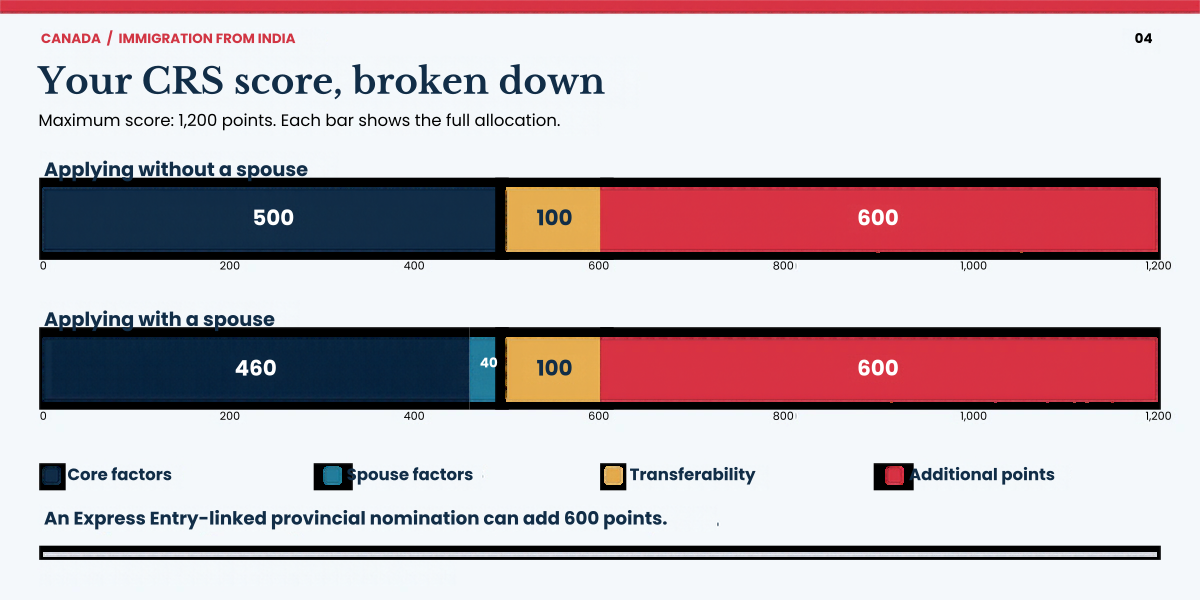
The CRS is out of 1,200 points.
| Part of the score | Maximum | What counts |
| Core human capital | 500 if single, 460 with a spouse | Age, education, English and French ability, Canadian work experience |
| Spouse factors | 40 | Spouse’s education, language and Canadian experience |
| Skill transferability | 100 | Education and work experience combined with strong language scores |
| Additional points | 600 | Provincial nomination (600), Canadian study (15 or 30), sibling in Canada (15), French (up to 50) |
Age matters a lot. A single applicant gets the most age points from 20 to 29 and loses points each year from 30.
Take a 29-year-old with a four-year B.Tech, four years of experience in a skilled IT role, and IELTS General Training scores of 8.0 listening, 7.0 reading, 7.0 writing and 7.0 speaking (CLB 9). They apply alone, with no French and no Canadian experience.
| Factor | Points |
| Age 29 | 110 |
| Education (bachelor’s degree, three years or more) | 120 |
| First language, CLB 9 | 124 |
| Skill transferability: education with language | 25 |
| Skill transferability: foreign work experience with language | 50 |
| Total | about 429 |
In the latest draws that score is below the CEC cut-off (518), the trades cut-off (476) and the healthcare cut-off (475). The French category invited candidates between roughly 380 and 420 since May, but only candidates with French at NCLC 7 or higher in all four skills. Add that French level and the same candidate gains second-language points plus up to 50 bonus points, which puts the total near 490. A provincial nomination would take the score past 1,000.
Since 2023, IRCC has held draws for specific occupations or language groups alongside draws for the whole pool. Cut-offs are often much lower in these draws, but you only qualify if you meet the category’s definition. Your occupation must match a listed NOC code. “In demand” in the news doesn’t count unless the code is on the list. Our NOC code guide explains how to find yours.
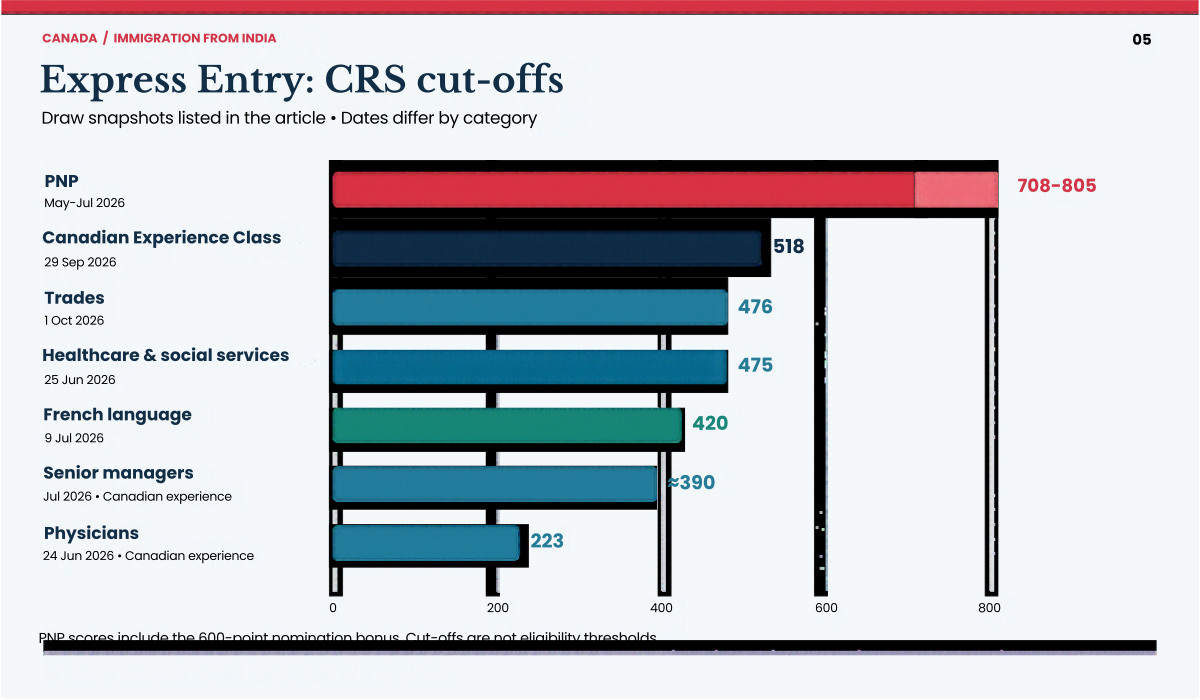
| Draw | Latest cut-off | Invitations | Date |
| Canadian Experience Class | 518 | 2,000 | 29 September 2026 |
| Trades | 476 | 3,500 | 1 October 2026 |
| Healthcare and social services | 475 | 3,500 | 4 September 2026 |
| French language | 382 | 5,000 | 19 August 2026 |
| Transport | 470 | 300 | 7 August 2026 |
| Senior managers (Canadian experience) | 389 | 250 | 16 September 2026 |
| Physicians (Canadian experience) | 198 | 229 | 3 September 2026 |
| Provincial Nominee Program | 772 | 752 | 13 October 2026 |
The PNP cut-offs look high because a nomination adds 600 points, and only nominees are invited in those rounds. For the live list, see IRCC’s rounds of invitations page. We update this table after each draw.
Mostly no. The main skilled routes don’t require one, though a job can help in specific ways. These are the questions people ask most.
No. Canada has no general employer-sponsorship rule for permanent residence. With Express Entry you apply on your own profile, and most provincial programs nominate you for your skills. Employer sponsorship does exist for temporary work permits and for a few PR routes such as the Atlantic Immigration Program, where a designated employer has to offer you a job.
No. Not having a job offer is not a reason for refusal under the Federal Skilled Worker Program, the Canadian Experience Class or most provincial streams. Refusals come from low points, missing documents, weak language scores or proof-of-funds problems. The Federal Skilled Trades Program is the exception, because it needs a job offer or a certificate of qualification.
Yes. Express Entry’s Federal Skilled Worker Program and Canadian Experience Class work without one, as do most provincial streams for skilled workers, Quebec’s PSTQ and family sponsorship. The route table near the top of this page shows which fits which profile, and the Express Entry and PNP guides cover the detail.
A job offer adds no CRS points. Before 25 March 2025 a valid offer was worth 50 or 200 points, depending on the job. Offers still matter in three ways. On the Federal Skilled Worker eligibility grid, arranged employment can still earn up to 10 of the 67 points. A valid offer, with permission to work in Canada, removes the proof-of-funds requirement. And the Federal Skilled Trades Program requires an offer or a certificate of qualification. Some provincial streams are also employer-driven.
It can be, but the job matters less than the occupation code. If your NOC code has its own Express Entry category, such as healthcare or the trades, cut-offs have been lower than in general draws. Provinces also invite from occupation lists. A job in a field with no category gives you no edge. The in-demand jobs section further down shows which fields have categories.
Usually not. Getting an offer from abroad is hard, a valid offer often needs an LMIA the employer has to obtain, and it no longer adds CRS points. Your time is better spent on your language score, your ECA and your profile. A job offer is worth chasing only when your route needs one: the trades program, the Atlantic program, an employer-driven provincial stream or a work permit.
Strict about proof, flexible about whether you have a job offer. Experience has to be paid, skilled (TEER 0 to 3), at least 30 hours a week, and continuous for the period required. That works out to 1,560 hours for one year of full-time work. Officers can ask for letters, payslips and tax records, and duties that don’t match the NOC code are a common reason for refusal.
Most provinces and territories run their own PNP. Each one nominates workers whose skills match local shortages. Quebec has a separate system, covered in the next section. Our Canada PNP guide covers streams in more detail.
There are two kinds of stream. An enhanced stream is linked to Express Entry: the province nominates you from the pool, your CRS goes up by 600 points and IRCC invites you in a PNP draw. A base stream is separate: you apply to the province, and if you are nominated you then file a PR application with IRCC. Base applications usually take longer.
Each province sets its own streams, fees and processing times, and changes its priorities often. Use this table to narrow the field, then read the province’s own page.
| Province | Where to look |
| Ontario (OINP) | Express Entry-linked streams for priority occupations including tech, trades and health |
| Alberta (AAIP) | A stream for Express Entry candidates and a stream for people already working in Alberta |
| British Columbia (BC PNP) | Skills Immigration streams with an Express Entry option, with tech and health priorities |
| Saskatchewan (SINP) | Express Entry and in-demand occupation streams |
| Manitoba (MPNP) | Skilled worker streams that usually need a link to Manitoba, such as a relative, past study or work, or an invitation |
| Nova Scotia, New Brunswick, PEI, Newfoundland and Labrador | Smaller programs, often tied to employers or labour-market priorities. The Atlantic Immigration Program is separate |
| Yukon | A small program, mostly employer-driven |
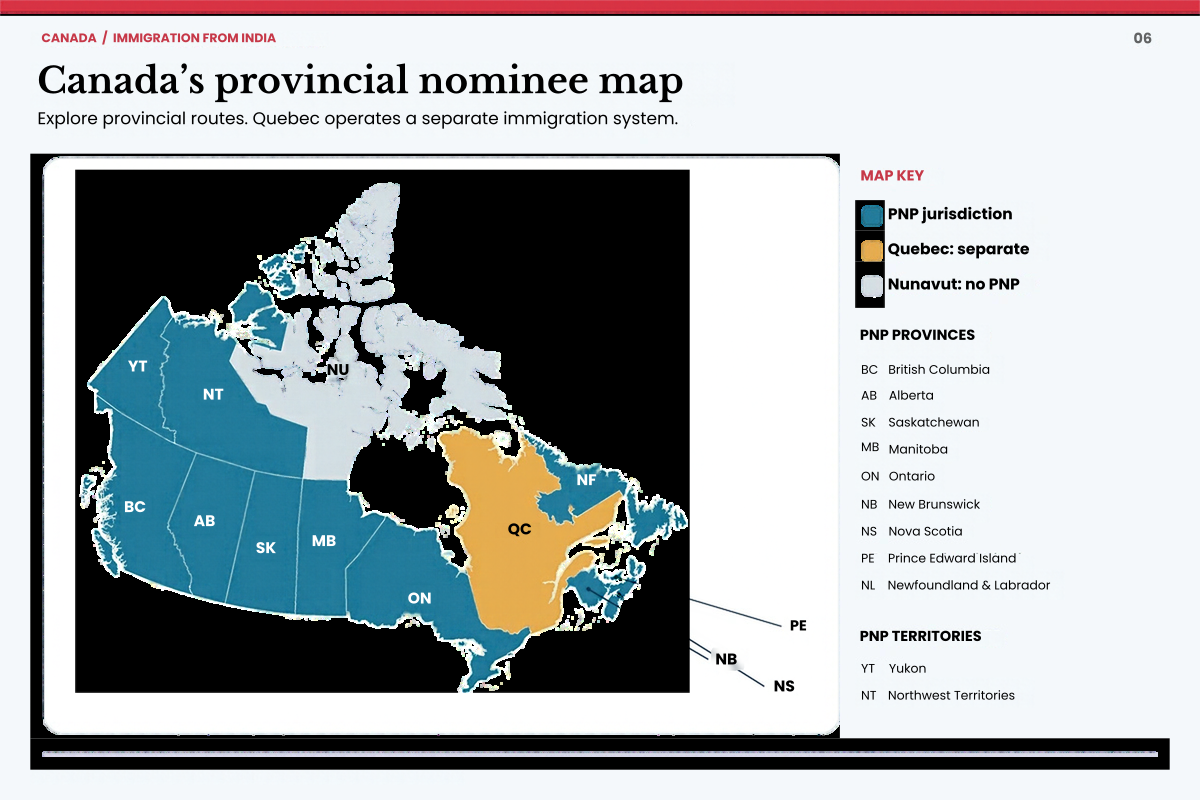
A nomination is a recommendation, not an application for PR. You still need to meet IRCC’s admissibility rules, and you are expected to live in the province that nominated you.
Every province with a PNP recruits, but how actively changes from year to year. The 2026 Levels Plan raised the provincial allocation to 91,500, so provinces have more nominations to give than before. Ontario, Alberta, British Columbia, Manitoba and Saskatchewan run the larger programs. The Atlantic provinces recruit hard for health, construction and trades workers, often through employer-linked streams and the Atlantic Immigration Program. Quebec selects separately.
Streams open and close, and priority occupations change, so read each province’s current page before choosing: Ontario, Alberta, British Columbia, Manitoba, Saskatchewan, Nova Scotia and New Brunswick.
Quebec chooses its own economic immigrants. Skilled workers apply through the Skilled Worker Selection Program, known as the PSTQ, which replaced the Quebec Skilled Worker Program (QSWP) in November 2024. You submit a declaration of interest through Quebec’s Arrima portal, and the province invites candidates in rounds. If you are selected you receive a Quebec Selection Certificate (CSQ), then apply to IRCC for permanent residence, where IRCC runs medical and security checks.
French ability carries heavy weight. If you don’t speak French, Quebec is rarely a realistic first choice. See our Quebec skilled worker guide for the current process.
Yes, but the route is narrower than skilled-worker immigration. The main federal option is the Start-Up Visa, which needs a letter of support from a designated organisation such as a venture fund, angel group or business incubator, a qualifying business, language ability at CLB 5 and settlement funds. Some provinces run their own entrepreneur streams with investment and business-plan rules. Starting a company doesn’t give you PR by itself, and most applicants without backing won’t qualify. Start-Up Visa intake has been limited in recent years, so check whether IRCC is currently accepting new applications before you plan around it.
Many Indians living in the US on an H-1B, L-1 or OPT, or waiting in a green card queue, look at Canada. Your eligibility depends on your own profile, not on where you live.
Yes. Express Entry doesn’t ask for a job offer, and living in the US doesn’t change your eligibility. Skilled work you did in the US counts as foreign experience if it is a TEER 0 to 3 job. You still need an ECA for your degree, even a US one. Expect to provide a police certificate from the US (an FBI check) and one for India, since you lived there.
No. US citizens can visit Canada without a visa for up to six months, but they can’t live or work there without status. They need permanent residence, for example through Express Entry, a provincial program or family sponsorship, or a work permit. The TN category under CUSMA is open to US and Mexican citizens only, so Indian citizens in the US can’t use it. Indian citizens usually need a visa or eTA to enter Canada even if they live in the US.
Most economic routes assess the same things: age, education, language, work experience and money. The sections below take each in turn.
Yes. Express Entry and most provincial streams have no upper age limit. Age only affects points. A single applicant gets 110 CRS points for age between 20 and 29, about 50 at age 40, and none from age 45.
You can make up the gap. Higher language scores (CLB 9 or above), French, a master’s degree, Canadian work experience or a provincial nomination, which adds 600 points, all move the score more than age takes away. If your spouse’s profile scores higher than yours, they can be the principal applicant.
The Federal Skilled Worker Program needs at least a secondary school credential. If your education is from India, you need an Educational Credential Assessment (ECA) from an organisation IRCC designates. Degrees earn more points than a school certificate does, and a master’s earns more than a bachelor’s.
The Federal Skilled Worker Program needs one year of continuous, skilled work in the last ten years. The Federal Skilled Trades Program needs two years in the trade in the last five. The Canadian Experience Class needs one year of skilled Canadian work in the last three. Provincial streams often ask for one to two years in the occupation.
More experience earns more points. Foreign experience combined with strong language scores reaches its maximum at three years, and Canadian experience scores up to five years. Full-time means at least 30 hours a week, and the job has to be paid and fall under TEER 0, 1, 2 or 3.
Canada classifies jobs under the National Occupational Classification (NOC). IRCC matches you on what you actually did, not on your job title. A title like “Senior Associate” or “Executive” tells an officer nothing. The main duties in the NOC code have to describe your real work, and your reference letters have to back that up. Use our NOC code guide to find yours.
Check five things.
If you can’t settle on a code, ask a Regulated Canadian Immigration Consultant before you build your profile. A wrong code is among the most common causes of refusal.
Canada scores measurable things. The strongest are language ability (CLB 9 or higher, and French if you have it), education (a master’s or two credentials), age under 30, Canadian work or study experience, skilled work in an occupation with its own draw, and a provincial nomination. Soft skills help you in interviews and at work but earn no CRS points. The quickest thing to improve is your language score, which is why many applicants retake the test.
That depends on the job. About one in five jobs in Canada is regulated, including nursing, medicine, engineering, teaching, law, accounting and the skilled trades. For those you need to register with the provincial or territorial regulator, which usually means credential assessment, exams and sometimes a bridging course. Nurses, for example, start with the National Nursing Assessment Service. Tradespeople may need a Red Seal certification.
Jobs that aren’t regulated, such as most IT, marketing and sales roles, need no licence, though employers may value a certificate such as PMP or a cloud certification. An ECA is for immigration and is not a licence to practise. Start the licensing process as early as the regulator allows. It often takes longer than the immigration application.
Everyone needs an approved test taken within the last two years.
Levels are expressed as Canadian Language Benchmarks (CLB). For IELTS General Training:
| CLB | Listening | Reading | Writing | Speaking |
| 7 | 6.0 | 6.0 | 6.0 | 6.0 |
| 8 | 7.5 | 6.5 | 6.5 | 6.5 |
| 9 | 8.0 | 7.0 | 7.0 | 7.0 |
| 10 | 8.5 | 8.0 | 7.5 | 7.5 |
CLB 7 is the floor for the Federal Skilled Worker Program. Every step up to CLB 9 adds real points, both directly and through skill transferability, so a retake is often the cheapest way to raise a score.
If you apply under the Federal Skilled Worker or Trades program, IRCC’s table, last updated 7 July 2025, requires CAD 15,263 for one person and CAD 28,362 for a family of four. Other family sizes are in IRCC’s proof of funds table. You don’t need a job to meet the requirement, since the money is meant to cover you until you find work.
You don’t have to show funds under the Canadian Experience Class, or if you hold a valid job offer and are already authorised to work in Canada. The funds earn no CRS points, and they must be yours, available and free of debt. Borrowed money doesn’t count, and neither does equity in property.
Get an official letter from your bank on its letterhead. It should show your name, the account numbers, the dates the accounts were opened, the current balance and the average balance over the past six months. Fixed deposits are usually accepted when the letter covers them.
Add recent bank statements. If a relative helps you with the money, keep a signed gift letter and the transfer record. A large deposit that appears just before you apply invites questions, so keep your accounts steady for the months beforehand and be ready to explain anything unusual.
There is no fixed list of conditions that disqualify you automatically. IRCC refuses on health grounds only when a condition is likely to be a danger to public health, a danger to public safety, or an excessive demand on health or social services. An officer decides based on your medical exam, case by case.
Excessive demand means the care you are expected to need would cost more than a threshold IRCC publishes. Conditions that sometimes raise questions include active tuberculosis, which is treatable and needs follow-up, and illnesses that need long-term care or very expensive treatment. If IRCC has concerns, it sends you a letter and you can respond with a plan for how you would cover the costs. Sponsored spouses, partners and children are exempt from the excessive demand rule, but skilled worker applicants are not.
You and your family also provide police certificates. Serious criminal records and misrepresentation can make you inadmissible.
Express Entry usually has no interview. The questions are in the forms: employer name, job title, dates, hours per week, duties, salary, NOC code and a contact at the company. Officers may ask for more documents, check with your employer, or in rare cases ask for an interview. Describe your duties in the same words in your profile, your reference letters and your payslips. Mismatches between them are what draw attention. Officers can also ask about your job when you land.
A partner’s job offer adds no CRS points. What counts is their education, language scores and any Canadian experience, worth up to 40 points in total. If your partner’s profile scores higher than yours, you can make them the principal applicant. A partner who has worked in Canada for a year in a skilled job may qualify for the Canadian Experience Class on their own. If your partner is a Canadian citizen or permanent resident, that is family sponsorship, which depends on the relationship and the sponsor’s status, not on their job.
| Document | What to watch in India |
| Passport | Your name must match across passport, degree, employer letters and test reports. Fix any variation now with an affidavit or gazette notice where needed |
| ECA report | WES is the most used body for Indian degrees, and IQAS, ICAS and others are also designated. Your university usually has to send transcripts directly, which is the slow part. Expect roughly CAD 240 to 340 depending on the report and courier. Reports are valid for five years |
| Language test result | IELTS General Training, CELPIP-General or PTE Core. Valid for two years |
| Employment reference letters | On company letterhead, signed, naming your job title, main duties, start and end dates, hours per week, salary and a contact at the company. Back them with appointment letters, payslips, Form 16 and bank statements showing salary credits. If the company has closed, ask a consultant about a statutory declaration |
| Proof of funds | An official bank letter on letterhead showing account details and balance, with the average balance over the past six months. Fixed deposits are usually accepted if the bank letter covers them |
| Police certificates | For India, apply online through Passport Seva. You also need one from every country where you lived for six months or more since age 18 |
| Medical exam | Done by an IRCC-approved panel physician. India has many. Results are valid for 12 months |
| Photos | Match IRCC’s specifications. Studio photos usually pass |
| Civil documents | Birth and marriage certificates for you and your family, and your spouse’s ECA if you claim spouse points |
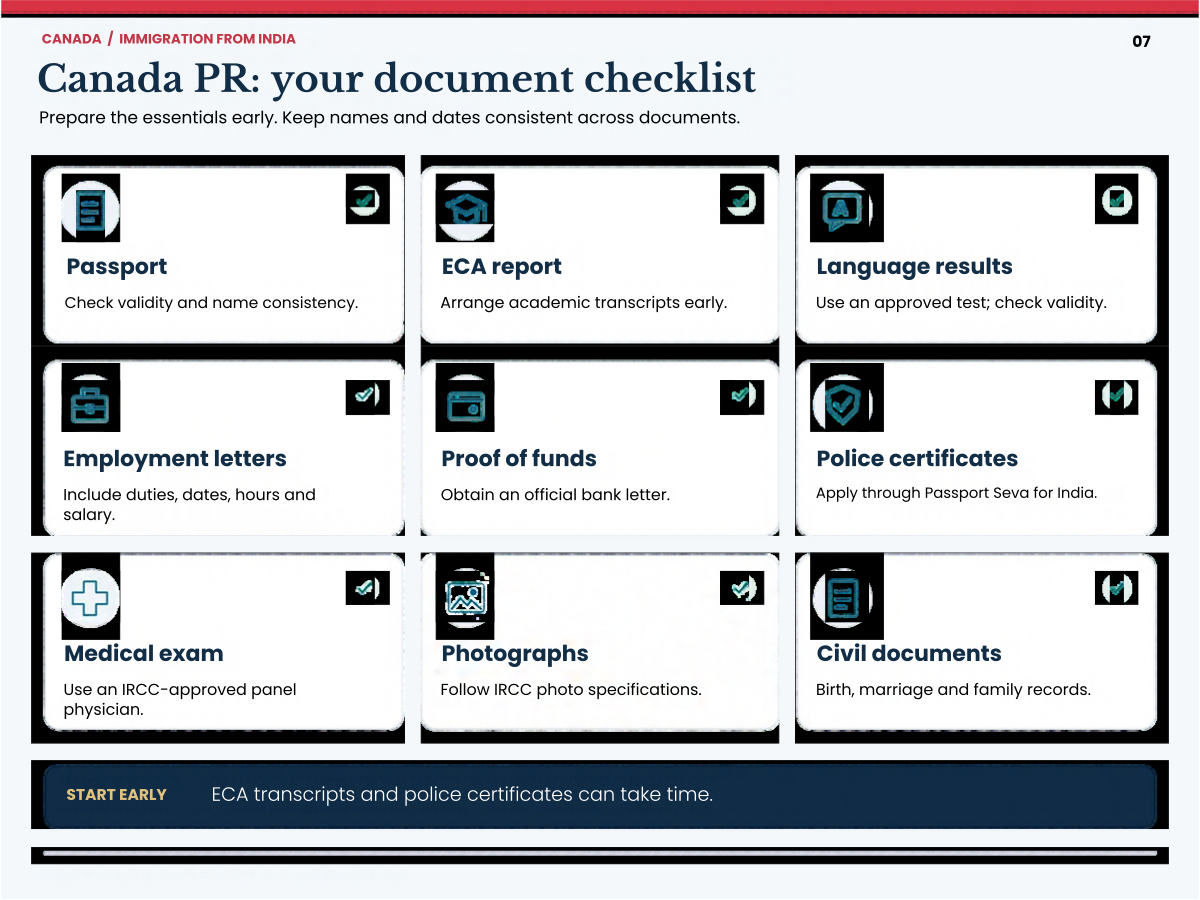
Order the ECA and police certificates early. They take the longest, and the 60-day window after an invitation is short.
How to immigrate to Canada comes down to nine steps, from choosing a route to landing as a permanent resident.
| Step | What you do | Time and cost |
| 1 | Choose a route and estimate your CRS score | A few hours. Free with IRCC’s CRS tool or a call with our team |
| 2 | Take IELTS General Training, CELPIP or PTE Core (or a French test) | Booking to result is usually one to three weeks. Price set by the test provider |
| 3 | Get your ECA | Allow six to ten weeks including document delivery |
| 4 | Create your Express Entry profile, or apply to a province’s stream | Free to create the profile. Accuracy matters more than speed |
| 5 | Get a provincial nomination, if you are going that way | Depends on the province |
| 6 | Receive an Invitation to Apply (ITA) | You then have 60 days |
| 7 | Submit the full application, documents, fees and biometrics | CAD 1,590 per adult plus CAD 85 biometrics per person |
| 8 | Complete the medical exam and answer any IRCC requests | IRCC aims for about six months from a complete file |
| 9 | Receive your Confirmation of Permanent Residence and travel to land | Land before the document expires |
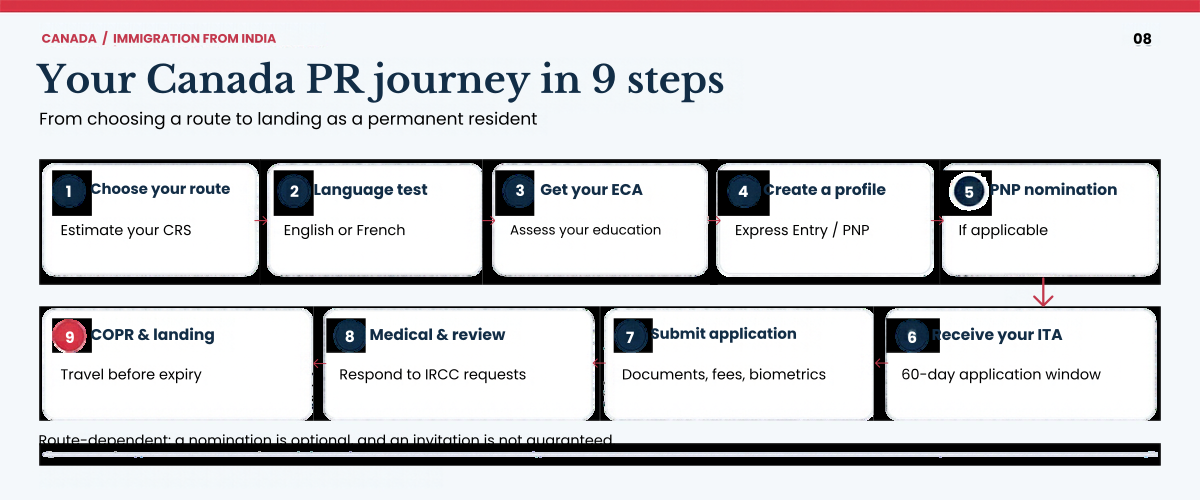
From a complete application, IRCC aims to finish most Express Entry files in about six months. Real times vary. They run longer if IRCC asks for more documents, if your medical or police certificates are late, or if a security check takes time. Base PNP streams generally take longer than Express Entry-linked ones, because you wait for the province first and then for IRCC.
The six months start when IRCC receives a complete application, not on the day you are invited. Use IRCC’s processing times tool for the current estimate for your program.
For one adult applying through Express Entry, the government fees come to CAD 1,590 plus CAD 85 for biometrics. Tests, the ECA, the medical exam and police certificates add to that.
| Item | Amount | Note |
| IRCC processing and RPRF, one adult | CAD 1,590 | CAD 990 + CAD 600. The RPRF is refunded if PR is refused |
| Spouse or partner | CAD 1,590 | Same fee as the main applicant |
| Each dependent child | CAD 270 | No RPRF for children |
| Biometrics | CAD 85 per person | CAD 170 maximum for a family |
| ECA | About CAD 240 to 340 | Depends on the report and courier |
| Language test | Set by the provider | Check the test centre’s current fee. Budget for a retake |
| Medical exam | Set by the panel physician | Charged per person |
| Police certificates | Low in India | Higher for other countries |
| Translations | Varies | Only for documents not in English or French |
| Provincial application fee | Varies by province | Some provinces charge, some don’t |
| Settlement funds | CAD 15,263 for one person | Not a cost, but the money must sit in your account |
You don’t have to use a consultant, and IRCC gives no priority to applications that have one. If you do hire one, fees are separate and should be in a written agreement.
“In demand” means two different things. Some occupations are in demand for immigration, meaning IRCC and the provinces select them through category draws and occupation lists. Others are in demand with employers who are hiring. They overlap but aren’t the same.
| Field | Category | Note |
| Nurses, pharmacists, dentists, psychologists and other health and social-services roles | Healthcare and social services | Latest cut-off was 475 |
| Electricians, welders, plumbers and other trades | Trades | Latest cut-off was 476 |
| Truck drivers and some logistics roles | Transport | New for 2026. Latest cut-off was 470 |
| Teachers in listed roles | Education | Renewed for 2026 |
| Software, data and engineering roles | STEM | The category exists, but there has been no STEM draw since April 2024. Look at CEC, a PNP or a French route instead |
| Physicians, researchers and senior managers | Dedicated categories | Each needs at least 12 months of Canadian work experience |
| Any field, with French | French language | NCLC 7 in all four skills |
Being in an in-demand occupation helps you get invited to apply for PR. It doesn’t get you a job. Employers also look at Canadian experience, licensing, language, your location and whether they can wait for you to arrive. Plenty of people receive PR in a listed occupation and still spend months looking for work in that field, so plan your savings for that gap.
You still have routes, but fewer shortcuts. You can apply through the general Express Entry pool and raise your score with language, French or a higher credential. You can target provincial streams that accept your occupation, or study in Canada and work after graduating. You can also retrain into a listed field such as a skilled trade, or make a spouse with a stronger profile the principal applicant. An honest assessment of your score before spending money is worth more than a hopeful application.
Health care and social assistance, construction and the skilled trades, transportation and logistics, technology, food processing and agriculture, and accommodation and food services all hire large numbers of newcomers. Health care has had the most job vacancies in recent years. Demand varies by province and changes with the economy, so check Job Bank and Statistics Canada’s job vacancy data for the city you are targeting.
Often, yes. Healthcare and social services has its own Express Entry category, with a cut-off of 475 in the September 2026 draw against 518 for the Canadian Experience Class. Physicians have a separate category for those with Canadian experience, and many provinces prioritise health occupations. The catch is licensing. You can be invited to apply for PR long before you can practise, and registration with a provincial regulator can take months.
Yes, but they are concentrated in specific places. Employers hire foreign workers through the LMIA process or through the Global Talent Stream for tech roles. Designated employers in the Atlantic provinces hire through the Atlantic Immigration Program. Health care, construction, trucking, food processing and farm work are common sponsoring sectors. Be careful of anyone who asks you to pay for a job offer or an LMIA. That is illegal for the employer to charge, and it is a common scam.
A Labour Market Impact Assessment (LMIA) is the government’s check that hiring a foreign worker won’t take a job from a Canadian. The employer applies to Employment and Social Development Canada, shows it advertised the job in Canada and couldn’t fill it, sets out the wage and duties, and pays a government fee. It can take weeks to months.
If the LMIA is positive, you apply for a work permit tied to that job. Some jobs are exempt, and the Global Talent Stream has a faster path for certain tech roles. An LMIA no longer adds CRS points. Low-wage LMIAs are also restricted in regions with high unemployment.
Getting PR and getting a job are separate steps. Most newcomers find work after they land, so it helps to know what to expect.
Several things stack up. Many employers prefer “Canadian experience”. Regulated professions need a licence, which can take months. A lot of hiring happens through referrals rather than job boards. Foreign job titles and company names mean little to a Canadian recruiter. And conditions differ by sector and city, so a field that is hiring in Toronto may be slow in Calgary. None of this is permanent, and each barrier has a workaround covered below.
There is no reliable single figure. Many newcomers need several months, and licensed professions such as nursing, medicine and engineering can take a year or more because of registration. Plan your savings for at least three to six months of living costs on top of the proof-of-funds amount, and treat a faster start as a bonus.
Employers look for the same things they look for in any candidate: relevant experience, the right skills for the role and good communication in English or French. Newcomers also help themselves by showing a Canadian-format CV, references who will respond, any required licence, and signs that they understand local workplace norms. Work authorisation matters too. A permanent resident has none of the restrictions a work permit holder does.
Yes. Entry-level roles in warehousing, retail, food service, customer service, caregiving and construction rarely ask for it. Skilled trades and many health roles care more about your credentials than where you worked. Large employers and global tech firms often hire on skills alone. Filter Job Bank listings by the experience level they list, and read “Canadian experience preferred” as a preference rather than a requirement.
You can do either, but most people with PR move first. Interviews can happen from abroad, and some employers will hire remotely. A foreign worker, though, needs permission to work in Canada before starting, and many employers won’t wait months for a work permit. If you have PR approved, you are free to accept any offer on landing, which makes you easier to hire than someone who needs an LMIA.
Yes. Nothing stops you from applying, and applying early lets you learn the market. Be open about your status. Say that you are applying for permanent residence, when you expect an invitation or decision and when you can start. Employers respond better to a clear timeline than to silence. Don’t accept any offer that asks you to pay for the job or the paperwork.
Start with LinkedIn. Follow companies you want to work for and message people in your field with a short, specific request for a 15-minute chat. Join alumni groups and industry associations, attend virtual events, and look for mentorship programmes for newcomers. IRCC funds free pre-arrival services for people approved for PR, so ask a settlement agency what is available for your field.
Translate it. Use job titles a Canadian recruiter would recognise and add the NOC title where it helps. Describe your company by size and sector rather than assuming it is known. State results with numbers, such as team size, budget, users or revenue, in Canadian dollars if you can. Keep the CV to two pages, drop the photo and date of birth, and list referees who will answer an email.
For immigration you need at least CLB 7 in the Federal Skilled Worker Program. For work, it depends on the job. Most roles expect good English, regulated professions set their own language minimums, and many jobs in Quebec require French. Being bilingual is an advantage in federal and customer-facing roles. If your score is below where you want it, IELTS coaching is often the fastest improvement you can make.
There is no guaranteed fast route. The quickest are the ones where an employer is ready to hire: an LMIA or Global Talent Stream offer, an intra-company transfer, an employer-linked provincial stream or the Atlantic Immigration Program. For most people with PR, the fastest practical path is to land, take a stepping-stone role and use referrals. Treat any promise of a guaranteed job as a warning sign.
Take a related or stepping-stone role so you have Canadian experience and a reference, and keep applying in your field. Look at bridging programmes for your profession, which many provinces fund. Finish any licensing steps. Ask a settlement agency about free career help. A contract or co-op placement is often easier to get than a permanent role and can lead to one.
Most break in through people, not postings. They build a small network through informational chats, volunteering, alumni groups and settlement agencies. They tailor their CV to each job in Canadian format. They take contract roles, staffing agency placements or a stepping-stone job to get a first reference. And they keep their licensing and language scores moving at the same time. Persistence matters more than any single tactic.
You can file a Canada PR application on your own. But having an expert help by your side can be beneficial for your profile. However it is up to the client whether he is opting for outside help or doing the filing on his own. In both cases, he can get a positive result.
However, be careful if anyone:
Pi Overseas has worked with Canada PR applicants from Delhi since 2012. Your file is handled by one of our certified consultants, and you can ask who your representative is at any point.