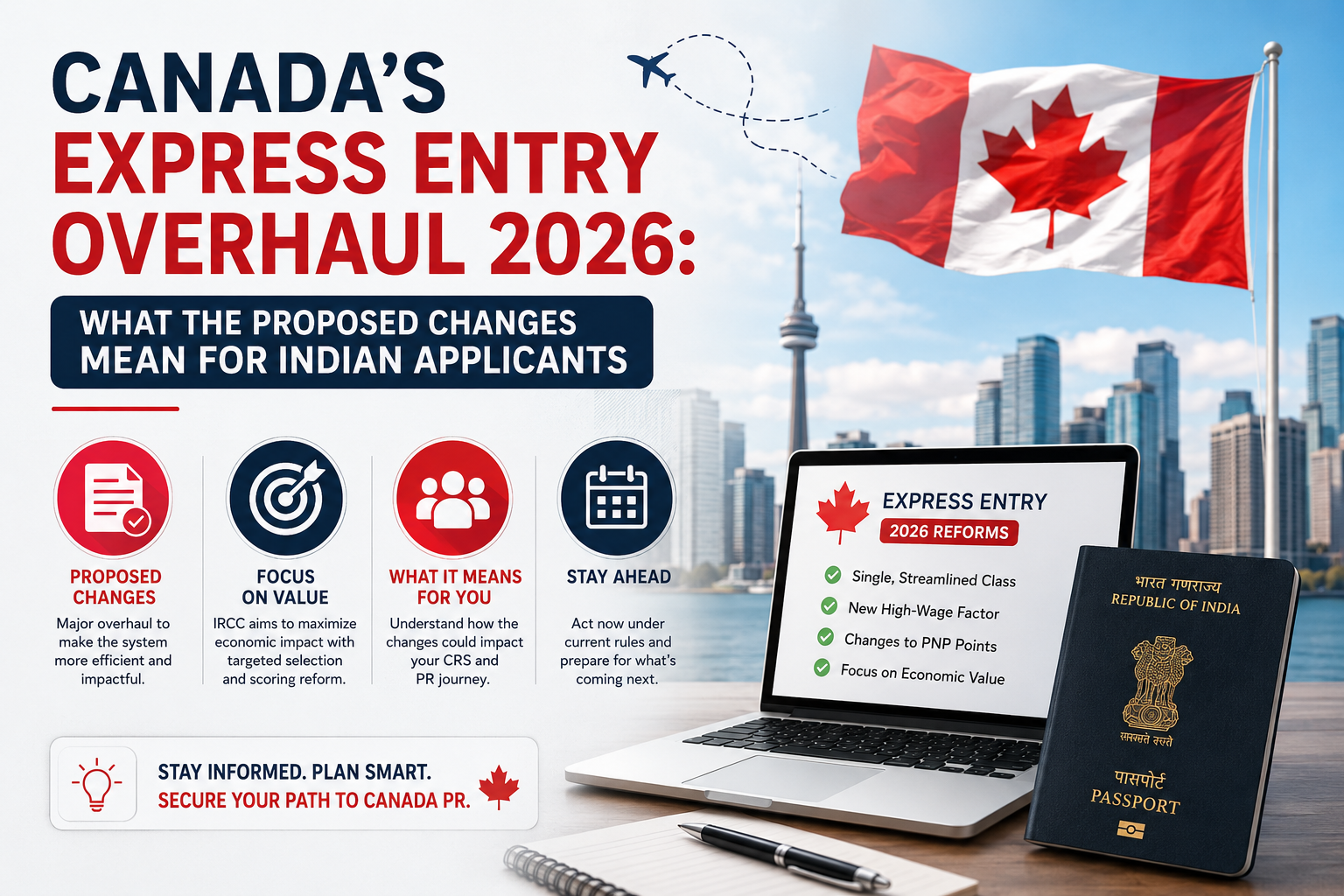
If you’ve had a Canada PR profile sitting in the Canada Express Entry 2026 pool for a few months and you’re wondering why draws feel slower and less predictable this year, you’re not imagining it. Immigration, Refugees and Citizenship Canada (IRCC) is in the middle of proposing the most significant redesign of Express Entry since the system launched in 2015 — and for the thousands of Indian applicants who rely on this route every year, understanding what’s actually changing (versus what’s still speculation) matters more than it has in a long time.
Why IRCC is overhauling Express Entry now
Express Entry currently runs through three federal programs — the Federal Skilled Worker Class, the Canadian Experience Class, and the Federal Skilled Trades Class — all feeding into one pool ranked by the Comprehensive Ranking System (CRS). Under its Forward Regulatory Plan for 2026–2028, IRCC has proposed retiring all three and replacing them with a single, streamlined class.
Canada’s 2026–2028 Immigration Levels Plan has set permanent residence targets at 380,000 for 2026 and 365,000 for 2027 — both lower than recent years. With fewer spots available, IRCC’s stated goal is to extract more economic value from every single invitation it issues, which means the scoring system itself is under review, not just the program structure.
What is confirmed, and what will be happening
A public consultation on the proposed Express Entry reforms ran from April 23 to May 24, 2026, open to both organizations and the general public. Alongside the structural proposal, IRCC has already rolled out new priority categories for 2026, including a dedicated category for physicians with Canadian work experience and an expanded senior managers category covering occupations in construction, transportation, and production. Renewed categories now require a minimum of one year of relevant work experience, up from previous thresholds.
On the ground, draw activity has been noticeably uneven. After a 29-day gap, IRCC resumed Canadian Experience Class draws on May 27.
The pause was the longest for CEC draws in 2026. IRCC issued 3,000 ITAs in the draw. The CRS cutoff score was 518. Ontario’s Provincial Nominee Program is also being restructured. A redesign took effect on May 30. The redesign revokes all nine existing Ontario PNP streams. This change will likely affect candidate flows into the Express Entry pool temporarily. It may reduce the number of provincially nominated candidates entering the pool in the short term.
Steps that are not yet final
This is the part where it’s worth being careful, because a lot of blog content right now overstates how settled these changes are. According to IRCC’s own forward regulatory plan, the proposed reforms would replace the three existing programs with a single class and introduce a new high-wage occupation factor into CRS scoring. Provincial nomination points — currently worth a substantial 600 points — are among the factors IRCC says it’s considering modifying or removing, on the reasoning that federal category-based draws already select for many of the same candidates, making the provincial points somewhat redundant in the system.
None of this is law yet. Any actual change must go through the Canada Gazette before it takes effect. IRCC has indicated it expects separate consultations on category-based selection priorities later in 2026. Treat any more specific claims with caution. This includes exact new point values. It also includes an exact launch date for the new class. Until IRCC publishes official details, such claims remain speculation.
What this means applying from India
For Indian applicants, your current CRS score composition will largely determine the practical impact of these changes.
If a large share of your points comes from a provincial nomination, this is worth watching closely — that 600-point boost is explicitly one of the factors under review. If your strength is in Canadian study or work experience feeding into the CEC pathway, the direction of travel (rewarding job offers and earnings) may actually work in your favour once the new high-wage factor is introduced, but it also means the old CEC-specific routes you may have been planning around could disappear entirely in their current form.
The single most important thing to understand is that IRCC has stated it will honour invitations already issued under the existing system. That’s not a promise about the new system once it launches — it’s a statement about not retroactively penalizing people who already received an ITA.
Things to Right Now
Don’t wait for certainty that may not arrive for months. Get your profile into the Express Entry pool under the current, known rules if you’re eligible today — there’s no advantage to delaying entry while a proposal is still in consultation. Focus your CRS-building efforts on factors that are unlikely to be eliminated regardless of how the reform lands—improve your language test scores, complete your education credential assessments, and maximize age-related points—instead of over-engineering a strategy around provincial nomination points alone. If you rely heavily on a PNP stream, check whether the specific provincial program is being redesigned (Ontario’s certainly is) before you invest time and money in it.
Most importantly, ask someone who tracks these announcements week to week to review your profile instead of relying on a generic eligibility checker. The gap between “technically eligible under today’s rules” and “well-positioned for whichever version of Express Entry exists in six months” is exactly where a proper assessment earns its value.
Frequently Asked Questions
Is Express Entry shutting down?
No. Express Entry as a system isn’t closing — what’s being proposed is a restructuring of the three programs that feed into it, not the elimination of the pathway itself.
When will the new unified class actually launch?
IRCC hasn’t confirmed a launch date. Any change requires publication in the Canada Gazette, and further consultations on category-based selection are expected later in 2026, so a 2026 launch of the full new system is unlikely.
Will my existing Express Entry profile or ITA be affected?
IRCC has stated that invitations already issued under the current system will be honoured. Existing profiles in the pool continue to be ranked under current CRS rules until any change is formally implemented.
Should I wait for the new system before applying?
There’s no clear advantage to waiting. If you’re eligible under current rules, entering the pool now means you’re positioned to receive an ITA under the system as it exists today, while reforms are still being consulted on.