Last updated: 2 September 2026
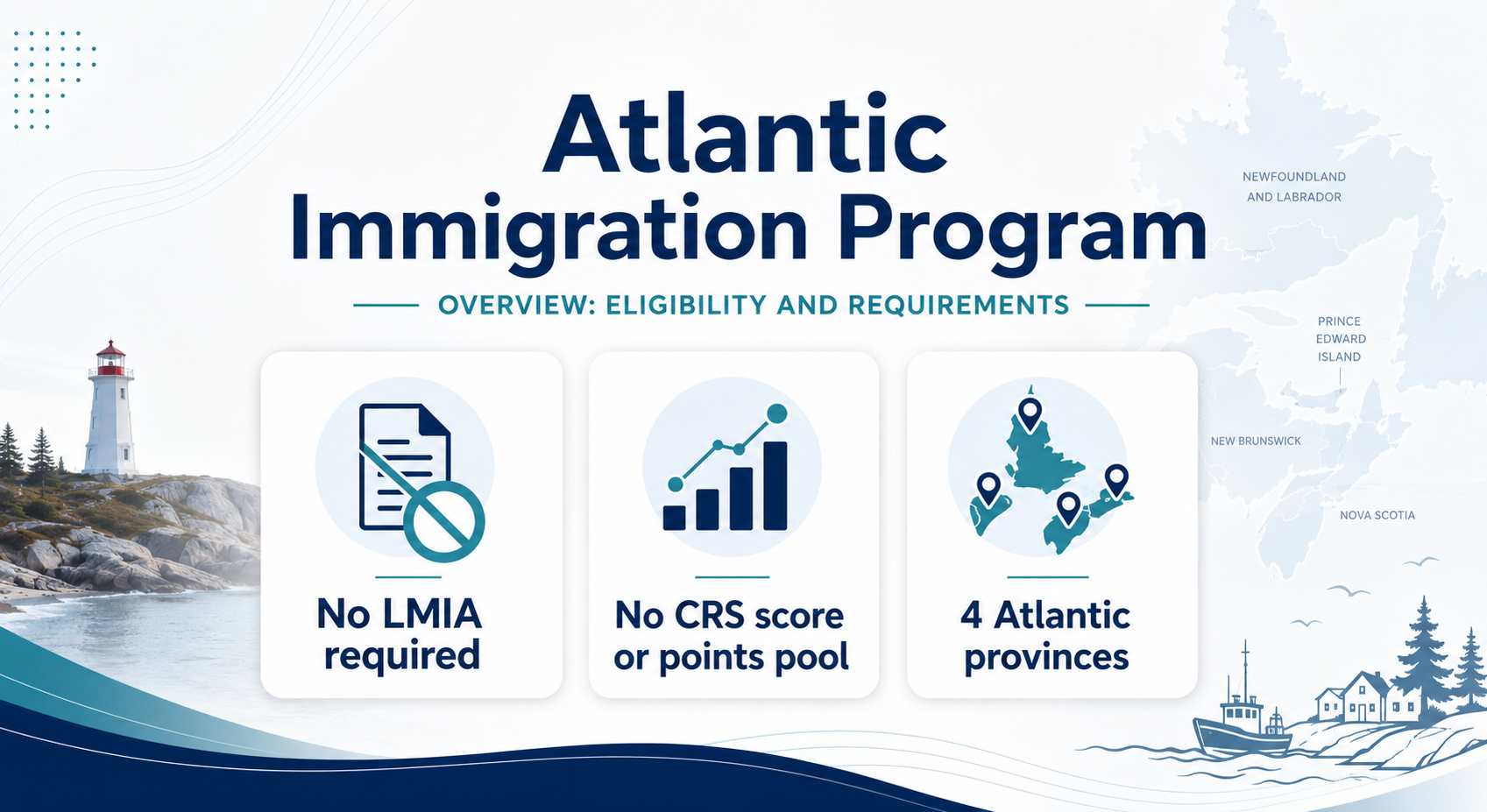
The Atlantic Immigration Program (AIP) is a Canadian permanent residence pathway for skilled workers and international graduates who have a genuine job offer from a designated employer in one of four Atlantic provinces: Nova Scotia, New Brunswick, Prince Edward Island, or Newfoundland and Labrador. Originally launched as a pilot in 2017, AIP became a permanent federal immigration program in 2022.
Unlike Express Entry, AIP does not use a CRS score or points-based ranking. Eligibility is assessed directly against a fixed set of criteria: a qualifying job offer, sufficient work experience (or an exemption for Atlantic graduates), a minimum language score, matching education credentials, and proof of settlement funds unless already exempt. This guide covers current AIP eligibility, the application process, processing times, and government fees, corrected against the latest 2026 IRCC figures.
AIP is built around two applicant categories:
Local employers use AIP to identify, recruit, and retain international talent without going through a Labour Market Impact Assessment (LMIA), since AIP is LMIA-exempt. This is one of the program’s biggest practical advantages for both employers and candidates.
Criteria | AIP | FSWP (Express Entry) | PNP (varies by stream) |
Job offer required | Yes, always | No | Depends on stream |
Ranking system | None, fixed criteria | CRS score, 67-point FSWP grid minimum | Varies, some CRS-linked |
Minimum language | CLB 4 to 5 depending on TEER | CLB 7 | Varies by stream |
LMIA required | No | N/A | N/A |
Best suited for | Candidates with an Atlantic job offer already secured | Skilled workers with strong CRS scores and no Canadian ties | Candidates targeting a specific non-Atlantic province |
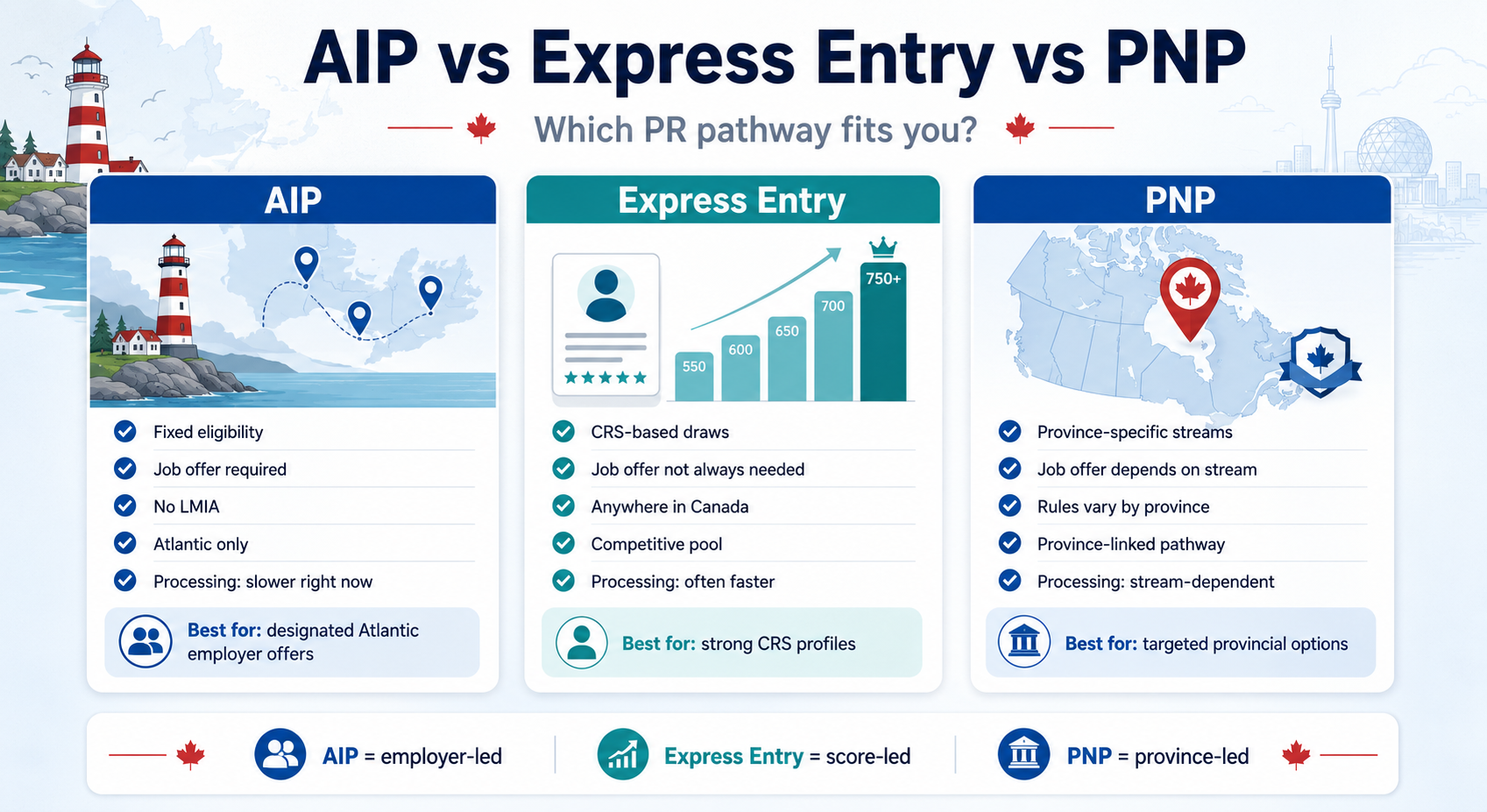
Practical takeaway: if you already have a genuine job offer from a designated Atlantic employer, AIP remains a legitimate route despite the current processing backlog. If you do not yet have a job offer, or your CRS score is reasonably competitive, Express Entry may currently offer a faster path to the same outcome. Many advisors recommend applying to more than one eligible pathway in parallel rather than treating them as mutually exclusive.
See our Federal Skilled Worker Program guide for the full CRS and points-grid breakdown if you’re weighing AIP against Express Entry.
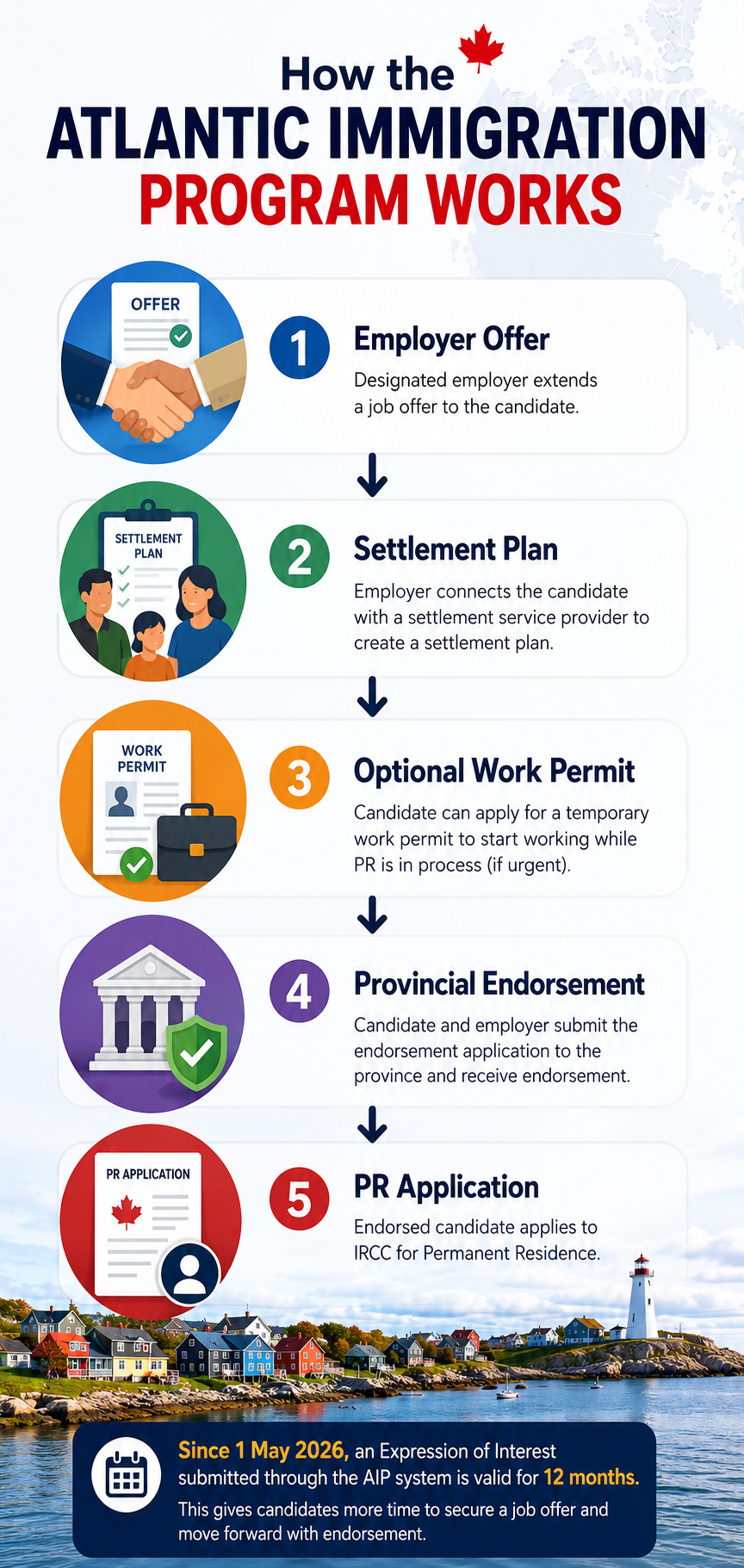
AIP exists to help designated employers in Atlantic Canada identify, recruit, and retain skilled workers and international graduates to address regional labour and population needs. The process runs in a clear sequence:
Since 1 May 2026, an Expression of Interest submitted through the AIP system is valid for 12 months, giving candidates a clearer window to secure a qualifying offer and move forward with endorsement.
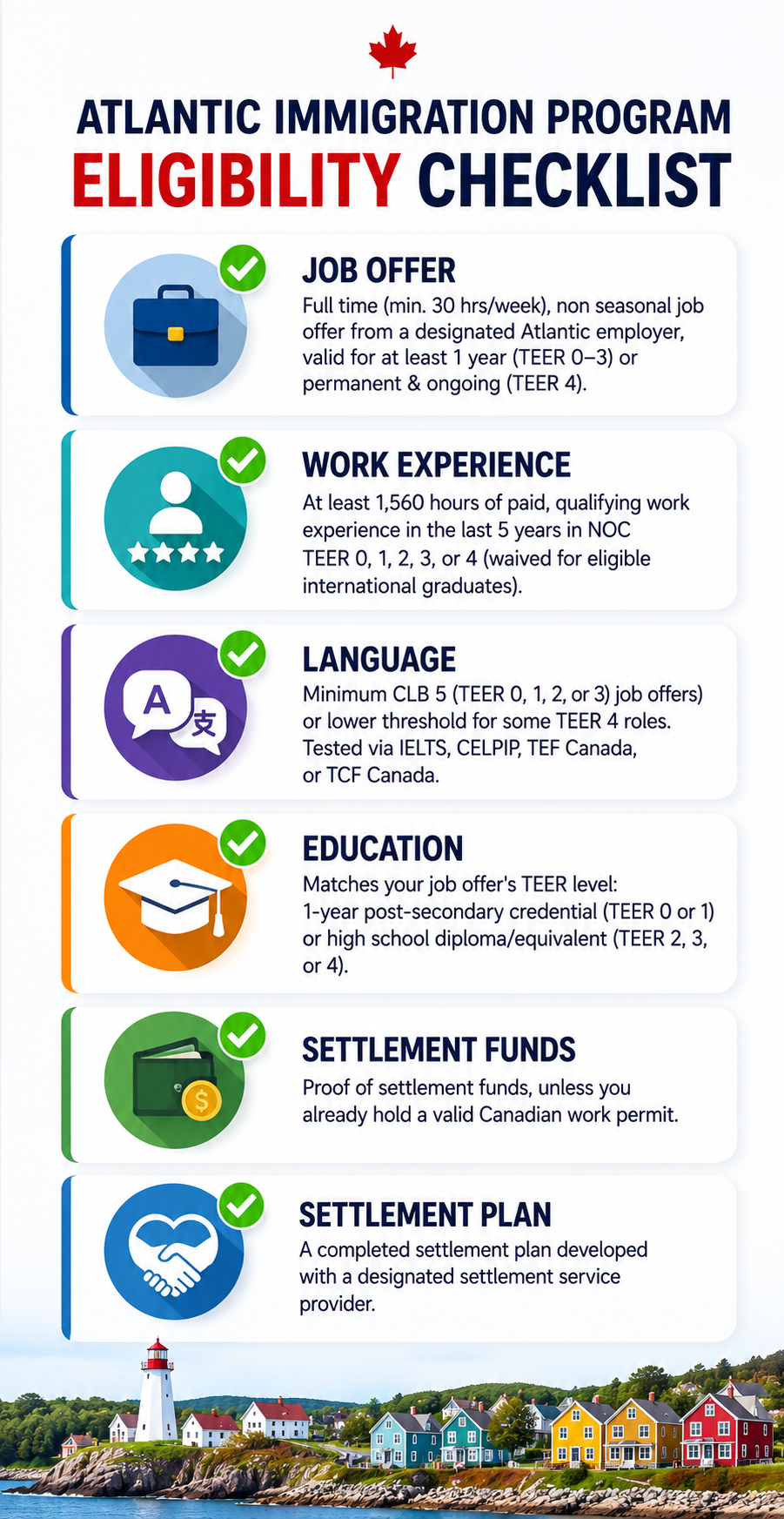
Most applicants need at least 1,560 hours of qualifying work experience within the last 5 years, accumulated over a minimum of 12 months. Working hours are calculated as follows:
Work experience must be in an occupation classified under NOC TEER category 0, 1, 2, 3, or 4, and your actual duties must match the corresponding NOC description.
International students who graduated from a recognized Atlantic Canada institution do not need to show work experience. To qualify as an international graduate, you must meet all of the following:
If your education was completed outside Canada, you’ll need an Educational Credential Assessment (ECA) to confirm it matches the Canadian standard for your job offer. Your ECA report must be less than 5 years old at the time of application.
If you’re already living in Canada with a valid work permit, you don’t need to show proof of funds. All other applicants must show they have enough money to support themselves and their family. The current minimum amounts, based on family size, are:
Family Size | Minimum Funds Required (CAD) |
1 person | $3,815 |
2 people | $4,750 |
3 people | $5,840 |
4 people | $7,090 |
5 people | $8,042 |
6 people | $9,p |
7 or more people | $10,098 |
If more than 7 people, for each additional family member, add | $1,028 |
Figures current as of the July 2025 IRCC update and remain in effect for 2026. These are based on Statistics Canada’s Low Income Cut-Off (LICO) and are reviewed periodically, always confirm the live figure on Canada.ca before relying on it.
Note: these AIP-specific funds requirements are considerably lower than the separate settlement funds table used for Express Entry programs like FSWP, since AIP uses a different LICO-based calculation. Don’t confuse the two if you’re weighing both pathways.
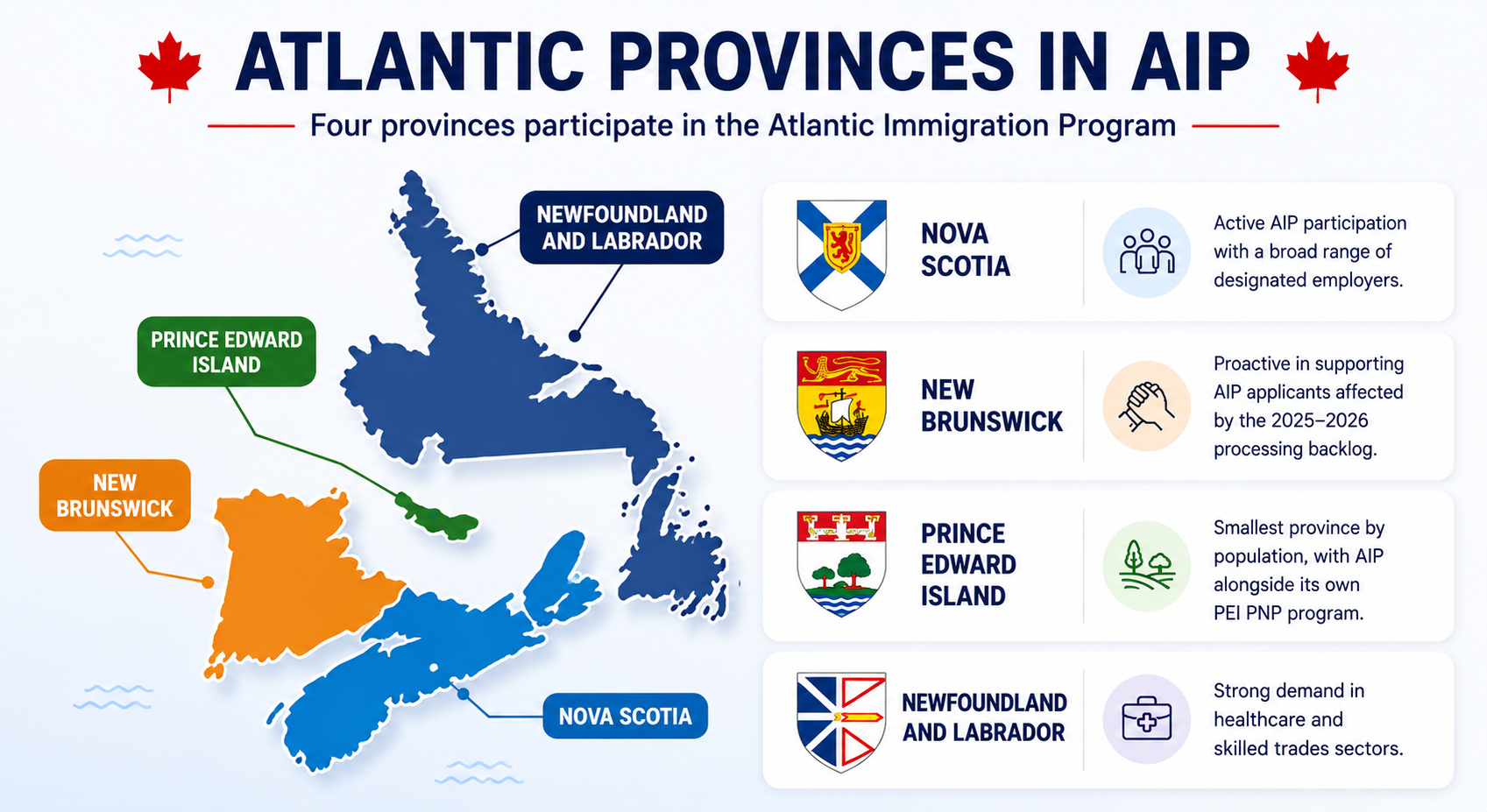
Four provinces take part: Nova Scotia, New Brunswick, Prince Edward Island, and Newfoundland and Labrador. Each province maintains its own list of designated employers and processes endorsement applications independently, though eligibility criteria and federal PR processing are consistent across all four.
Province | What to Know |
Nova Scotia | Active AIP participation with a broad range of designated employers across sectors |
New Brunswick | Has taken a notably proactive role in supporting AIP applicants affected by the 2025 to 2026 processing backlog |
Prince Edward Island | Smallest province by population, with AIP alongside its own PEI PNP program |
Newfoundland and Labrador | Strong demand in healthcare and skilled trades sectors |
Qualifying hours can come from full time or part time paid work, whether in Canada or abroad, though work in Canada requires that you held valid work authorization at the time. Only paid work counts, unpaid or volunteer hours do not, and self employed hours are not counted. Hours must be accumulated over at least 12 months, and hours worked while studying can count if they complied with your study permit conditions at the time.
Your occupation must fall under NOC TEER category 0, 1, 2, or 3, and the actual duties you performed need to match the official NOC description for that occupation.
A designated employer is a company that has been formally reviewed and approved by an Atlantic province specifically to hire through AIP. This designation replaces the need for an LMIA entirely, the province vets the employer once, rather than requiring separate federal labour market approval for every individual hire.
Only job offers from currently, actively designated employers count toward AIP eligibility. A genuine job offer from a legitimate but non designated company does not qualify, a mistake that trips up a meaningful number of applicants. Each province publishes and regularly updates its own designated employer list, so always confirm current status before relying on any specific employer.
To apply for AIP, you’ll typically need to provide:
Additional documents may include proof of experience and a marriage license, where relevant. Incomplete or inaccurate documentation is one of the most common causes of processing delays or refusal, it’s worth having a regulated immigration consultant review your file before submission.
AIP is a competitive program, and meeting the eligibility requirements alone does not guarantee approval.
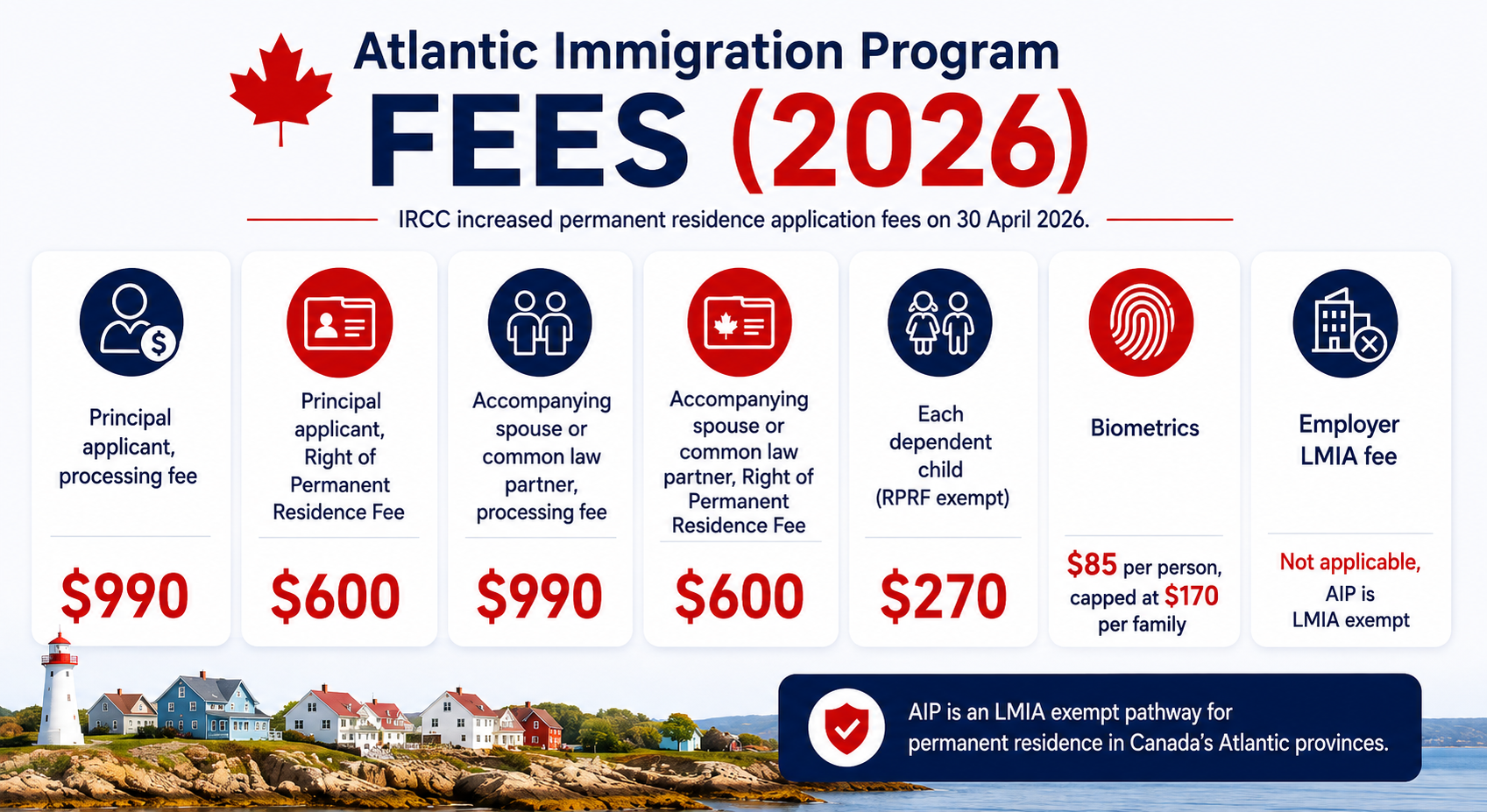
IRCC increased permanent residence application fees on 30 April 2026. The figures below reflect the current schedule.
Fee | Amount (CAD) |
Principal applicant, processing fee | 990 |
Principal applicant, Right of Permanent Residence Fee | 600 |
Accompanying spouse or common law partner, processing fee | 990 |
Accompanying spouse or common law partner, Right of Permanent Residence Fee | 600 |
Each dependent child (RPRF exempt) | 270 |
Biometrics | 85 per person, capped at 170 per family |
Employer LMIA fee | Not applicable, AIP is LMIA exempt |
All in, the current total per adult applicant is approximately 1,590 CAD (990 processing fee plus 600 RPRF). Confirm exact current figures against the official IRCC fee schedule before applying, since these amounts are reviewed periodically.
Several Atlantic provinces, including Nova Scotia and Newfoundland and Labrador, have introduced a formal Expression of Interest (EOI) system for AIP endorsements, effective 1 May 2026. Under this system, candidates (or their employer) submit an EOI, which remains active in the province’s system for 12 months. If selected, you’ll receive an Invitation to Apply (ITA) and generally have 60 days to submit a complete application. EOIs that aren’t selected within 12 months expire automatically and can be resubmitted if the applicant still meets eligibility criteria.
This is a genuinely new mechanic for AIP, worth understanding clearly before you apply, since it adds a formal selection step ahead of endorsement in provinces that have rolled it out. Not every province has implemented an identical system, so confirm the current process for your target province directly.
This is one of the most decision relevant facts on this page, and it deserves to be stated plainly rather than buried.
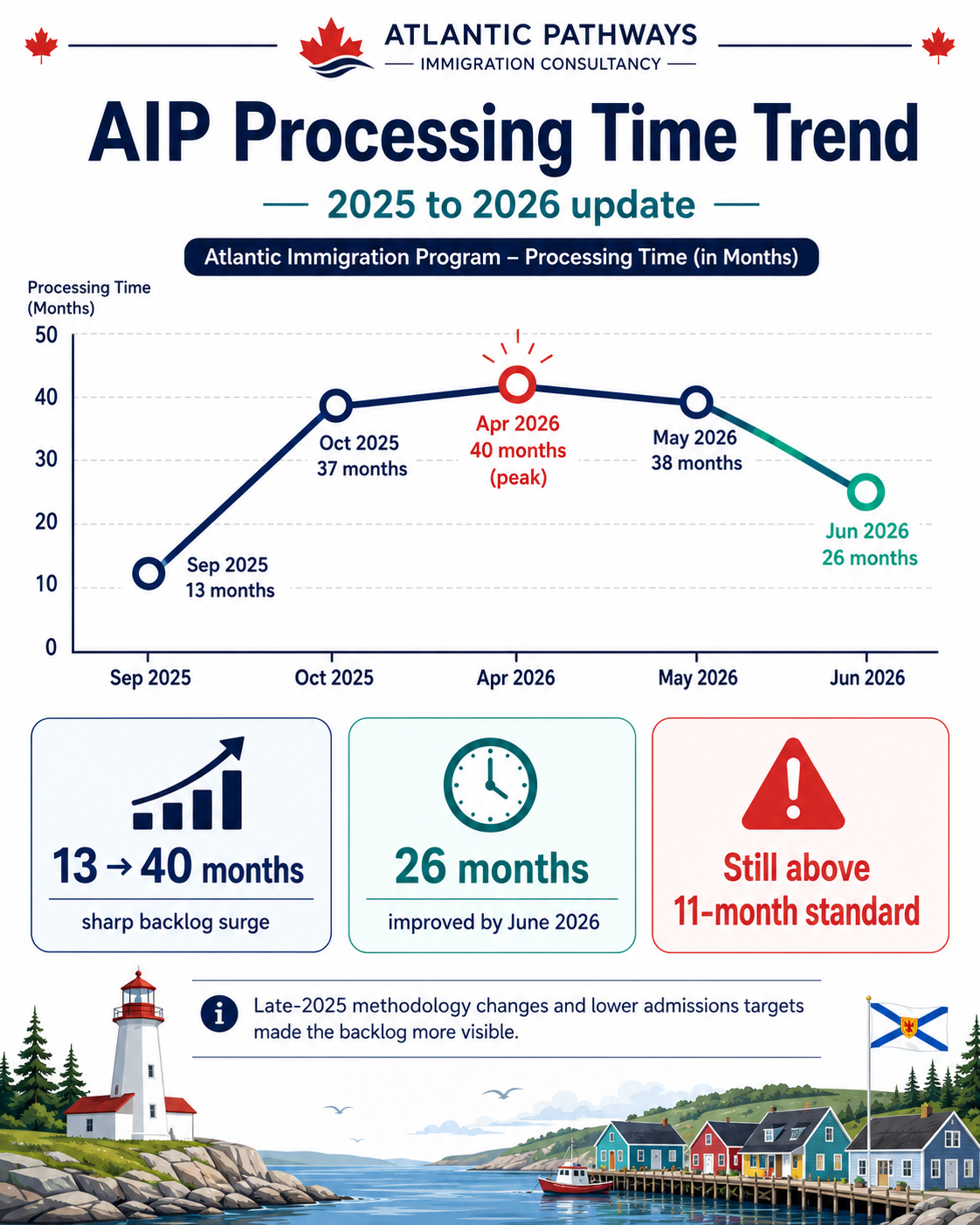
AIP processing times spiked dramatically starting in October 2025, jumping from a 13 month median in September 2025 to 37 months in a single month, an increase of roughly 185 percent. This was driven by two factors: IRCC switched AIP to a forward looking processing time estimate that made a real, existing backlog suddenly visible in published figures, and the federal government reduced AIP’s annual admissions target, further compounding the queue. Processing times peaked at approximately 40 months in April 2026.
As of 8 June 2026, published processing time has improved to approximately 26 months, a 12 month reduction from the 38 months published just one month earlier, and the lowest figure recorded since the backlog began. This remains well above IRCC’s 11 month service standard, and a substantial application inventory, reported at roughly 12,900 applications, remains in the system.
What this means practically: if you are weighing AIP against another pathway you also qualify for, current processing realities are a genuine factor to weigh, not just a formality. Because the dedicated work permits held by many in Canada AIP applicants are capped at two years, and these applicants are not eligible for bridging open work permits, some Atlantic provinces (led by New Brunswick) have stepped in with support letters enabling extended closed work permits for applicants caught in the backlog. If you are already in Canada on an AIP related work permit approaching expiry, this is worth discussing with a consultant directly.
AIP’s coverage of NOC TEER 0 through 4 makes it one of the more accessible programs for a wide range of occupations, including many roles that don’t qualify for Express Entry’s FSWP (which stops at TEER 3). Sectors with consistent AIP demand include:
For Indian applicants, AIP is often a strong complement to Express Entry rather than a replacement for it: its lower language bar (CLB 4 to 5 versus Express Entry’s practical CLB 7+ floor) and broader occupation coverage make it accessible to candidates who wouldn’t be competitive in general Express Entry draws, provided a genuine Atlantic job offer is secured first.
If you’d like to know more about the Canada AIP PR visa process, you can contact us by email at mail@pioverseas.com, and one of our experts will help you through every step. Call us at +91-9310-10-6988, request a call back through our inquiry form, or talk to our experts directly through live chat.
The Atlantic Immigration Program is an employer-driven pathway to Canadian permanent residence for skilled workers and international graduates who have a job offer from a designated employer in one of Canada’s four Atlantic provinces. Originally launched as a pilot in 2017, it became a permanent federal immigration program in 2022. Unlike Express Entry, there’s no CRS score or points-based competition — eligibility hinges on securing a genuine job offer and meeting baseline language, education, and work experience requirements.
You’re eligible for the AIP if you have a full-time, non-seasonal job offer from a designated employer in Nova Scotia, New Brunswick, PEI, or Newfoundland and Labrador, and you meet the program’s baseline requirements: at least 1,560 hours (about 1 year) of qualifying work experience in the last 5 years (waived for graduates of recognized Atlantic institutions), a minimum CLB 5 language score for most occupation levels, education matching your job’s TEER level, and enough settlement funds unless you’re already working in Canada on a valid work permit. There’s no CRS score or points ranking involved; eligibility is assessed directly against these fixed criteria.
Eligibility Checklist:
Requirement | Standard |
Job offer | Full-time (30+ hrs/week), non-seasonal, from a designated Atlantic employer |
Work experience | 1,560 hours in the last 5 years (waived for Atlantic graduates) |
Language | Minimum CLB 5 for most TEER 0–3 roles (IELTS, CELPIP, TEF, TCF) |
Education | Matches TEER level of the job offer (1-yr post-secondary for TEER 0/1; high school equivalent for TEER 2–4) |
Settlement funds | Required, unless already working in Canada with a valid work permit |
Settlement plan | Mandatory, developed with a designated settlement service provider |
Neither is universally “better”. They suit different profiles. AIP requires a job offer upfront but is LMIA-exempt and has no CRS/points competition, making it strong for candidates who already have (or can secure) an Atlantic employer. PNP offers far more streams and provincial choice across the country, some of which don’t require a job offer at all, and its enhanced streams (linked to Express Entry) generally process faster federally — around 6 months — than AIP’s currently reported total timeline of 26–38 months amid its 2026 application backlog.
AIP vs. PNP at a Glance:
| Atlantic Immigration Program (AIP) | Provincial Nominee Program (PNP) |
Geographic scope | 4 Atlantic provinces only | Every province/territory except Quebec and Nunavut |
Job offer required | Yes, always | Depends on stream — many don’t require one |
LMIA required | No (LMIA-exempt) | N/A (PNP doesn’t involve a work permit LMIA directly) |
CRS points added | N/A — not CRS-based | +600 for enhanced/Express Entry-linked streams |
Federal processing (post-approval) | ~6 months (standard), but total 2026 timeline running 26–38 months | ~6 months (enhanced) / ~16 months (base) |
Best for | Candidates with an Atlantic job offer already in hand | Candidates with no job offer, or ties to a specific non-Atlantic province |
Practical takeaway: if you already have a job offer from a designated Atlantic employer, AIP remains a legitimate route despite the current backlog. If you don’t have a job offer yet, or you’re weighing multiple provinces, a PNP stream, particularly one without a job offer requirement, like several Saskatchewan or Manitoba categories, may currently offer a more predictable timeline.
It depends on your situation. AIP is a strong option if you already have, or can realistically secure, a job offer from a designated Atlantic employer and wouldn’t be competitive in general Express Entry draws, its lower language and CRS-free eligibility bar makes it more accessible for many candidates. However, given the 2026 processing backlog, candidates who also qualify for Express Entry (with a reasonably competitive CRS score) may find that route faster overall in the current environment, since Express Entry’s federal processing standard is holding around 6–7 months. Many immigration advisors now recommend applying to both simultaneously where eligible, rather than treating AIP and Express Entry as mutually exclusive strategies.
Four provinces participate: Nova Scotia, New Brunswick, Prince Edward Island, and Newfoundland and Labrador. Each province maintains its own list of designated employers and processes endorsement applications independently, though the overall program structure, eligibility criteria, and federal PR processing are consistent across all four.
As of the 30 April 2026 fee increase, the government fee is $990 CAD processing fee plus $600 CAD Right of Permanent Residence Fee, totaling $1,590 CAD for the principal applicant, and the same $1,590 CAD for an accompanying spouse, and $270 CAD per dependent child (who is exempt from the RPRF). Biometrics cost $85 CAD per person, capped at $170 CAD per family. Employers benefit from not having to pay the standard $1,000 CAD LMIA fee, since AIP is LMIA-exempt.
Fee | Amount (CAD) |
Principal applicant (processing fee $990 plus $600 RPRF) | ~$1,590 |
Accompanying spouse | ~$1,590 |
Dependent child (RPRF exempt) | ~$270 |
Biometrics | $85/person, capped at $170/family |
Employer LMIA fee | $0 (exempt) |
The core requirements are:
(1) A qualifying job offer from a designated Atlantic employer,
(2) Sufficient work experience (1,560 hours in the last 5 years, or an exemption for Atlantic graduates),
(3) A language test result meeting the minimum CLB threshold for your occupation’s TEER level,
(4) Education credentials matching that TEER level,
(5) Proof of settlement funds (unless already working in Canada), and
(6) A completed settlement plan prepared with a designated settlement organization.
All six elements must be satisfied together, meeting most, but not all, of these will result in an ineligible application.
Yes. The Atlantic Immigration Program is a direct pathway to Canadian permanent residence, not a temporary status program. Once a candidate secures a job offer, obtains a provincial endorsement, and IRCC approves the permanent residence application, they and their accompanying family members become Canadian permanent residents. Some candidates also use an optional 1-year, LMIA-exempt temporary work permit to start working in Canada while their PR application is processed in parallel, but the program’s end goal; and the reason it exists, is permanent residence, not a standalone temporary work status.
A designated employer is a company that’s been formally reviewed and approved by one of the four Atlantic provinces specifically to hire international candidates through the AIP. This designation replaces the need for an LMIA, the province vets the employer once, rather than requiring federal labour-market approval for every individual hire. Only job offers from currently, actively designated employers count toward AIP eligibility; a genuine job offer from a legitimate but non-designated company doesn’t qualify, which is one of the most common points of confusion for applicants. Each province publishes and regularly updates its own designated employer list, so it’s essential to check the current, dated version before relying on any specific employer’s status.
This is genuinely important to know before applying: AIP’s overall processing time has swung significantly through 2026 and continues to move. IRCC’s federal PR service standard for AIP remains around 6 months once a provincial endorsement is issued, but published total, end-to-end processing times (job offer to PR decision) have moved sharply within the year: as high as 37 to 38 months by March to May 2026, down to roughly 26 months by June 2026, and more recent reporting shows the estimate has moved back up toward 38 months since then.
Stage | Typical Time |
Employer designation (if new) | Weeks, if employer isn’t already designated |
Provincial endorsement | 4–8 weeks, if the file is complete |
Federal PR processing (post-endorsement) | ~6 months (official standard) |
Total published processing time (2026) | ~26–38 months, depending on month reported |
Note: This is one of the fastest-moving figures on this page. Given the significant swings reported between March and June 2026 alone, always check IRCC’s live processing time tool for the current AIP estimate before setting expectations, do not rely on a single cached number.
AIP Settlement Fund Requirements by Family Size
Family Size | Minimum Funds Required (CAD) |
1 person | $3,815 |
4 people | $7,090 |
Applicants already living and working in Canada on a valid work permit are exempt from the settlement funds requirement entirely. This exemption doesn’t apply to applicants outside Canada or those without current valid work authorization. They must show the full applicable amount for their family size regardless of any other financial circumstances.
Yes. A job offer is the central, non-negotiable requirement. You need a full-time (minimum 30 hours/week), non-seasonal job offer from an employer that’s been officially designated by one of the four Atlantic provinces. For TEER 0–3 occupations, the offer must be valid for at least 1 year from the date of PR approval; for TEER 4 occupations, it must be a permanent, ongoing offer. Unlike Express Entry, you cannot enter a general pool speculatively; you must already have, or actively secure, a genuine offer from a qualifying employer before the process can begin.
Yes. Employers hiring through the AIP do not need to obtain a Labour Market Impact Assessment (LMIA); a major advantage over standard work permit routes, which typically take 48–60 business days and cost the employer $1,000 CAD per position. Provinces vet and designate employers once, upfront, rather than requiring per-hire federal labour-market approval, which makes repeat hiring significantly faster for approved employers. This LMIA exemption is one of the program’s biggest practical selling points for both employers and candidates.
AIP is structured around two main applicant categories:
Note: some older resources reference three separate legacy streams: High-Skilled, Intermediate-Skilled, and International Graduate; from the program’s original 2017–2022 pilot structure; the current permanent program operates with simplified eligibility criteria applied across TEER levels.
Most applicants need at least 1,560 hours (roughly the equivalent of 1 year full-time) of paid work experience within the last 5 years, in an occupation classified under NOC TEER 0, 1, 2, 3, or 4. International graduates from a recognized Atlantic Canada post-secondary institution are fully exempt from this requirement, provided they have a qualifying job offer. Some occupational cross-recognition also applies, for example, experience as a licensed practical nurse or registered nurse can qualify a candidate for certain related TEER 3/4 caregiving roles.
Language requirements are generally lower than Express Entry’s, and vary by occupation skill level: candidates for TEER 0, 1, 2, or 3 positions typically need a minimum of CLB 5, while some TEER 4 roles may require a lower threshold. Accepted tests include IELTS, CELPIP (English) and TEF Canada or TCF Canada (French). This relatively accessible language bar is one reason AIP is often recommended to candidates who wouldn’t be competitive in general Express Entry draws.
Education requirements scale with the job offer’s TEER level: for TEER 0 or 1 job offers, you generally need a Canadian one-year post-secondary credential or a recognized foreign equivalent (assessed via an Educational Credential Assessment if obtained abroad); for TEER 2, 3, or 4 job offers, a Canadian high school diploma or foreign equivalent is generally sufficient. International graduates applying under the graduate stream automatically satisfy this requirement through their Atlantic Canada credential.
A designated employer is a company that’s been formally vetted and approved by an Atlantic province specifically to hire through the AIP. This designation is separate from, and doesn’t require, an LMIA. Only job offers from currently designated employers count toward AIP eligibility; an otherwise legitimate job offer from a non-designated company does not qualify, a mistake applicants frequently make. Each province publishes and regularly updates its own official designated employer list, always check the current, dated list on the relevant provincial or IRCC page, since these lists change frequently (one major federal update refreshed designated-employer data as recently as April 1, 2026).
Yes, every AIP applicant needs a personalized settlement plan. This is a document, typically developed with help from a designated settlement service provider organization that outlines how the applicant and their family will integrate into their new Atlantic community (housing, schools, healthcare access, employment support, community connections). It’s a mandatory part of both the endorsement application and the eventual permanent residence application, and reflects the program’s broader goal of long-term regional retention, not just filling a short-term job vacancy.
Yes, in many cases. If you have an urgent job offer, you can apply for a 1-year, LMIA-exempt, employer-specific work permit once you receive a referral letter from the province issued after the province receives your job offer, needs assessment, and settlement plan, and after you commit to submitting a PR application within 90 days of your work permit application. This lets you start working in Canada relatively quickly while your full permanent residence application is processed in the background, which is especially valuable given the extended 2026 total processing timelines.
The Expression of Interest system is how candidates register initial interest before a full endorsement application. As of May 1, 2026, IRCC set Expressions of Interest to be valid for 12 months, with transition measures applying to EOIs already in the system at that time. This change gives candidates a clearer, defined window to secure a qualifying job offer and move forward with endorsement before needing to resubmit their interest.
Yes. Once your AIP application results in permanent residence, you have full rights to work for any employer in Canada, the same as any other permanent resident. Any restriction to your original designated employer applies only during the temporary work permit stage, if you used one, not after PR is granted.
This is a genuine risk worth understanding. If your employer’s designation is revoked or expires before your application is finalized, it can affect your eligibility, since the job offer underpinning your application needs to come from a currently designated employer. Discuss this scenario with your employer and a migration consultant if you have any concern about your employer’s ongoing designation status.
Not directly through the standard skilled worker route, since that requires qualifying work experience you generally cannot accumulate as a full time student. However, if you are close to graduating from a recognized Atlantic institution, the international graduate stream may apply once you meet its specific requirements, including the residency and full time study conditions.
No. AIP accepts English or French language test results on equal footing, IELTS or CELPIP for English, and TEF Canada or TCF Canada for French, with the same CLB or NCLC threshold applying regardless of which official language you test in.
AIP does not publish a fixed minimum salary threshold the way some other programs do. Instead, the job offer needs to reflect a genuine, ongoing position that meets standard employment conditions in the province. Salary reasonableness may still be assessed as part of determining whether the offer is genuine.
Refusal reasons vary, and options depend on the specific grounds. In many cases, reapplying with corrected or stronger documentation is more practical than a formal appeal, though certain refusals may carry formal review or appeal rights depending on the circumstances. A consultant can help assess your specific refusal letter and realistic next steps.
Time spent in Canada as a temporary resident, including on an AIP related work permit, can count partially toward the physical presence requirement for citizenship, though at a reduced rate compared to time spent as a permanent resident. The clock for full permanent resident credit begins once your PR status is confirmed.
Dependents included in your application remain part of it throughout processing, however long it takes, though ages and circumstances can change. A dependent child who turns 22 during a lengthy processing period, for example, may fall outside the definition of a dependent child under current rules, so this is worth discussing proactively with a consultant given the currently extended timelines.
There is no fixed federal cap published on the number of AIP hires per employer, though provinces monitor employer usage of the program as part of ongoing designation review. An employer with an unusually high volume of AIP hires relative to its size may attract additional provincial scrutiny.
The standard AIP temporary work permit is employer specific, not open. Separately, some Atlantic provinces have introduced support measures, including extended closed work permits, specifically to help applicants affected by the current processing backlog remain authorized to work, but this is distinct from a general conversion to open work permit status.
Yes. AIP has its own annual admissions target within Canada’s overall immigration levels plan, separate from the Express Entry linked categories. Changes to this specific target directly affect AIP processing capacity and are part of what drove the 2025 to 2026 backlog.
Your spouse’s education, language ability, and work experience are not part of the core AIP eligibility assessment, which is centered on the principal applicant’s job offer and qualifications. However, a well qualified spouse can strengthen your family’s broader settlement plan and may open additional pathway options if your spouse independently qualifies for another program.
Healthcare, skilled trades, hospitality, food processing, and technology are among the most active sectors using AIP to fill labour gaps in Atlantic Canada, though designated employers span a wide range of industries. Checking current provincial designated employer lists by sector is the most reliable way to identify active opportunities in your field.
Generally yes, there is no rule preventing you from pursuing AIP and a PNP application simultaneously, provided you genuinely meet each program’s separate requirements. Just be prepared to manage two active applications and keep both sets of documentation current and consistent.
No. This is worth stating plainly given how much confusion exists on this point: AIP does not use CRS scores, points, or any competitive ranking system. Eligibility is a fixed pass or fail assessment against the program’s criteria, not a comparison against other applicants in a pool.