Australia Subclass 491 Visa: Points, Eligibility & Your Pathway to PR

The Subclass 491 (Skilled Work Regional Provisional) visa is a 5-year points-tested visa that lets skilled workers live, work, and study in designated regional areas of Australia — and it’s one of the fastest-growing pathways into the country, largely because it offers 15 bonus points, nearly triple what a Subclass 190 state nomination gives, and because “regional Australia” includes far more territory than most applicants assume (Perth, Adelaide, Canberra, and the Gold Coast all count).

Importantly: the 491 is not a permanent residency visa on its own. It’s a provisional visa that leads to PR through the Subclass 191 after you’ve lived and worked in a regional area for at least three years.

This guide covers everything: eligibility, the points system, which occupation lists apply, a state-by-state breakdown of nomination programs, what actually counts as a “regional area,” visa fees, processing times, and exactly how the pathway to permanent residency via Subclass 191 works.

Quick answer: To qualify for the Subclass 491 visa, you need a minimum of 65 points (including a 15-point bonus for regional nomination or family sponsorship), an occupation on the MLTSSL or Regional Occupation List, a positive skills assessment, and nomination by a state/territory government or sponsorship by an eligible family member living in a regional area. The visa is valid for 5 years and leads to permanent residency via Subclass 191 after 3 years of compliant regional residence.
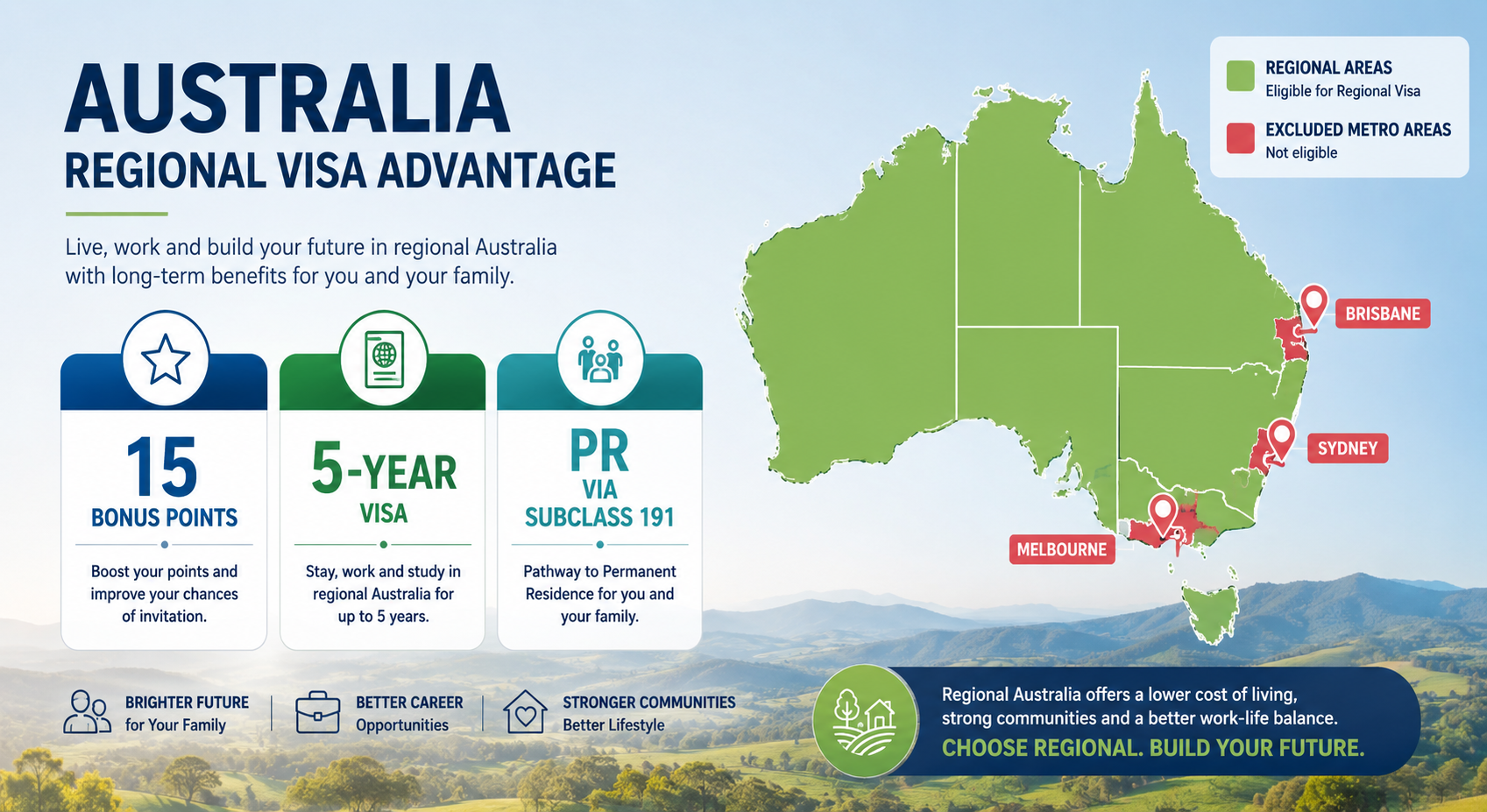
Australia Subclass 491 visa overview points, validity and PR pathway

What Is the Subclass 491 Visa?

The Subclass 491 replaced the older Subclass 489 visa in November 2019, with a key structural change: it’s designed as a genuine long-term pathway to permanent residency (via Subclass 191), rather than a purely temporary category. It’s aimed squarely at addressing skill shortages outside Australia’s three largest cities by offering meaningfully higher points and a broader occupation list than the equivalent non-regional visas.

Key features:

  • Visa validity: 5 years
  • Visa type: Provisional (temporary), points-tested
  • Nomination required: State/territory government or an eligible relative living in a designated regional area
  • Points bonus: 15 points for nomination/sponsorship (compared to 5 points for a Subclass 190 state nomination)
  • Work rights: Full work rights in any regional occupation, for any employer, within regional Australia
  • Family inclusion: Spouse/partner and dependent children can be included
  • PR Pathway: Eligible to apply for Subclass 191 after 3 years of compliant regional residence and work

Why Consider the 491 Over the 190 or 189?

  • Significantly higher points bonus — 15 points versus 5 points for a 190 state nomination, which can be the difference between an invitation and a missed round for borderline applicants.
  • Broader occupation list — the Regional Occupation List (ROL) includes roughly 77 additional occupations beyond MLTSSL, opening doors for applicants whose occupation isn’t eligible for 189/190.
  • “Regional Australia” is broader than most people assume — Perth, Adelaide, Canberra, Hobart, and the Gold Coast are all classified as regional, so this often doesn’t mean relocating to a remote town.

Criteria

Subclass 189

Subclass 190

Subclass 491

Sponsorship needed

No

State/Territory

State/Territory or eligible relative

Points bonus

None

+5

+15

Occupation list

MLTSSL only

MLTSSL + STSOL

MLTSSL + STSOL + ROL

Location commitment

None

Nominating state, ~2 years (moral commitment, not a legal condition)

Regional area, legally enforced (Condition 8579)

PR status

Immediate

Immediate

Provisional — PR via Subclass 191 after 3 years

Realistic points needed

Often 85–100+ for professional occupations

Typically lower than 189 once nomination bonus is added

Often the most accessible of the three, given the 15-point bonus

  • A genuine, structured PR pathway via Subclass 191, without needing to reapply through the full points system again.

Note: you must live, work, and study only in regional areas for the visa’s 5-year period (or until you transition to 191) — moving to Sydney, Melbourne, or Brisbane while on a 491 breaches your visa condition. More on this below. Subclass 491 visa versus 190 and 189 bonus points comparison
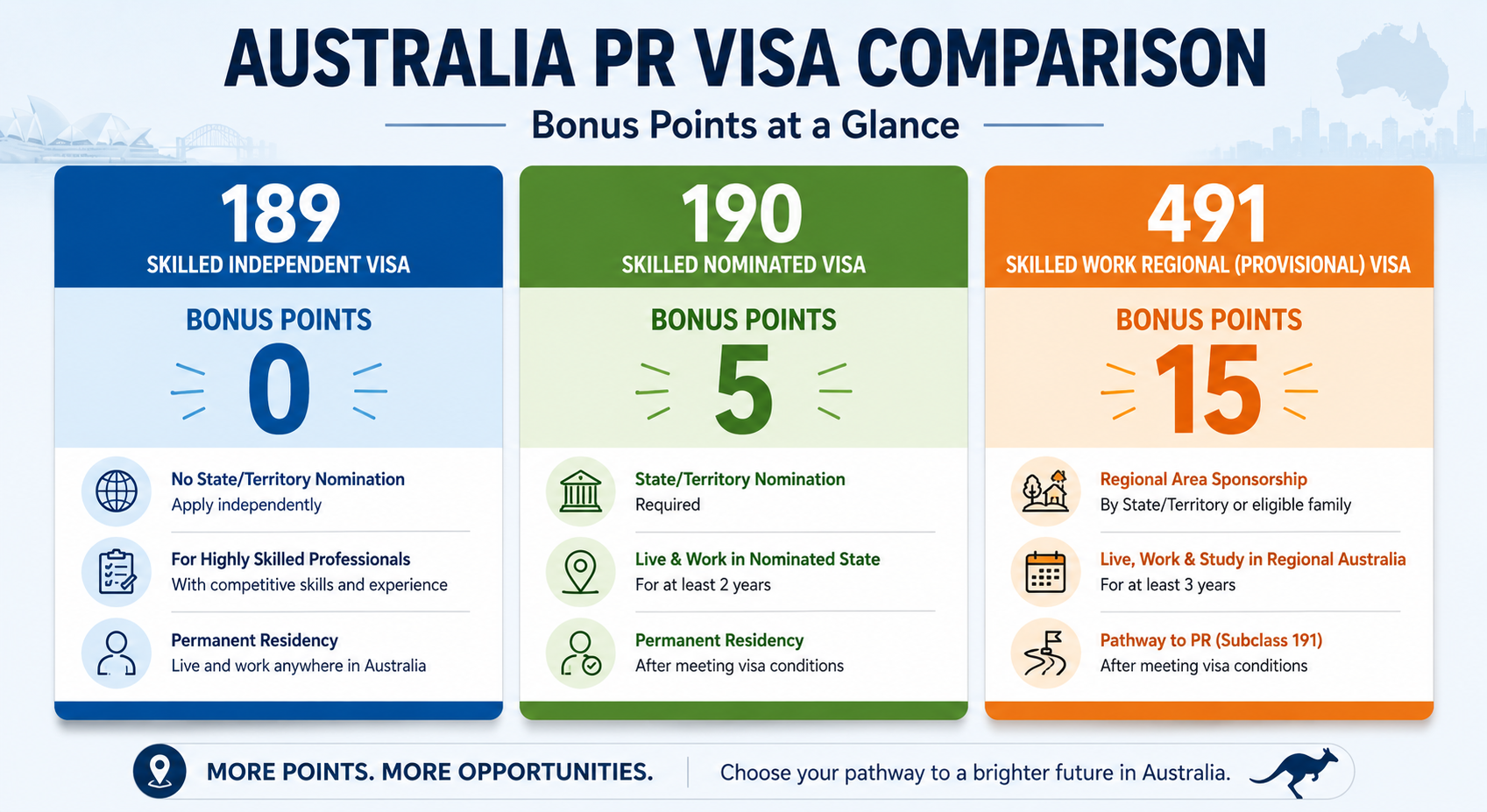
Eligibility Requirements for the Subclass 491 Visa

To qualify for the Subclass 491, you generally need to meet the following:
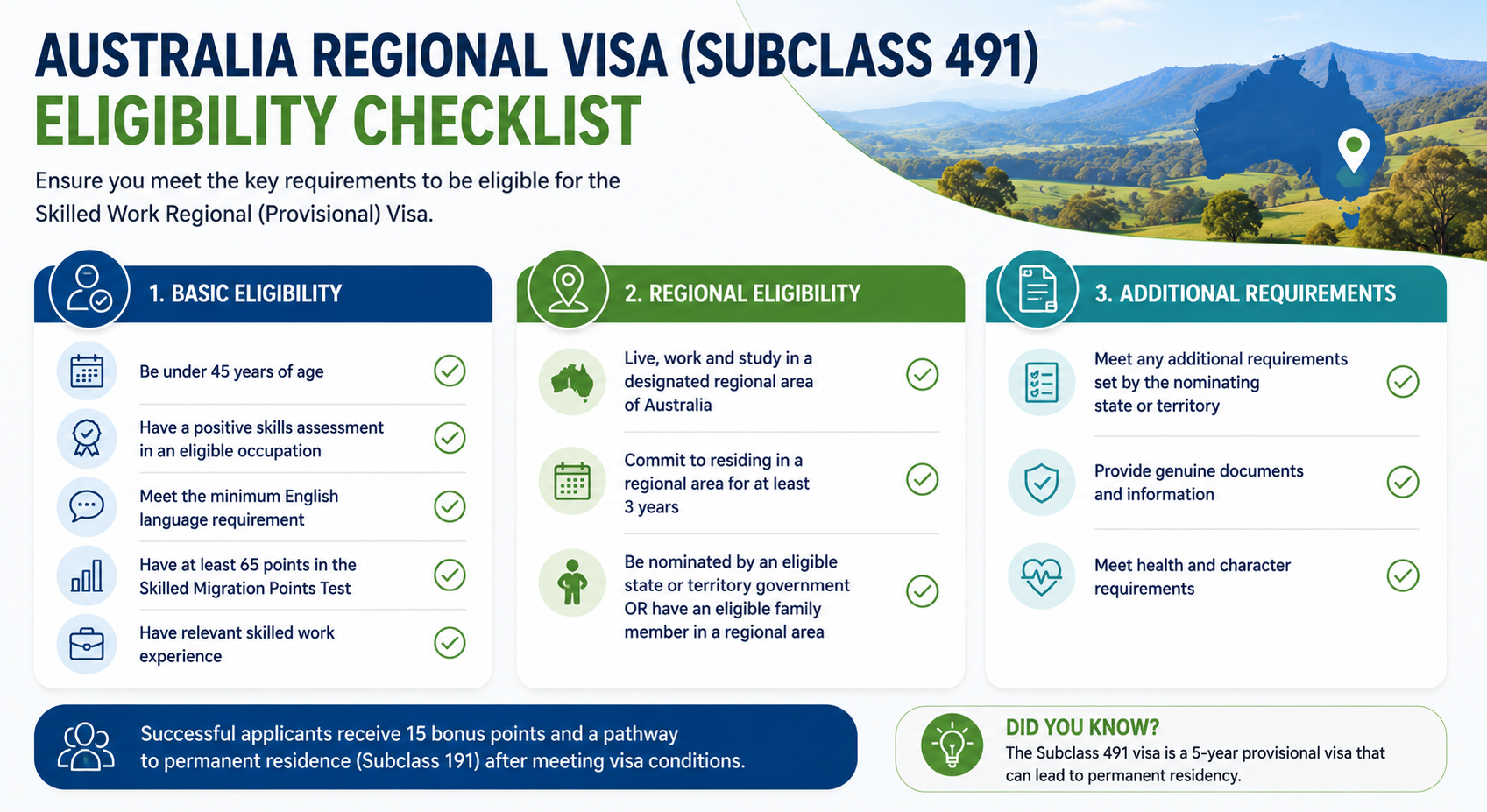
  • Age: Under 45 at the time of invitation
  • Occupation: Listed on the MLTSSL or the Regional Occupation List (ROL)
  • Skills assessment: A positive skills assessment from the relevant assessing authority for your occupation
  • English language proficiency: Competent English or higher (IELTS 6.0 or equivalent in each band, minimum)
  • Points score: Minimum 65 points on the points test, including your nomination/sponsorship bonus
  • Nomination or sponsorship: By a state/territory government agency, or by an eligible relative who is an Australian citizen or permanent resident usually residing in a designated regional area
  • Health and character: Medical examinations and police clearance certificates for all applicants

Australia Subclass 491 visa eligibility checklist

Australia 491 Visa Points System

The 491 uses the same points test as the 189 and 190, with one major difference: regional nomination or family sponsorship adds 15 points (compared to 5 points for a 190 state nomination) — meaning you only need 50 base points to reach the 65-point threshold.

Factor

Points Available

Age (25–32 years — highest-scoring band)

30

English language proficiency (Superior)

20

Skilled employment outside Australia (8–10 yrs)

15

Skilled employment in Australia (8–10 yrs)

20

Educational qualification — Doctorate

20

Educational qualification — Bachelor’s/Master’s

15

Australian study requirement

5

Study in a designated regional area

5

Credentialed community language qualification

5

Professional Year in Australia

5

Regional nomination or family sponsorship (491-specific)

15

Skilled spouse or de facto partner

10

Partner with Competent English only

5

Single applicant, or partner is citizen/PR holder

10

Because the 15-point regional bonus is so much larger than the 190’s 5 points, the 491 is often the more realistic pathway for applicants who are a few points short for 189 or 190.

Occupation Lists for the Subclass 491 Visa

Your occupation must appear on one of three lists to qualify

  • MLTSSL (Medium and Long-term Strategic Skills List) — the same list used for 189 and 190, roughly 212 occupations. MLTSSL occupations give you the widest range of visa options, including 189.
  • STSOL (Short-term Skilled Occupation List) — roughly 215 occupations. STSOL occupations are not eligible for the independent Subclass 189, but are eligible for the 190 and 491 (subject to your target state listing the occupation).
  • Regional Occupation List (ROL) — an additional list specific to regional visas, with roughly 77 further occupations not available under 189/190. This is one of the 491’s biggest advantages: applicants whose occupation doesn’t qualify for 189 or 190 may still be eligible for 491 through the ROL.

The 491 has the broadest occupation eligibility of any of the three points-tested skilled visas, since it draws from all three lists combined,

On top of these three national lists, each state and territory publishes its own regional occupation list for nomination purposes — so your occupation also needs to match what your target state is currently nominating for. This is covered state-by-state below.
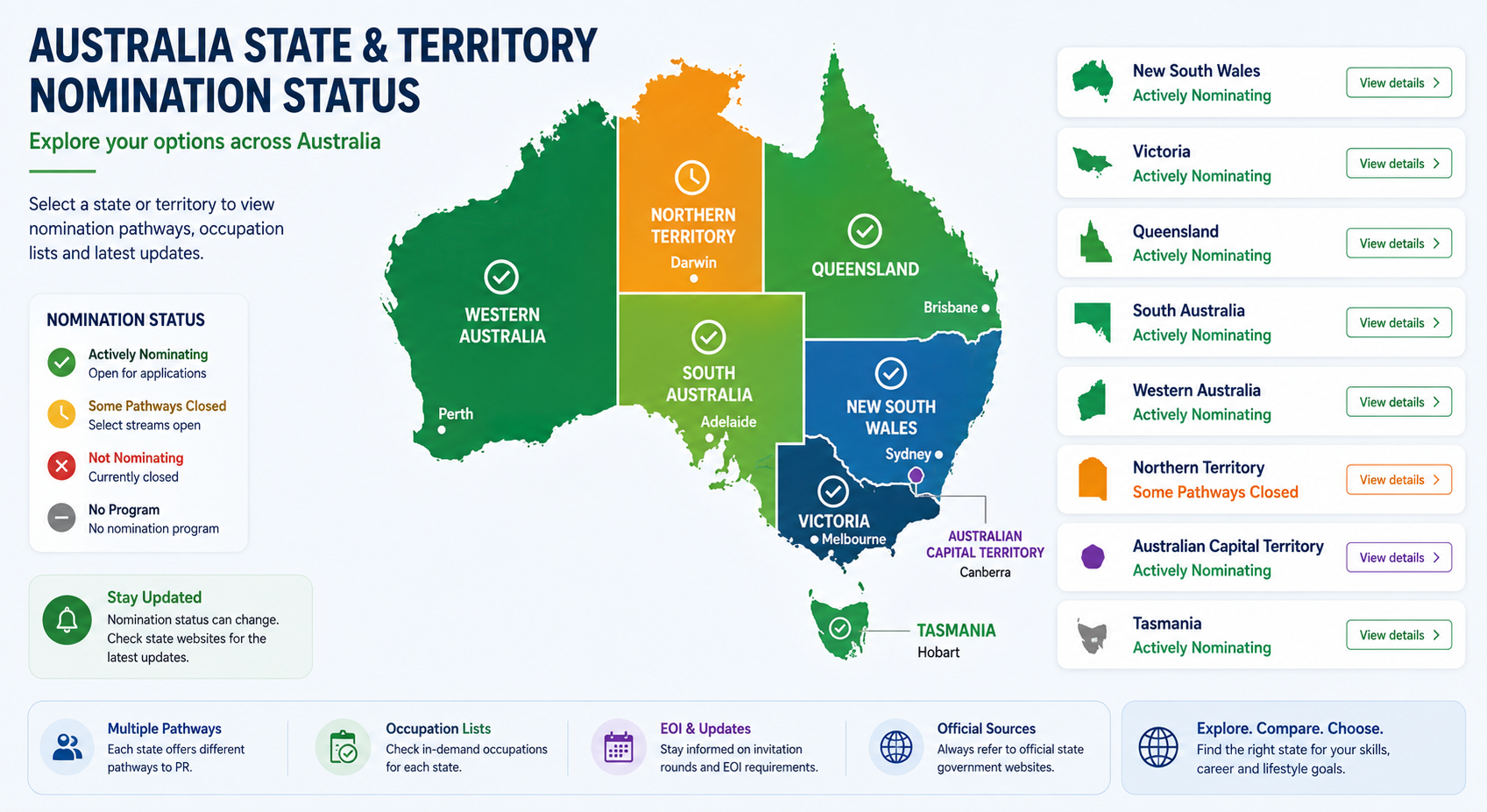
State-by-State 491 Nomination Programs

Australia state and territory 491 visa nomination programs map

Every state and territory runs its own 491 nomination stream, with its own occupation list, criteria, and (in most cases) its own application portal.

State/Territory

What to Know

New South Wales (NSW)

Nominates via a dedicated regional occupation list separate from Sydney-focused criteria; typically prioritizes healthcare, trades, and regional labour-market needs.

Victoria

Nominates for regional Victoria (outside Melbourne); occupation list and criteria updated periodically based on regional demand.

Queensland

Nominates for regional Queensland (Gold Coast and Sunshine Coast included as regional); strong demand in healthcare, engineering, and trades.

South Australia

One of the most active 491 nominating states; Adelaide itself counts as regional, and SA has historically run graduate and skilled-worker-friendly regional streams.

Western Australia

Perth counts as regional for this visa; WA nominates based on state priority occupation lists tied to its labour market needs (notably mining, engineering, and healthcare).

Tasmania

Runs one of the more accessible regional nomination programs, often with strong support for applicants already living/working in the state.

Northern Territory

Actively nominates to address skill shortages; entire NT is regional.

Australian Capital Territory (ACT)

Canberra counts as regional for 491 purposes; ACT runs its own matched/nomination criteria.

Each state’s occupation list and criteria change periodically.

What Counts as a “Regional Area” for the 491 Visa?

The rule is simple: everywhere in Australia counts as regional except Greater Sydney, Greater Melbourne, and Greater Brisbane.

That means the following do count as regional, despite being major cities:
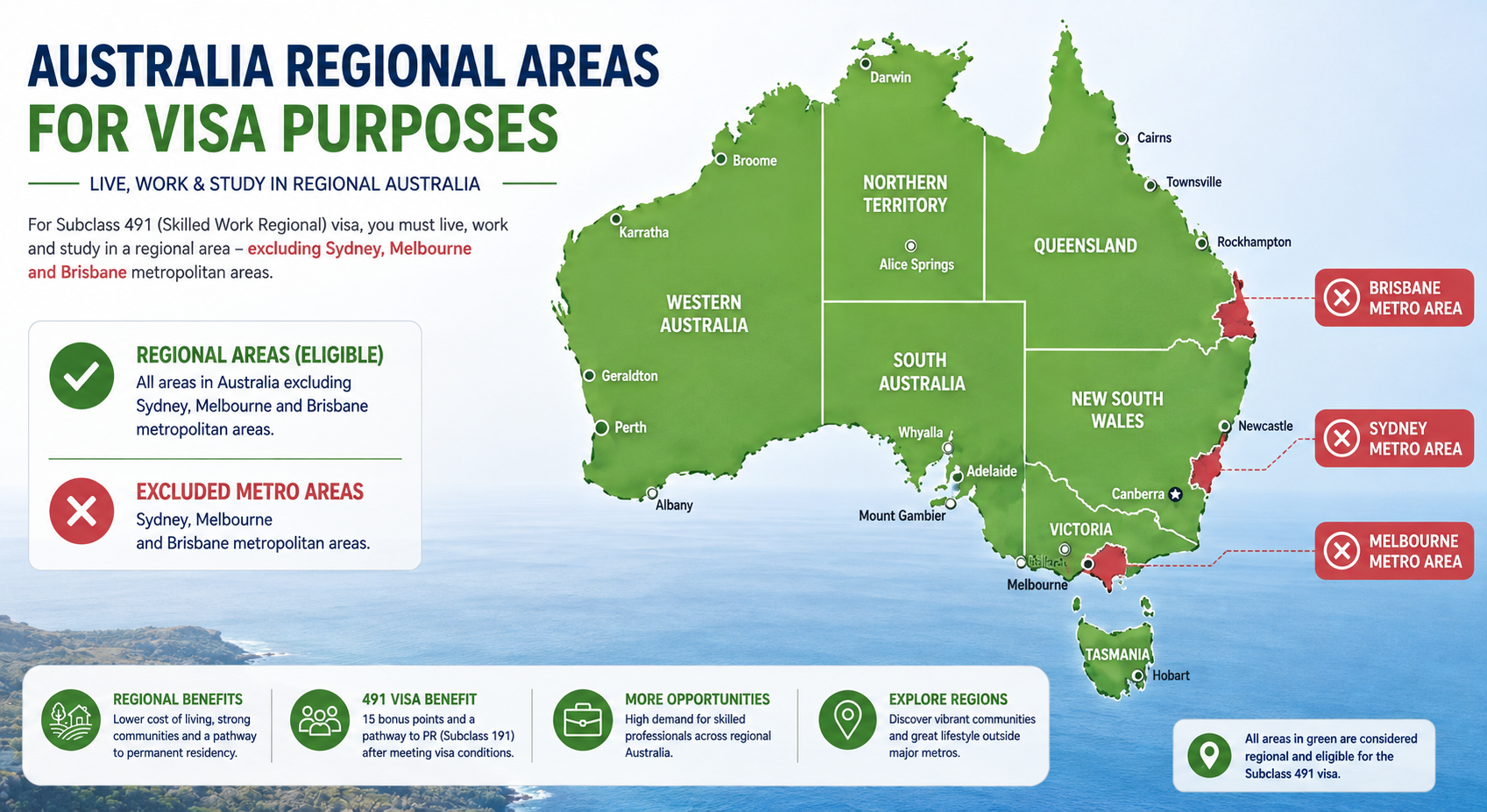
  1. Perth
  2. Adelaide
  3. Canberra
  4. Hobart
  5. Darwin
  6. Gold Coast
  7. Sunshine Coast
  8. Newcastle / Lake Macquarie
  9. Wollongong / Illawarra
  10. Geelong

Map of designated regional areas for Australia Subclass 491 visa

Plus every regional town, rural area, and smaller centre across the country. The entire states of South Australia, Tasmania, and the Northern Territory, and the whole ACT, are regional.

Only Sydney, Melbourne, and Brisbane metro areas are excluded.

Visa Condition 8579: What You Must Maintain

Once granted, your 491 visa carries Condition 8579, which requires you to live, work, and study only within designated regional areas for the life of the visa (or until you transition to Subclass 191). This includes:

  • Your primary residence must be in a regional area
  • Your place of work must be in a regional area
  • Any study you undertake must be at a regional institution

Breaching Condition 8579 — for example, by moving to Sydney, Melbourne, or Brisbane — can put your visa at risk and jeopardize your future eligibility for the Subclass 191 permanent visa. You can move freely between different regional areas (e.g., from regional NSW to Adelaide) without breaching the condition.
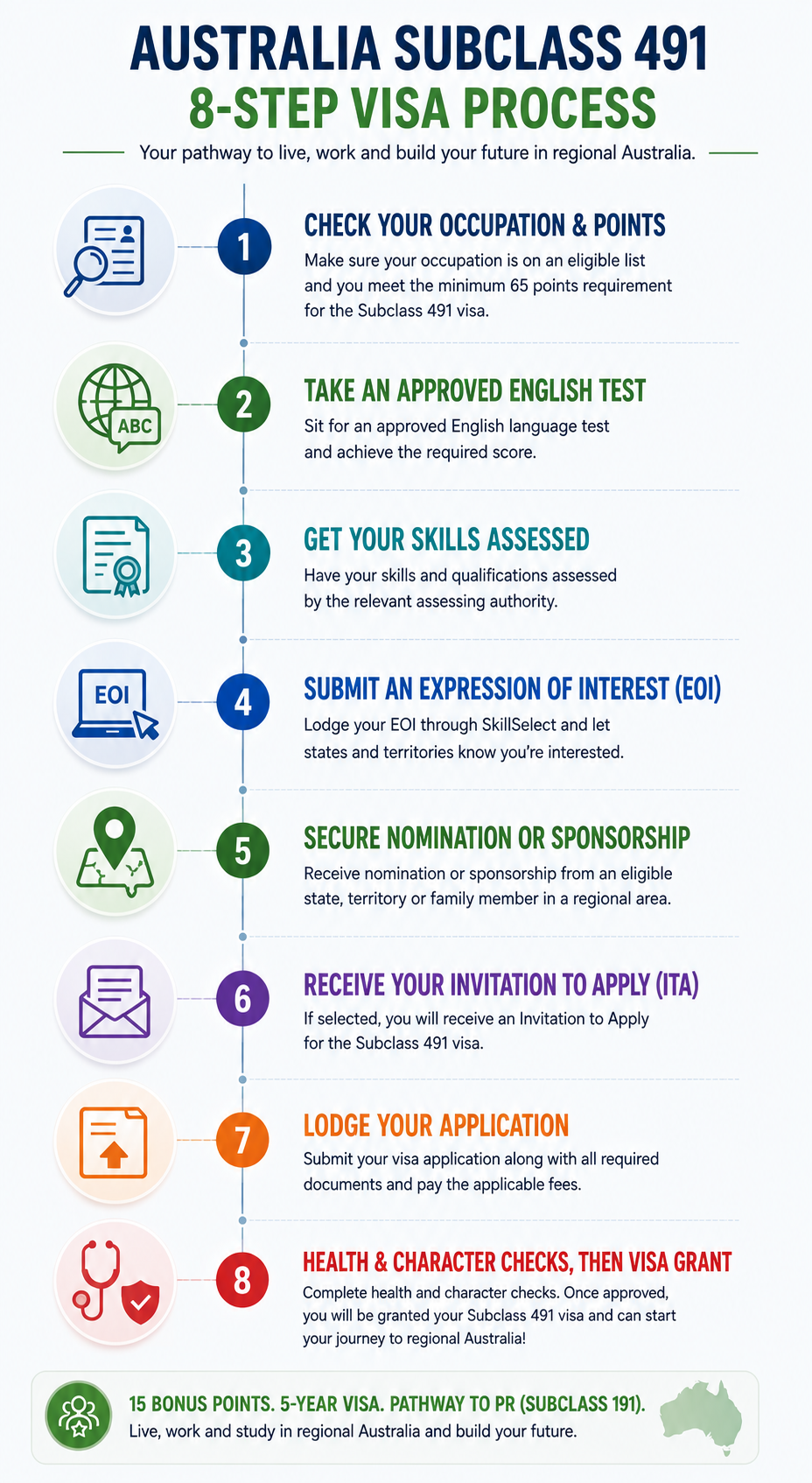
How to Apply for the Subclass 491 Visa: Step-by-Step

Step by step process to apply for Australia Subclass 491 visa

Step 1: Check Your Occupation & Points

Confirm your occupation is on the MLTSSL or ROL, and calculate your points score including the 15-point regional bonus.

Step 2: Take an Approved English Test

Sit for IELTS, PTE Academic, or another accepted test a

nd achieve at least Competent English (higher scores improve your points).

Step 3: Get Your Skills Assessed

Apply to the relevant assessing authority for a positive skills assessment in your occupation.

Step 4: Submit an Expression of Interest (EOI)

Register your interest in the 491 through SkillSelect, and (if pursuing state nomination) apply directly to your target state or territory’s regional migration program.

Step 5: Secure Nomination or Sponsorship

Receive nomination from a state/territory government, or secure sponsorship from an eligible relative living in a designated regional area.

Step 6: Receive Your Invitation to Apply (ITA)

Once nominated/sponsored and points-eligible, you’ll receive an invitation to lodge your 491 visa application.

Step 7: Lodge Your Application

Submit your full application with supporting documents within 60 days of invitation.

Step 8: Health & Character Checks, Then Visa Grant

Complete medical exams and police clearances, and receive your 5-year Subclass 491 visa.

Your Pathway to Permanent Residency: Subclass 491 to Subclass 191

After holding your Subclass 491 (or 494) visa for at least 3 years, and maintaining compliance with Condition 8579 throughout, you become eligible to apply for the Subclass 191 (Permanent Residence – Skilled Regional) visa. Unlike the 491, the 191 is a genuine permanent residency visa — once granted, all regional location restrictions are lifted and you’re free to live and work anywhere in Australia, including Sydney, Melbourne, or Brisbane.

A note on the income requirement: you may see the figure AUD 53,900/year quoted online as an income threshold for the 191 visa. This figure is outdated and doesn’t apply to the 191. It originates from the Temporary Skilled Migration Income Threshold (TSMIT) that applied to Subclass 494/187 nominations lodged between 1 July 2013 and 30 June 2023 — a different visa process entirely. The TSMIT itself has since risen substantially (to AUD 70,000 in 2023–24, AUD 73,150 in December 2024, AUD 76,515 for 2025–26, and AUD 79,423 for 2026–27), so the AUD 53,900 figure has been out of date for years regardless of which visa it’s applied to.
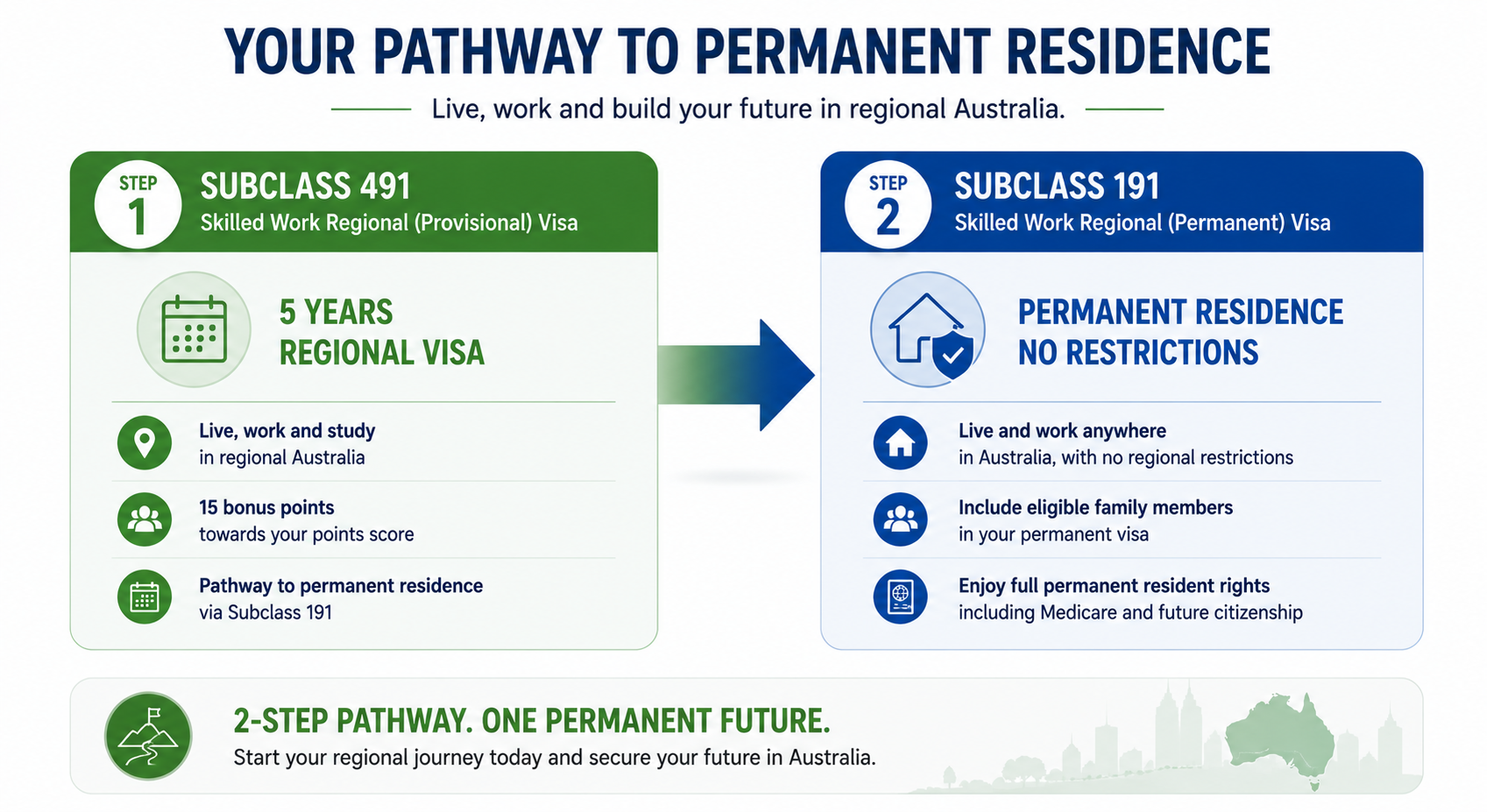
Pathway from Subclass 491 to Subclass 191 permanent residency

191 key facts:

  • No points test, no age limit, no new skills assessment required
  • Requires 3+ years holding a 491 or 494 visa with Condition 8579 compliance
  • Requires 3 years of ATO Notices of Assessment
  • Grants full, unrestricted permanent residency
  • Pathway to Australian citizenship after meeting residency requirements (generally 4 years total, including 12 months as PR)

Read our full [Australia Subclass 191 Visa: Eligibility & PR Guide] for the complete 491-to-191 transition process.

Subclass 491 Visa Fees (2026)

Following the Department of Home Affairs fee increase effective 1 July 2026, current charges are:

Applicant

Fee (AUD)

Primary applicant

6,140

Additional applicant (18+)

3,070

Dependent child (under 18)

1,535

On top of the government fee, budget for skills assessment (AUD 500–1,500), English test (AUD 200–350), medical examinations, and police clearance certificates. (Verify exact current figures via the Department of Home Affairs Visa Pricing Estimator before publishing or advising a client — fees are indexed annually on 1 July.)

Subclass 491 Visa Processing Time

Processing generally takes 6 to 12 months from application lodgement, though this varies by state nomination stream, occupation demand, and application completeness. State nomination itself can take anywhere from a few weeks to several months depending on the state and occupation.

Why Choose Pi Overseas for Your Subclass 491 Application

  • 15+ years of experience specifically in Australia immigration casework
  • 90% + Australia visas success rate
  • End-to-end support: eligibility assessment, documentation, skills assessment guidance, EOI submission support, and application review
  • Transparent, structured process with a dedicated complaint-resolution system for a smooth client experience
  • Free initial eligibility check and points assessment

If you are willing to know more about the Australia Subclass 491 Visa process, you can certainly contact us by writing us an email at mail@pioverseas.com and one of our experts will help you out in every possible way. Call us at +91-9310-10-6988 or you can also receive a call back from our expert once you fill out the inquiry form. You can also talk to our experts directly through our live chat feature and clear your doubts instantaneously.

We at Pi Overseas have a team of dedicated experts that cater to every need of the clients. We have a proven track record in the immigration industry which was achieved in a very short span of time. Our experts will help and guide you through every step of the filing process and keep you posted throughout the whole cumbersome process of visa filing.

Let’s Start Your Visa Journey — Contact Us Today

Frequently Asked Questions

The Subclass 491 Skilled Work Regional (Provisional) visa is a five year, points tested visa that lets skilled workers live, work, and study in designated regional areas of Australia. It is not a permanent visa. It grants provisional status with a clear pathway to permanent residence through the Subclass 191 visa after at least three years of regional living, provided you meet an income threshold. Unlike the Subclass 189, the 491 requires either state or territory nomination or eligible family sponsorship.

Yes, through the Subclass 191 visa. After holding the 491 for at least three years and living and working in a designated regional area during that time, you become eligible to apply for the 191, which converts your status to full, unrestricted permanent residence with no ongoing regional obligation. The three year clock starts from the date your 491 was granted, not from the date you physically arrived in Australia.

The base government application fee for the primary applicant is approximately AUD 4,640 to 4,770 as of 2026. Once you add mandatory skills assessment fees, English test fees, medical examinations, and police clearance certificates, along with fees for any included family members, the realistic total cost typically runs AUD 8,000 to 15,000 or more per applicant, scaling further with each additional family member.

Cost Component

Approximate Range (AUD)

Base visa application fee

6,140 plus AUD 3,070 for each additional applicant 18+ and AUD 1,535 per dependent child

Skills assessment

500 to 1,500

English test

200-350

Medical examination

300 to 800

Police clearance certificates

Varies by country

Realistic total per applicant

8,000 to 15,000 or more

After at least 3 years on your 491 visa, having complied with Condition 8579 (regional residence, work, and study) and provided 3 years of ATO Notices of Assessment, you become eligible to apply for the Subclass 191 permanent visa. No new points test or skills assessment is required.

Condition 8579 is the visa condition attached to the 491 (and 494) requiring you to live, work, and study only in designated regional areas. Breaching it can jeopardize your visa and your future eligibility for Subclass 191.

The maximum age to be invited for the Subclass 491 visa is 45 years. Applicants aged 25 to 32 receive the highest age points (30 points), and points reduce progressively after 32, reaching zero at 45. There is generally no lower age limit beyond the standard adult application age.

No. Unlike employer-sponsored visas, the 491 requires state/territory nomination or family sponsorship — not a job offer from an employer.

To be eligible, you generally need to be under 45 years old at the time of invitation, hold a positive skills assessment in an occupation on an eligible list, meet a minimum of Competent English, score at least 65 points on the skills migration points test (including 15 bonus points for nomination or sponsorship), and secure either a state or territory nomination or sponsorship from an eligible relative living in a designated regional area.

Requirement

Standard

Age

Under 45 at time of invitation

Skills assessment

Positive assessment in an eligible occupation

English

Competent English minimum

Points

At least 65 total, including 15 for nomination or sponsorship

Nomination or sponsorship

State/territory nomination or eligible relative in a regional area

Occupation list

MLTSSL, STSOL, or ROL (Regional Occupation List)

Based on current Department of Home Affairs processing data (75 percent of cases as of March 2026), post invitation processing for the 491 runs around 11 months, notably longer than the 189 (around 7 months) or the 190 (around 6 months). Before reaching that stage, applicants also need time for a skills assessment (2 to 6 months) and time waiting in the Expression of Interest pool for an invitation, which varies significantly depending on points score and occupation.

For 491 purposes, “regional Australia” covers nearly the entire country. The excluded, non-regional cities are Sydney, Melbourne, Brisbane, Gold Coast/Tweed Heads, Newcastle/Lake Macquarie, Wollongong, Sunshine Coast, and Perth. Every other city and town in Australia, including Adelaide, Canberra, and Hobart, counts as regional for this visa. This same regional definition also applies to the Subclass 494 employer-sponsored regional visa and the Subclass 191 permanent visa.

The technical minimum is 65 points on the skilled migration points test, the same floor used for the 189 and 190 visas. A state, territory, or family nomination adds 15 points, which is a significantly larger boost than the 5 points available for a 190 nomination. This 15 point advantage is often what pushes a borderline candidate from an unrealistic score into invitation range, since regional occupation lists and nomination rounds also tend to have lower competition than general 189 draws.

You can qualify for the 15 bonus points through either route. State or territory nomination means an Australian state or territory government formally endorses your application, usually tied to their own occupation priorities and a commitment to live in that state. Family sponsorship means an eligible relative, such as a parent, sibling, child, aunt, uncle, niece, or nephew, who is an Australian citizen or permanent resident usually residing in a designated regional area, sponsors you directly. Both pathways add the same 15 points, but the eligibility criteria and evidence required differ substantially.

Occupations on the MLTSSL (Medium and Long-term Strategic Skills List), the STSOL (Short-term Skilled Occupation List), or the Regional Occupation List (ROL) may qualify — the 491 draws from all three, giving it the broadest occupation eligibility of the points-tested skilled visas — subject to also appearing on your target state’s specific regional occupation list.

No. The 491 is a provisional visa valid for five years, not a permanent one. It comes with conditions, most importantly the requirement to live and work in a designated regional area. Permanent status only comes later, through a separate application for the Subclass 191 visa once you have met the three year regional living and income requirements.

Most current sources consistently cite a minimum individual taxable income of around AUD 53,900 per year (indexed annually for inflation), required for at least three of the five years you hold the 491. This income generally must come from employment in regional Australia, meaning salary and wages from full-time, part-time, or casual work, including income from multiple jobs combined. Business income, passive income, and a partner’s income generally do not count toward this threshold on their own.

Note on a genuine discrepancy in current sources: one source describes the Regional Provisional stream of the 191 as having no fixed minimum income threshold, requiring only three years of Australian Tax Office Notices of Assessment showing income and filed tax returns. Given this conflicting detail, treat the AUD 53,900 figure as the widely cited benchmark, but confirm the exact current requirement directly on the Department of Home Affairs website before relying on it for a real application, since this is the single most consequential number in the entire 491 to 191 pathway.

Yes. A partner and dependent children can be included in your 491 application and will receive matching visa status. Family members gain access to Medicare from the date the visa is granted, and children can attend Australian schools in the regional area where the family settles. If your 491 later leads to a 191 permanent visa, any family members included on the 491 can generally also be included on the 191 application.

Breaching the regional residency or work conditions attached to a 491 visa can seriously jeopardize your path to the Subclass 191 permanent visa and affect future visa applications. The Department of Home Affairs takes compliance seriously and can request location data, employment records, and tax information to verify that you genuinely lived and worked in a designated regional area for the required period. Because the three-year clock and income threshold are both closely tied to demonstrated regional presence, inconsistent tax records and extended time spent outside your regional area can undermine an otherwise strong application.

The most notable 2026 developments include continued annual indexing of the Subclass 191 income threshold in line with inflation, ongoing updates to the eligible occupation lists that applicants should verify directly at the time of lodging an Expression of Interest, and updated English test score requirements for tests taken on or after August 7, 2025 (for PTE specifically: Listening 47, Reading 48, Writing 51, Speaking 54, broadly equivalent to IELTS 6.0 in each component). The broader December 2024 to July 2025 reform wave affecting employer sponsored migration, including the Skills in Demand visa and the Core Skills Occupation List, does not directly change 491 eligibility, since the 491 remains governed by MLTSSL, STSOL, and ROL rather than the newer CSOL.

The Subclass 190 (Skilled Nominated) visa is a permanent visa with no location restriction once granted, while the Subclass 491 is a provisional visa that requires you to live, work, and study only in a designated regional area for at least three years before you can apply for permanent residency. The 491 also offers 15 bonus points versus 5 points for the 190, which can make it easier to reach a competitive score.

Yes. The Subclass 491 visa does not require a job offer from an Australian employer. You can be nominated by a state or territory government based on your occupation and points score, or sponsored by an eligible family member, without needing employment secured in advance. However, some state nomination streams do prioritize applicants who already have a regional job offer, so check the specific state’s criteria before applying.

All Australian states and territories run their own Subclass 491 nomination programs, including New South Wales, Victoria, Queensland, South Australia, Western Australia, Tasmania, the Northern Territory, and the Australian Capital Territory. Each jurisdiction sets its own occupation list, points thresholds, and additional criteria such as a regional job offer or genuine commitment to living in that state, so eligibility and processing speed vary by location.

The primary applicant on a Subclass 491 visa generally needs at least Competent English, roughly equivalent to an IELTS score of 6 in each band (or an equivalent score on PTE Academic, TOEFL iBT, or OET). Secondary applicants aged 18 or over usually need to demonstrate at least Functional English or pay an additional visa charge.

For many skilled applicants, yes. The Subclass 491 visa offers 15 bonus points, making it more achievable for applicants who cannot yet compete at the higher scores often needed for the Subclass 189 or 190, and it provides a clear three year pathway to permanent residency via the Subclass 191 visa. The main trade off is the requirement to live and work in a regional area rather than a major city during that period.

Yes. Despite being a capital city, Perth is classified as a designated regional area for the Subclass 491 visa, along with Adelaide, Canberra, Hobart, Darwin, and the Gold Coast. Only Sydney, Melbourne, and Brisbane are excluded from the regional definition.