
+91 9310106988
mail@pioverseas.com
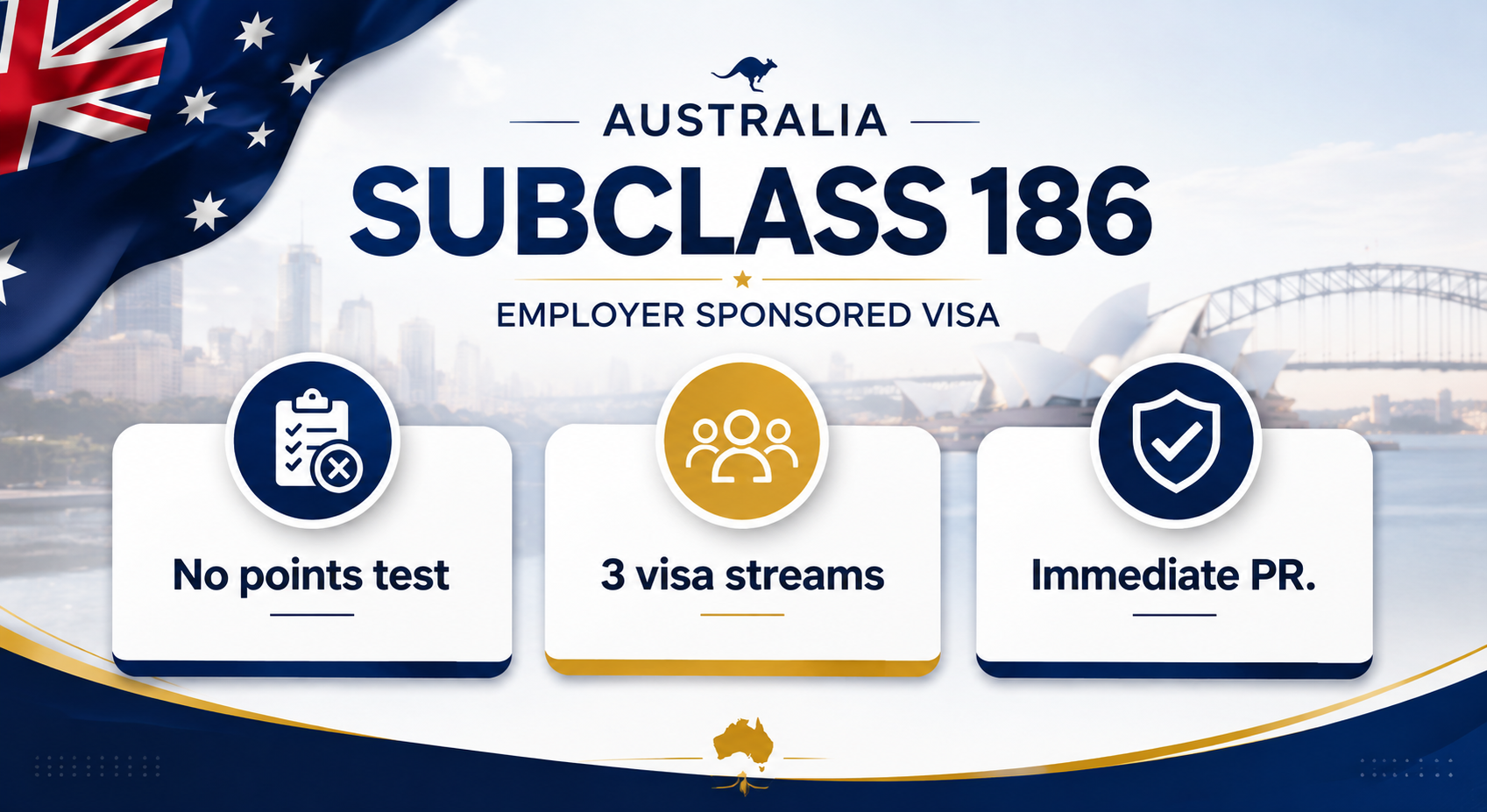
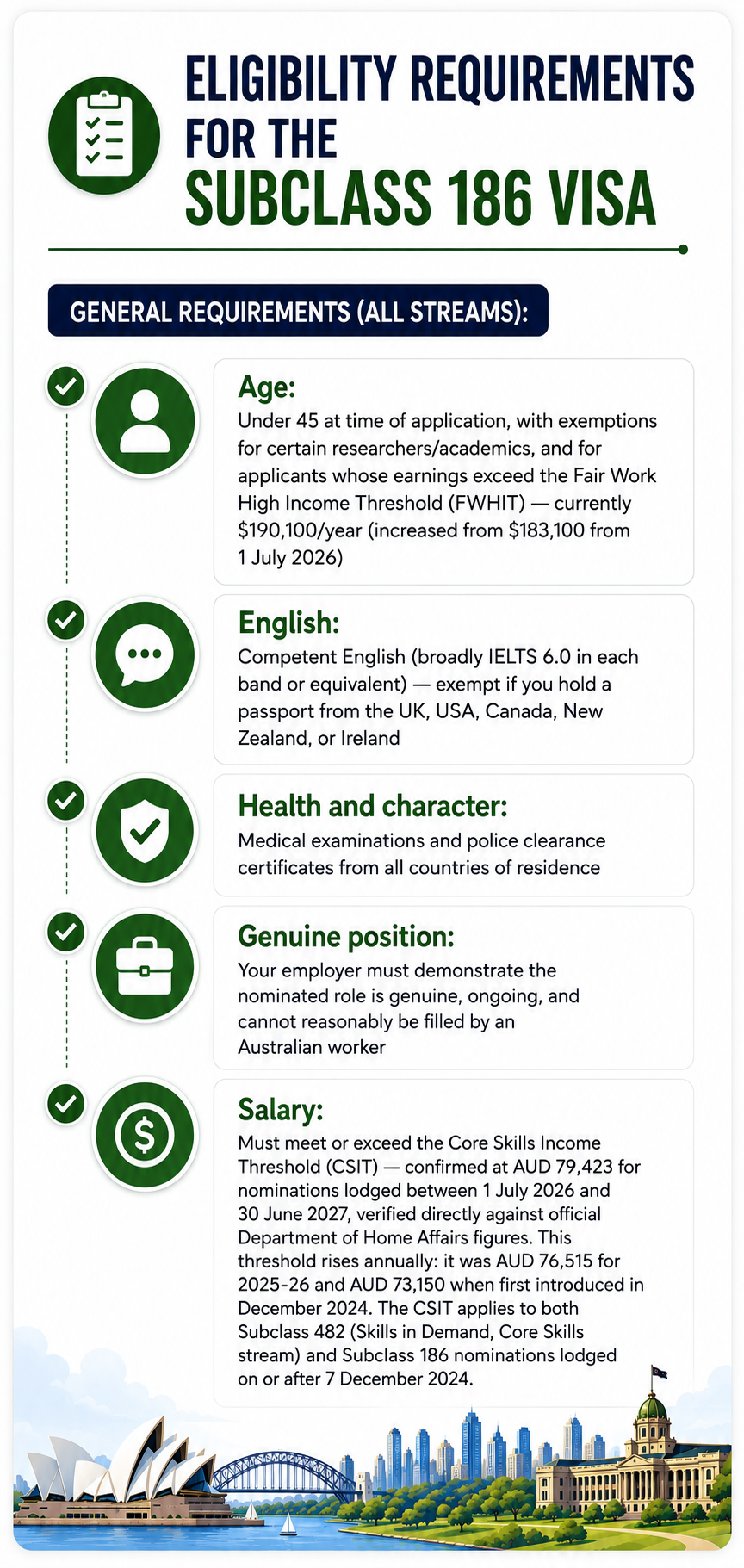
The Subclass 186 (Employer Nomination Scheme) visa is Australia’s primary employer-sponsored permanent residency visa — and unlike the 189, 190, and 491, it involves no points test at all. If an Australian employer is willing to nominate you for a genuine, ongoing skilled role and you meet the age, skills, salary, and English requirements, you can be granted PR directly, regardless of how you’d score on the points test used for independent skilled migration.
The 186 has three distinct streams — Direct Entry, Temporary Residence Transition (TRT), and Labour Agreement — and which one applies to you depends heavily on your current visa status and work history in Australia. Getting the stream right matters: it changes whether you need a fresh skills assessment, how long you need to have worked with your employer, and what evidence you’ll need to provide.
This guide covers all three streams, current eligibility requirements, the salary threshold your employer must meet, occupation list requirements, fees (including who pays what), processing times, and how the 186 compares to the Skills in Demand (482) visa most applicants transition from.
NOTE: The Subclass 186 grants immediate, direct permanent residency to skilled workers nominated by an approved Australian employer, with no points test required. Eligibility depends on your stream: Direct Entry requires a positive skills assessment and an MLTSSL-listed occupation; TRT requires at least 2 years working full-time for your nominating employer on a 482 (or legacy 457) visa; Labour Agreement applies where your employer has a negotiated agreement with the Australian government. Your employer’s offered salary must meet the Core Skills Income Threshold (CSIT), indexed annually.
Key features:
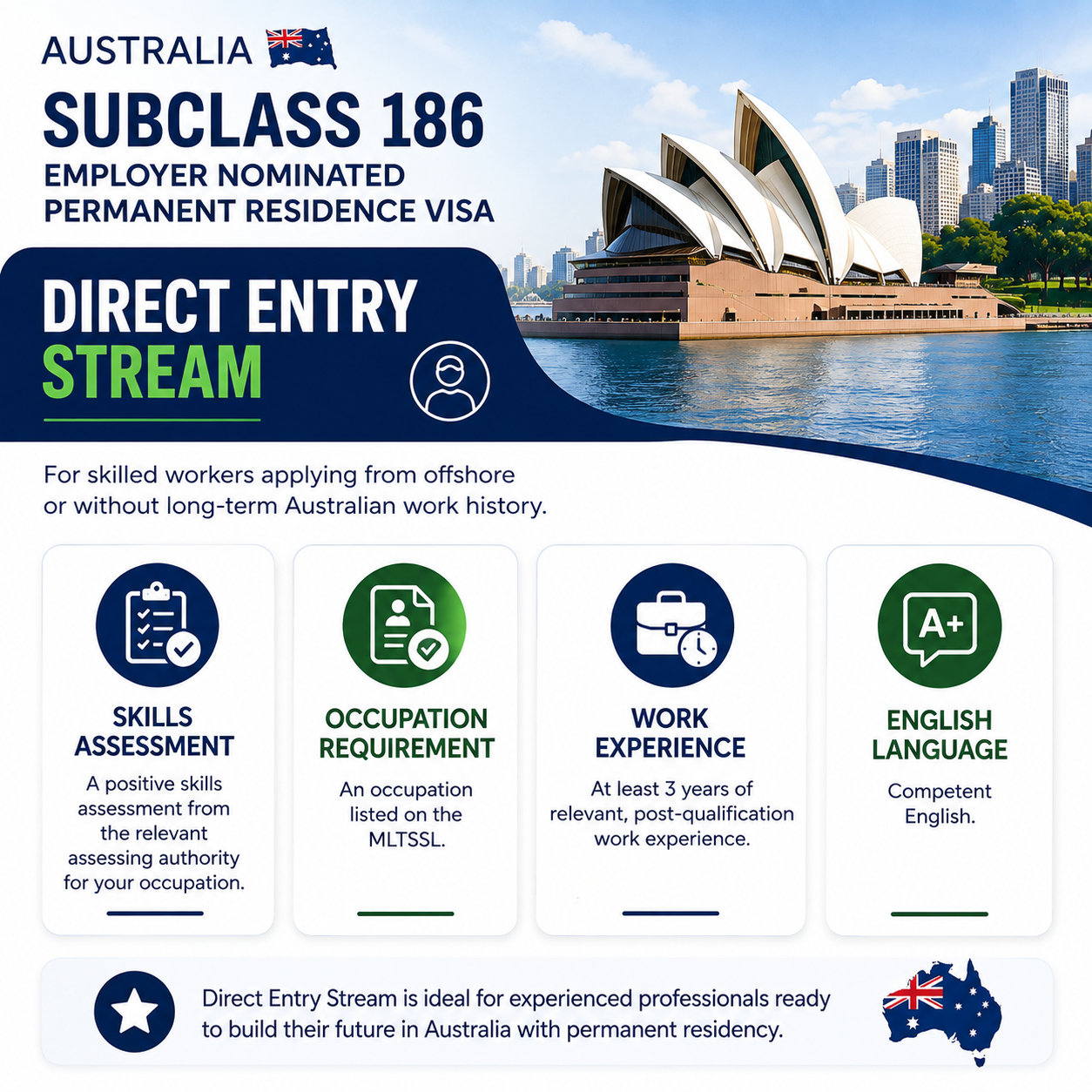
For skilled workers who haven’t held an Australian work visa long enough to qualify for TRT, or who are applying from offshore with no prior Australian work history. Requires:
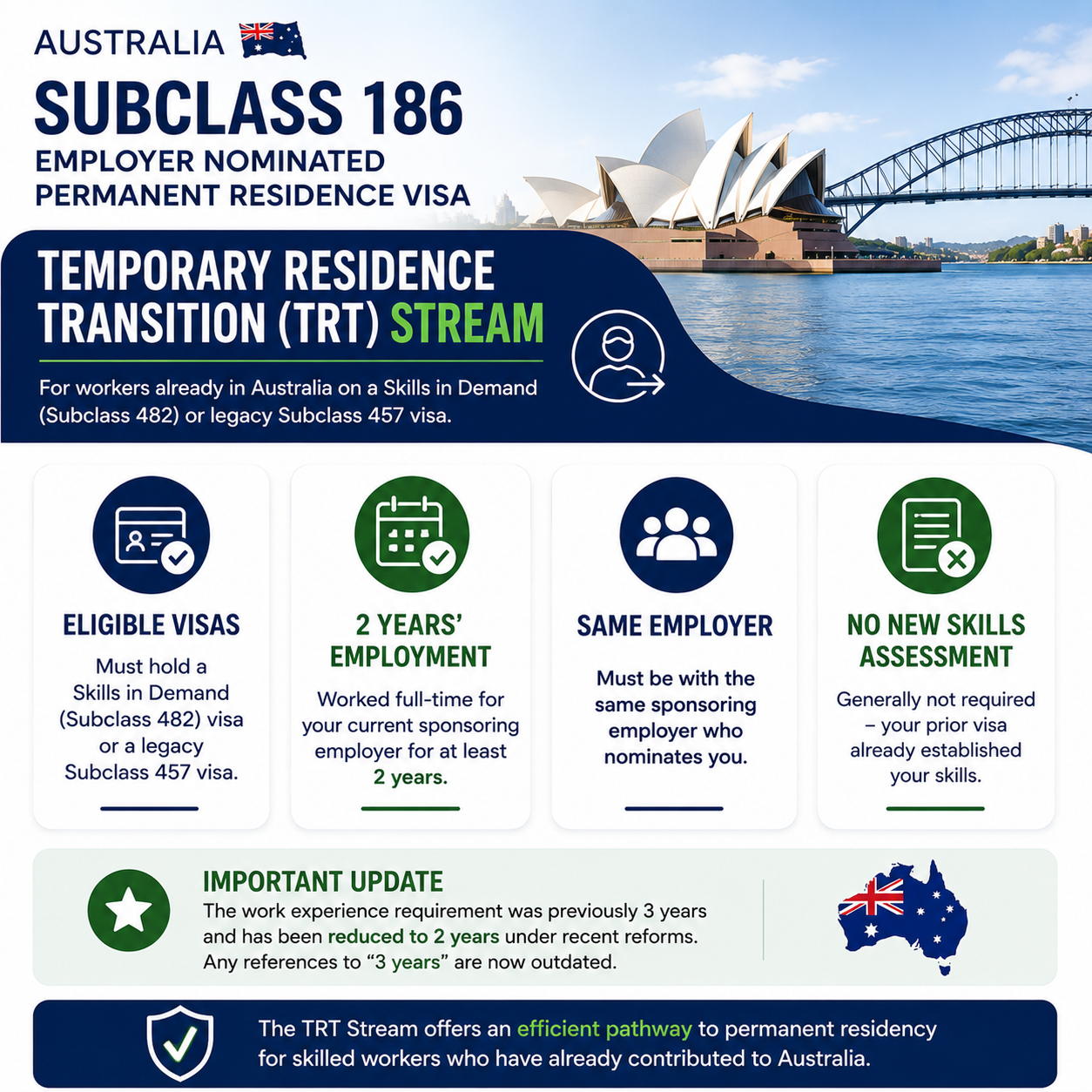
For workers who are already in Australia on a Skills in Demand (Subclass 482) visa, or a legacy Subclass 457 visa, and have worked full-time for their current sponsoring employer for at least 2 years. Here’s an important, commonly outdated detail: this requirement was previously 3 years and was reduced to 2 years under recent reforms. TRT generally does not require a fresh skills assessment, since your prior visa approval already established your skills — one of its biggest practical advantages over Direct Entry.
Note: the 457 visa closed to new applicants in March 2018. TRT applicants today are overwhelmingly transitioning from 482, not 457 — 457 remains relevant only to the shrinking pool of applicants who still hold a legacy 457.
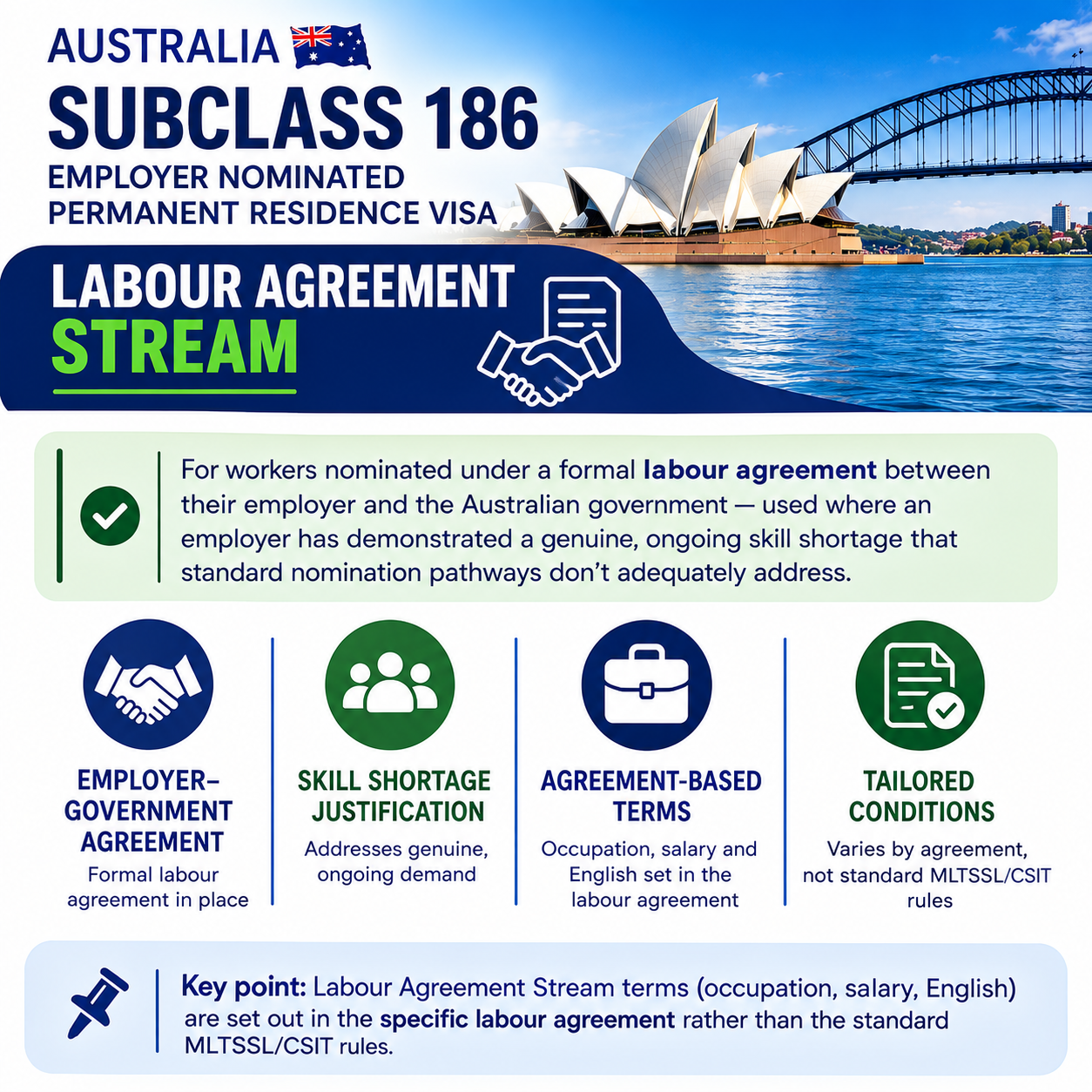
For workers nominated under a formal labour agreement between their employer and the Australian government — used where an employer has demonstrated a genuine, ongoing skill shortage that standard nomination pathways don’t adequately address. Terms (occupation, salary, English requirements) are set out in the specific labour agreement rather than the standard MLTSSL/CSIT rules.
Most 186 applicants are coming from, or considering, the 482 (Skills in Demand) visa.
Criteria | Subclass 482 (Skills in Demand) | Subclass 186 (ENS) |
Visa type | Temporary (up to 4 years) | Permanent |
Points test | No | No |
SAF levy | Yes, paid annually per year of visa duration | Yes, one-off payment at nomination |
PR pathway | Via TRT stream of 186 (after 2 years) | Direct — this is the PR visa |
Occupation list | CSOL (Core Skills Occupation List) | MLTSSL (Direct Entry stream) |
Read our full [Skills in Demand (Subclass 482) Visa] guide if you’re earlier in your employer-sponsorship journey and considering 482 as your first step toward 186.
Get a personalised document checklist for your specific 186 stream: Free Consultation
Cost Component | Amount (AUD) | Who Pays |
Visa application charge (primary applicant) | ~6,140 | Applicant |
Additional applicant (18+) | ~3,070 | Applicant |
Dependent child (under 18) | ~1,535 | Applicant |
Employer nomination fee | 540 | Employer |
SAF (Skilling Australians Fund) levy — one-off | AUD 3,000 (business turnover under $10M) / AUD 5,000 (turnover $10M or more) — confirmed via the official Home Affairs SAF levy calculator | Employer |
Second English instalment (if functional English isn’t demonstrated) | Reported figures vary, roughly AUD 9,800 | Applicant, where applicable |
On the SAF levy specifically —the ENS/RSMS (which includes Subclass 186) one-off levy is AUD 3,000 for small businesses (turnover under $10M) and AUD 5,000 for other businesses. The lower AUD 1,200/1,800 figures some sources cited for “186” actually describe the annual Skills in Demand (482) rate, charged per year of proposed stay.
By law, employers cannot pass the nomination fee or SAF levy on to the visa applicant — attempting to do so is a sponsorship compliance breach.
Processing varies meaningfully by stream and is generally considered one of the slower PR pathways. Based on current published Department data, Direct Entry applications have recently run in the range of 9-13 months for 50% of applications, with longer tails for more complex cases. TRT applications are often faster given the reduced documentation burden (no fresh skills assessment). Priority processing applies to certain occupations.
If you are willing to know more about the Australia Subclass 186 Visa process, you can certainly contact us by writing us an email at mail@pioverseas.com and one of our experts will help you out in every possible way. Call us at +91-9310-10-6988 or you can also receive a call back from our expert once you fill out the inquiry form. You can also talk to our experts directly through our live chat feature and clear your doubts instantaneously.
We at Pi Overseas have a team of dedicated experts that cater to every need of the clients. We have a proven track record in the immigration industry which was achieved in a very short span of time. Our experts will help and guide you through every step of the filing process and keep you posted throughout the whole cumbersome process of visa filing.