Australia’s skilled migration points test hasn’t seen a structural overhaul in years — and that’s about to change. The 2026–27 Federal Budget confirmed the government will reform the points test used for permanent skilled visas, calling it one of the biggest updates to the system in a decade. If you’re sitting on an Expression of Interest for Subclass 189, 190, or 491, or you’re still building your profile, here’s what’s actually been confirmed and what’s still being worked out.
What was actually confirmed
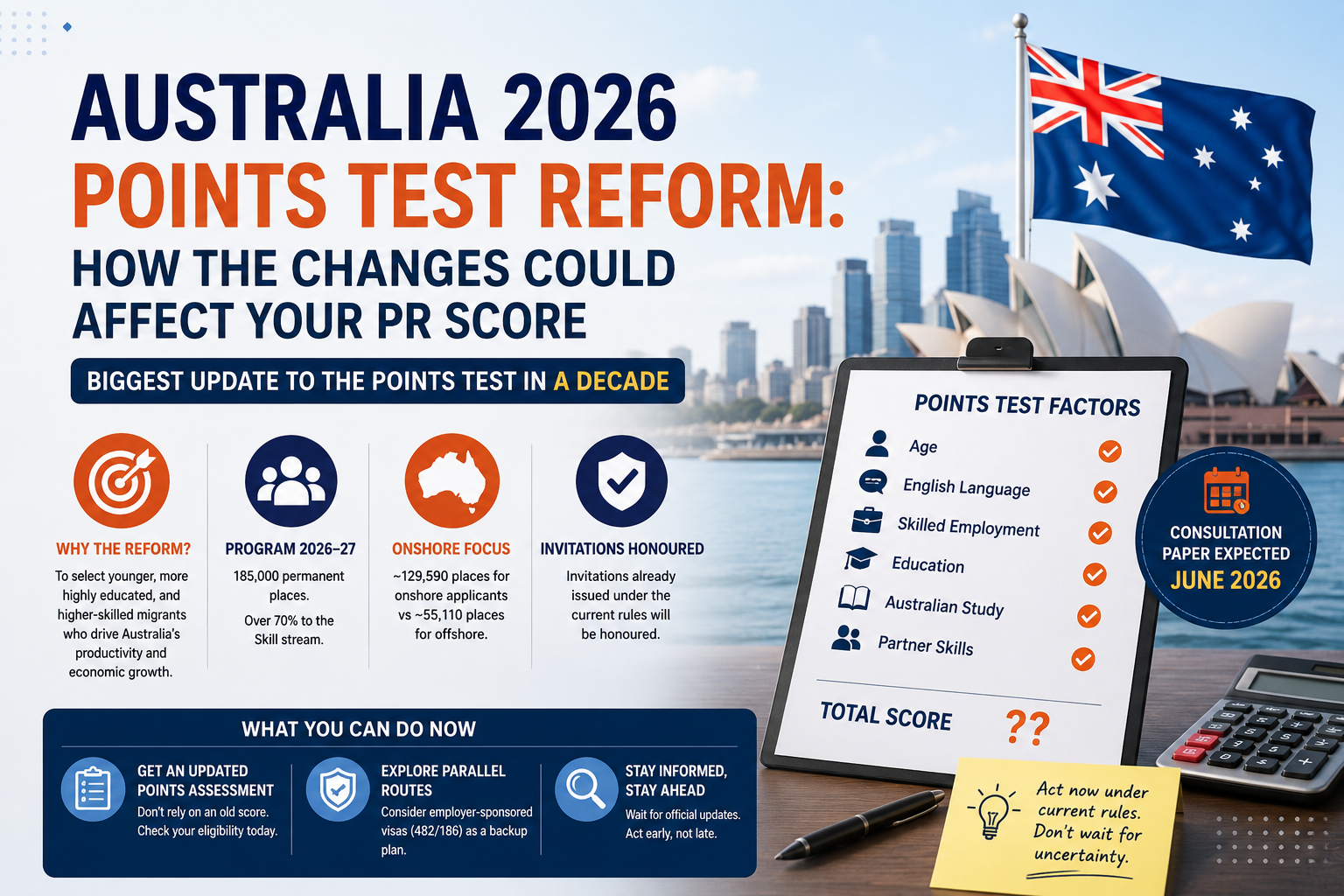
The Australian Government has stated it will “optimize” the points test to select better migrants who support the country’s long-term economic and productivity goals — specifically, candidates the government describes as younger, more highly educated, and higher-skilled overall. The 2026–27 permanent Migration Program is being held at 185,000 places, with more than 70% of those allocated to the Skill stream. Within that, the government has confirmed a clear preference for onshore applicants, allocating roughly 129,590 places to migrants already living in Australia compared with around 55,110 offshore places.
Importantly, the government has also confirmed that invitations already issued under the current points matrix will be honoured — so if you’ve already received an invitation, this reform doesn’t retroactively change your application.
Things that are still genuinely unknown
This is where a lot of competing content gets ahead of itself, so it’s worth being precise. The government hasn’t yet released the details of how the new points test will actually work. Several things are being floated in industry discussion but are not yet official: whether the minimum points threshold to lodge an EOI (currently 65) will rise, possibly to 70; whether a new income-based points factor will be introduced for applicants already earning above Australia’s Specialist Skills Income Threshold (currently around AUD 141,210); how partner skills points might be treated; and whether regional study bonuses and Professional Year credits will survive the redesign.
The honest answer, which the Migration Institute of Australia and several migration law firms have echoed, is that none of this is confirmed until the government’s consultation paper is released — expected around June 2026 — and the actual rule changes are formalised after that. Be skeptical of any source presenting exact new point values as settled fact right now.
Which visas this affects
The points test applies to the main points-tested permanent skilled pathways: Subclass 189 (Skilled Independent), Subclass 190 (Skilled Nominated), and Subclass 491 (Skilled Work Regional). It’s worth noting that employer-sponsored pathways — Subclass 482 (Skills in Demand) and Subclass 186 (Employer Nomination Scheme) — aren’t governed by the points test at all, which makes them worth considering as a parallel route if you’re concerned about how the points reform might affect your competitiveness.
What this means for Indian applicants right now
Competitive invitation rounds already typically require scores well above the current 65-point minimum — most successful applicants in recent rounds have scored in the 85–100+ range. If the floor does rise and additional weight shifts toward factors like age (with the 25–32 bracket widely expected to be favoured) and English proficiency, applicants who are older or who were relying heavily on study-related bonus points may find their relative position weaker once any changes land, even if their absolute score doesn’t change.
The practical risk isn’t the reform itself — it’s the temptation to wait passively for clarity that may not arrive until mid-2026 or later. Points test history in Australia shows that transition periods tend to reward people who acted under the existing rules rather than those who paused indefinitely.
What to do while the details are pending
Get a proper, current points assessment done now rather than relying on a score you calculated months ago — language test results and skills assessments have validity windows, and letting either lapse while waiting for “the new system” can cost you months later. If your profile leans heavily on factors that are explicitly part of the reform conversation — older age bands, regional study bonuses, partner points — it’s worth discussing a parallel strategy, including whether an employer-sponsored visa makes sense as a hedge. And treat any sources of news on this topic with care: distinguish, as we’ve tried to here, between what the Budget papers actually said and what individual migration agents are speculating about.
Want a clear picture of where your profile stands today, and how to hedge against the upcoming points test changes? Book a free Australia PR points assessment with our migration team.
Australia‘s points test reform is an active, evolving policy process. We’ve distinguished above between what’s officially confirmed in Budget documents and what remains industry speculation, and recommend checking the Department of Home Affairs website for the latest official updates before making application decisions.