Canada remains one of the most popular permanent immigration destinations for Indian professionals, offering multiple well-established pathways to permanent residency — primarily through Express Entry, Provincial Nominee Programs (PNP), and the Quebec Skilled Worker Program (QSWP). As a Delhi-based immigration consultancy, Pi Overseas has guided applicants through each of these pathways, from initial eligibility assessment through to visa grant.
This guide covers Canada’s main PR pathways, eligibility requirements, the documents you’ll need, the step-by-step application process, and how our team can support you through each stage.
NOTE: Indians can pursue Canadian permanent residency mainly through Express Entry (a points-based system using the Comprehensive Ranking System, or CRS) or through a Provincial Nominee Program (PNP), where a Canadian province nominates skilled workers to address local labour needs. Applicants generally need a positive National Occupational Classification (NOC) match, language test results (IELTS/CELPIP/TEF), and proof of funds. Applications are managed by Immigration, Refugees and Citizenship Canada (IRCC).
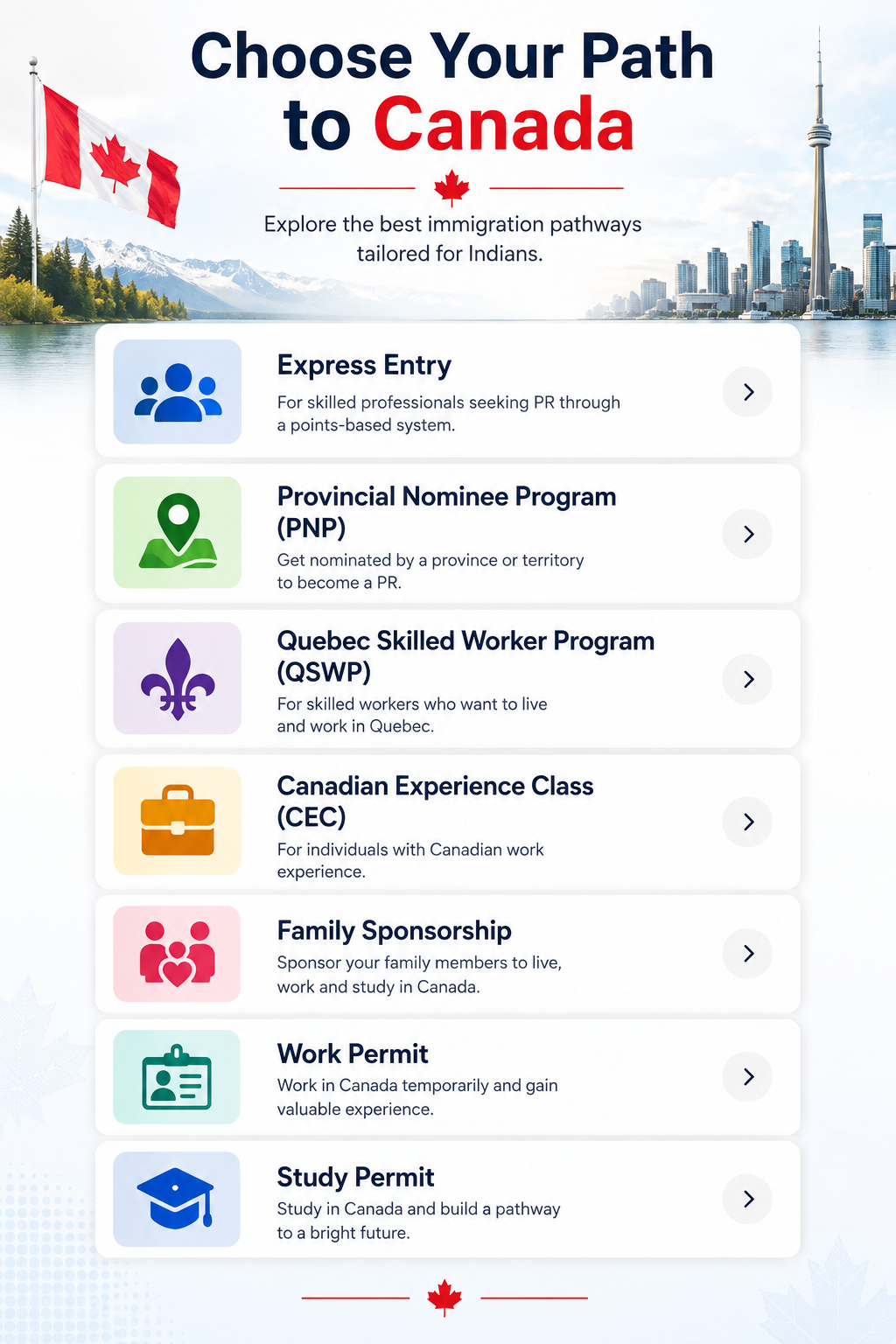
Canada offers several distinct routes to permanent residency, each suited to different profiles:
Pathway | Best Suited For |
Express Entry | Skilled workers with strong CRS-relevant profiles (age, education, work experience, language scores) |
Provincial Nominee Program (PNP) | Applicants with skills matching a specific province’s labour market needs, or with a connection to that province |
Quebec Skilled Worker Program (QSWP) | Applicants targeting Quebec specifically, assessed under Quebec’s own selection criteria (Arrima) |
Canadian Experience Class (CEC) | Applicants who already have Canadian work experience |
Family Sponsorship | Applicants with a spouse, partner, or eligible family member who is a Canadian citizen or PR holder |
Work Permit | Those seeking to work in Canada temporarily, sometimes as a stepping stone toward PR |
Study Permit | Students pursuing education in Canada, often followed by a Post-Graduation Work Permit and PR pathway |
Read our dedicated guides for [Canada Express Entry], [Canada PNP], [Quebec Skilled Worker Program], [Canadian Experience Class], [Canada Work Permit], and [Study in Canada] for full eligibility, points, fees, and process details for each pathway.
Express Entry is a points-based system managed by Immigration, Refugees and Citizenship Canada (IRCC), using the Comprehensive Ranking System (CRS) to rank candidates. It covers three federal programs:
Candidates are ranked by CRS score based on age, education, work experience, and language proficiency, with additional points available for a provincial nomination — currently the single largest score boost — or French language skills. IRCC periodically issues rounds of invitations, inviting the highest-ranked candidates in the pool to apply for permanent residence.
See our dedicated [Canada Express Entry] guide for the full CRS scoring breakdown, current draw trends, government fees, and a points calculator.
Each Canadian province and territory (except Quebec, which runs its own separate system) operates its own Provincial Nominee Program, allowing them to nominate skilled workers who match their specific labour market needs. A provincial nomination adds significant CRS points if pursued alongside Express Entry, or can lead to PR through a province’s “base” (non-Express Entry-aligned) streams.
See our dedicated [Canada PNP] and [Alberta PNP] guides for province-specific streams and eligibility criteria.
Quebec selects its own economic immigrants independently of the federal Express Entry system, through its own points-based system assessed via the Arrima portal. Successful candidates receive a Certificat de sélection du Québec (CSQ), after which they apply to IRCC for permanent residence, where IRCC conducts medical and criminal background checks before a final decision.
See our dedicated [Quebec Skilled Worker Program] guide for eligibility, the EOI process, and current processing fees.
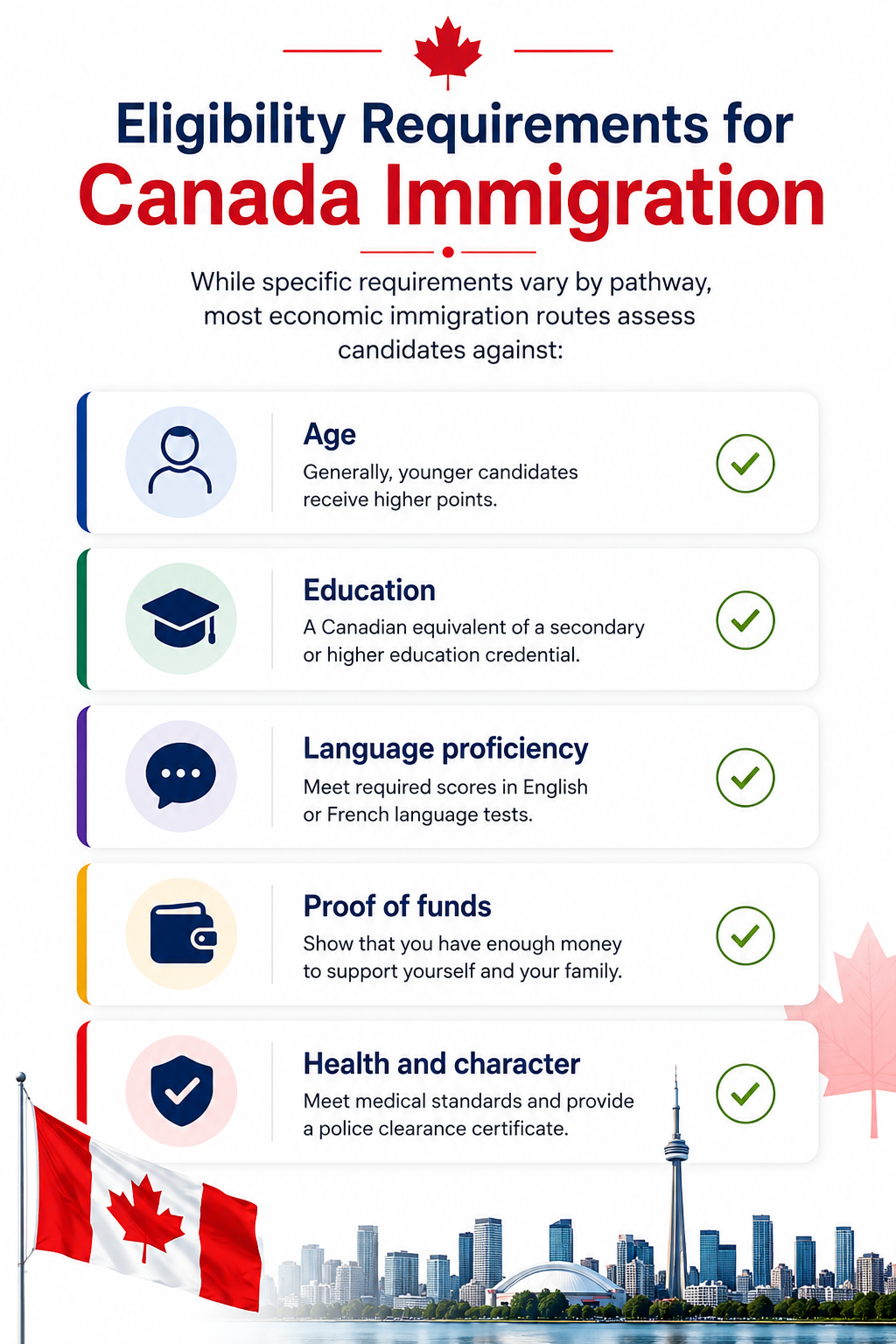
While specific requirements vary by pathway, most economic immigration routes assess candidates against:
Important: All documents submitted must be current and typically need to be submitted within 60 days of receiving your Invitation to Apply (ITA) — missing this window can result in your application being refused, so having documents prepared in advance of your EOI submission is strongly recommended.
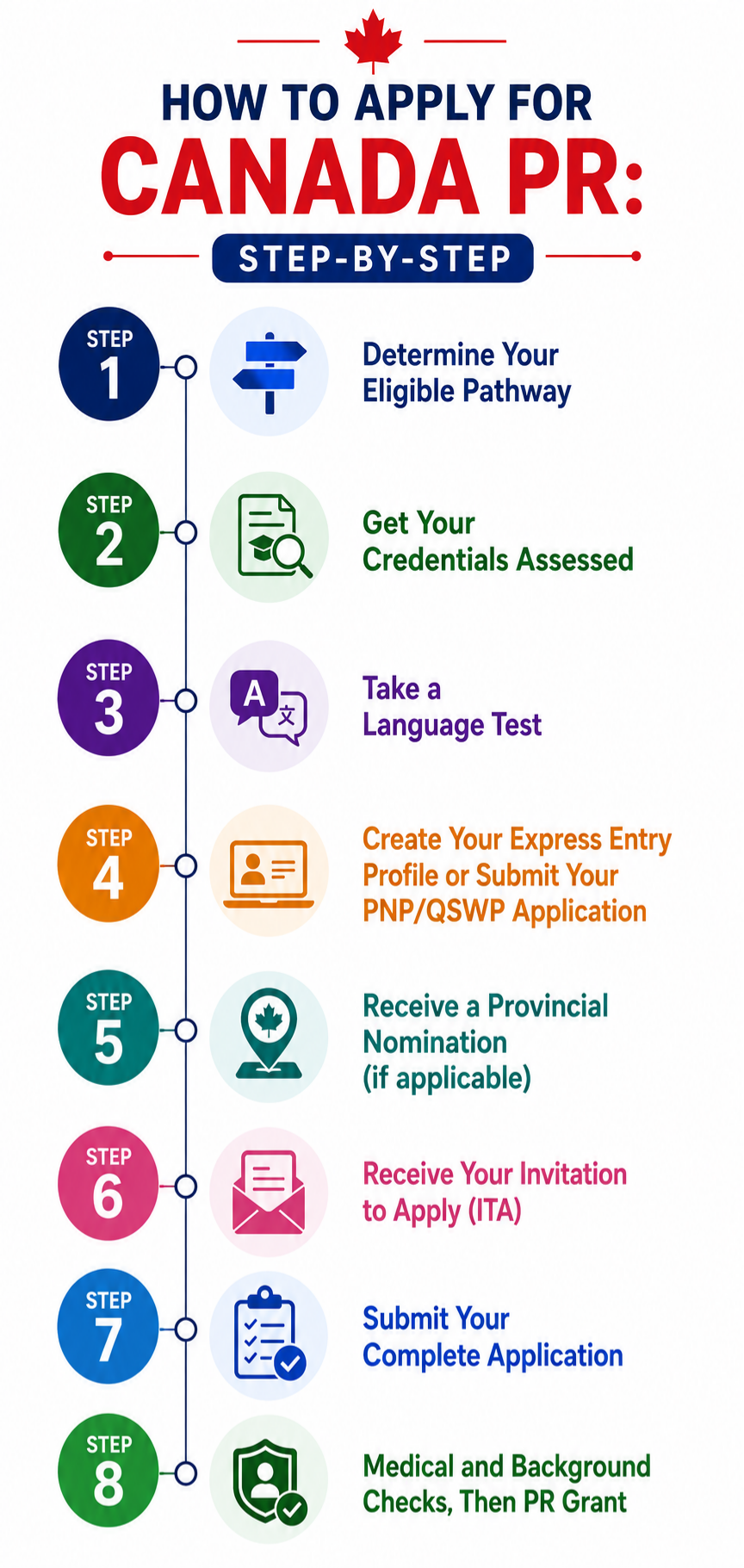
Step 1: Determine Your Eligible Pathway
Assess whether Express Entry, PNP, or QSWP best fits your profile.
Step 2: Get Your Credentials Assessed
Obtain an Educational Credential Assessment (ECA) for your qualifications.
Step 3: Take a Language Test
Sit for IELTS/CELPIP (English) or TEF/TCF (French), depending on your target pathway.
Step 4: Create Your Express Entry Profile or Submit Your PNP/QSWP Application
Enter the Express Entry pool with your CRS score, or apply directly through your target province or Quebec’s Arrima system.
Step 5: Receive a Provincial Nomination (if applicable)
If pursuing PNP, secure nomination from your target province, which adds significant CRS points if aligned with Express Entry.
Step 6: Receive Your Invitation to Apply (ITA)
Once ranked highly enough (or nominated), you’ll receive an ITA.
Step 7: Submit Your Complete Application
Lodge your full application with all supporting documents within 60 days of your ITA.
Step 8: Medical and Background Checks, Then PR Grant
IRCC conducts medical and criminal background checks before issuing your Confirmation of Permanent Residence.
If you are willing to know more about the Canada Immigration process, you can certainly contact us by writing us an email at mail@pioverseas.com and one of our experts will help you out in every possible way. Call us at +91-9310-10-6988 or you can also receive a call back from our expert once you fill out the inquiry form. You can also talk to our experts directly through our live chat feature and clear your doubts instantaneously.
We at Pi Overseas is one of the best Canada Immigration Consultancy and have a team of dedicated experts that cater to every need of the clients. We have a proven track record in the immigration industry which was achieved in a very short span of time. Our experts will help and guide you through every step of the filing process and keep you posted throughout the whole cumbersome process of visa filing.
Most Indian applicants immigrate to Canada through Express Entry (a points-based federal system) or a Provincial Nominee Program (PNP), both leading to permanent residency. Eligibility depends on factors like age, education, work experience, and language proficiency.
Express Entry is Canada’s primary system for managing applications for skilled worker immigration, using the Comprehensive Ranking System (CRS) to rank candidates and invite the highest-scoring applicants to apply for permanent residence.
The Comprehensive Ranking System (CRS) score ranks Express Entry candidates based on factors including age, education, work experience, and language proficiency, with additional points available for a provincial nomination (+600 points, the single largest boost available) or French language skills.
Note: a job offer no longer adds CRS points as of 25 March 2025 — see our dedicated [Canada Express Entry] guide for the full current breakdown.
Express Entry is a federal, points-based system open to skilled workers nationally, while PNP allows individual provinces to nominate candidates who match their specific labour market needs — a provincial nomination can also add substantial CRS points if pursued through an Express Entry-aligned PNP stream.
No. Many Express Entry candidates, particularly under the Federal Skilled Worker Program, don’t need a job offer to qualify, though having one can add CRS points and improve your ranking.
Processing times vary by pathway and individual circumstances. Check IRCC’s current processing time tool for the most accurate estimate for your specific application type.
The Quebec Skilled Worker Program (QSWP) is Quebec’s own selection system for economic immigrants, run independently of federal Express Entry through the Arrima portal, leading to a Certificat de sélection du Québec (CSQ) before final IRCC approval.
Common requirements include a valid passport, Educational Credential Assessment (ECA), language test results, employment reference letters, proof of funds, medical exam results, and police clearance certificates from all countries of residence.
The National Occupational Classification (NOC) is Canada’s system for classifying jobs by skill type and level. Your work experience must match an eligible NOC code for most economic immigration pathways, and it directly affects your eligibility and CRS points.
You still need to demonstrate language proficiency, but IELTS isn’t the only option — CELPIP is also accepted for English, while TEF and TCF are accepted for French, depending on your chosen pathway.
The required proof of funds depends on your family size and is updated periodically by IRCC — applicants with a valid Canadian job offer or those already legally working in Canada are generally exempt from this requirement.
Yes. Your spouse or common-law partner and dependent children can generally be included in your Express Entry profile or PNP application and receive permanent residency alongside you.
Once you receive an ITA, you generally have 60 days to submit your complete application with all supporting documents to IRCC, who then conduct medical and background checks before issuing a final decision.
There’s no single “easiest” province — each runs its own streams and criteria based on its specific labour market needs, which change based on demand. The right choice depends on your occupation, profile, and any existing connection you have to a particular province.
Yes. Permanent residents can generally apply for Canadian citizenship after meeting IRCC’s residency requirements, which include a minimum period of physical presence in Canada within a set timeframe.
Several notable shifts are underway in 2026: permanent residence and citizenship fees increased on April 30 and March 31 respectively; five new Express Entry categories (senior managers, researchers, transport, physicians, military recruits) launched in February, while the agriculture and education categories were retired; job offer points remain removed from the CRS calculation (a change from March 2025); and overall federal high-skilled landing targets were reduced to 109,000 for the year, down from previous levels.
Because Canada’s Immigration Levels Plan and category list are reviewed and updated regularly, this is one of the fastest-moving areas of the immigration system — worth checking the official IRCC news page for the latest before making application decisions.
Canada’s top in-demand fields for immigration in 2026 are healthcare (nurses, dentists, pharmacists, psychologists), skilled trades (electricians, welders, construction managers), STEM (software developers, engineers), transport occupations, and education. These align directly with IRCC’s category-based Express Entry draws, which prioritize candidates in these sectors with lower CRS cutoffs than general rounds.
Sector | Example Roles |
Healthcare & social services | Registered nurses, dentists, pharmacists, psychologists, personal support workers |
Skilled trades | Electricians, welders, plumbers, construction managers |
STEM | Software developers/engineers, data scientists, civil engineers |
Transport | Truck drivers, logistics coordinators |
Education | Teachers (specific K-12 and early childhood roles) |
Your specific occupation must match an active NOC (National Occupational Classification) code listed under a current category to benefit from these draws; a job simply being “in demand” in a general sense doesn’t guarantee immigration priority unless it’s formally listed.
You need a recognized language test, but it doesn’t have to be IELTS specifically. Accepted English tests include IELTS and CELPIP, while French speakers can use TEF Canada or TCF Canada. The minimum requirement for most Express Entry programs is around CLB 7 (roughly IELTS 6.0 in each band), though higher scores significantly boost your CRS points through skill transferability bonuses.
There’s no way to bypass language testing entirely for Express Entry; it’s a mandatory component of the CRS score and of program eligibility.
For most skilled workers, Express Entry is the fastest and most accessible route, it manages three federal programs (Federal Skilled Worker, Canadian Experience Class, Federal Skilled Trades) through a single online profile, with no job offer required. Combining Express Entry with a Provincial Nominee Program (PNP) nomination, which adds 600 points, is widely considered the most reliable path to an invitation for candidates without an exceptionally high base score.
There’s no single “easiest” program for everyone; the right route depends on your occupation, education, language scores, and whether you have Canadian work or study experience. Category-based draws (healthcare, trades, French-language, STEM) have also opened lower-scoring pathways for candidates in specific in-demand fields.
Express Entry applicants (outside the Canadian Experience Class) must show proof of settlement funds, starting at roughly $15,000+ CAD for a single applicant, with the required amount increasing for each additional family member. These funds must be readily available, unencumbered by debt, and confirmed through an official bank letter, not simply claimed on the application.
Candidates applying under the Canadian Experience Class or those who already have a valid job offer in Canada are generally exempt from the proof-of-funds requirement.
Yes, absolutely — Indian nationals remain one of the largest applicant groups for Canadian permanent residence, and Express Entry, PNP, and family sponsorship all remain open to Indian applicants. However, 2026 has brought increased competition and higher scrutiny: CRS cutoffs have risen in several draw types, and IRCC is applying closer review of financial proof and “genuine temporary resident” intent for study and work permit applicants from India specifically.
Indian applicants continue to dominate the Express Entry pool and have strong representation in technology, healthcare, and engineering; fields that align closely with Canada’s current category-based draws. A provincial nomination or Canadian work/study experience significantly improves realistic chances compared to relying on general federal draws alone.
Yes. Most Canadian permanent residence pathways, including Express Entry’s Federal Skilled Worker Program and Canadian Experience Class, do not require a job offer. As of March 2025, IRCC removed CRS points for job offers entirely, so having one no longer provides a scoring advantage. Candidates qualify based on age, education, language ability, and work experience instead.
That said, “without a job” doesn’t mean without a job history; most programs require at least one year of continuous, full-time skilled work experience, whether in Canada or abroad. You’ll also need to show proof of settlement funds (starting around $15,000+ CAD for a single applicant) to demonstrate you can support yourself while you find work after arriving.
As of the April 30, 2026 fee increase, a principal applicant under an economic program (like Express Entry) pays $990 CAD in processing fees plus a $600 CAD Right of Permanent Residence Fee (RPRF), a total of $1,590 CAD. An accompanying spouse pays the same $990 + $600, and each dependent child costs $270 CAD. Biometrics add $85 per person (capped at $170 per family).
Fee | Amount (CAD) |
Principal applicant processing fee | $990 |
Right of Permanent Residence Fee (RPRF) | $600 |
Accompanying spouse/partner processing fee | $990 |
Spouse/partner RPRF | $600 |
Dependent child (each) | $270 |
Biometrics (per person / family cap) | $85 / $170 |
Budget separately for an Educational Credential Assessment (ECA, ~$235–340 CAD), language testing, medical exams, and police clearance certificates, which aren’t included in IRCC’s processing fees.
Mid-sized cities with lower cost of living and active newcomer communities are generally considered the easiest to settle in, including Winnipeg (Manitoba), Halifax (Nova Scotia), Quebec City, and Moncton (New Brunswick). These cities combine lower rent, accessible healthcare and services, active Provincial Nominee Program streams, and less competitive job markets than Toronto or Vancouver, making the settlement process smoother for most newcomers.
“Easy” depends on your priorities: Winnipeg and Halifax offer strong PNP pathways and diverse job markets; Moncton and Quebec City offer some of the lowest costs of living; Calgary offers no provincial income tax and strong employment in energy and tech. French-language cities (Quebec) require French for daily life, which is worth weighing if you’re not bilingual.
Among Canada’s most affordable cities in 2026 are Trois-Rivières and Saguenay (Quebec), Moncton (New Brunswick), Thunder Bay (Ontario), and Lethbridge (Alberta), where a one-bedroom apartment can rent for as little as $850–950 CAD/month, less than half the cost in Toronto or Vancouver. A single newcomer’s total monthly cost of living in these cities typically runs $2,200–2,800 CAD, compared to $3,500–4,500 CAD in major metros.
City | Avg. 1-Bed Rent (CAD/month) | Notes |
Trois-Rivières / Saguenay, QC | ~$850–880 | French required daily |
Moncton, NB | ~$1,270 | Bilingual, small-city feel |
Thunder Bay, ON | Below national average | Strong healthcare/trades demand |
Lethbridge, AB | ~15% below Toronto (with rent ~54% cheaper) | Agriculture-driven economy |
Regina, SK | ~$1,400 | Capital-city services at lower cost |
Note: Rents shift monthly; verify current figures with a live cost-of-living tracker (e.g., Numbeo, Rentals.ca) before budgeting a move.
The most significant recent addition is a set of five new Express Entry categories introduced in February 2026: Senior Managers, Researchers, Transport occupations, Physicians with Canadian work experience, and Skilled Military Recruits, alongside existing categories like Healthcare, STEM, Trades, French-language proficiency, and Education. The Agriculture and Agri-Food category was retired around the same time. IRCC is also consulting on a larger overhaul that could eventually merge the Federal Skilled Worker, Federal Skilled Trades, and Canadian Experience Class into a single streamlined category, though this remains a proposal, not law.
The Physicians category made headlines by clearing its entire eligible pool at a record-low CRS cutoff of 169 in its first draw, showing how dramatically cutoffs can vary between categories.
Canada’s main immigration pathways include: Express Entry (Federal Skilled Worker, Canadian Experience Class, Federal Skilled Trades), Provincial Nominee Programs (PNP) run by individual provinces, Family Sponsorship (spouse, partner, children, parents/grandparents), the Start-Up Visa for entrepreneurs, regional pilots (Rural Community Immigration Pilot, Francophone Community Immigration Pilot, Atlantic Immigration Program), and Study-to-PR pathways via a study permit, Post-Graduation Work Permit, and Canadian Experience Class.
Program | Best For |
Express Entry | Skilled workers, no job offer needed |
Provincial Nominee Program | Candidates with a connection to a specific province |
Family Sponsorship | Spouses, partners, children, parents/grandparents of citizens/PRs |
Start-Up Visa | Entrepreneurs with a qualifying business idea |
Study-to-PR (PGWP → CEC) | International students |
Regional pilots (Rural, Francophone, Atlantic) | Workers willing to settle in specific regions |
In 2026, healthcare and social services is consistently the strongest field for PR, given Canada’s ongoing shortage of nurses, doctors, and allied health workers — it regularly sees dedicated category-based draws with lower CRS cutoffs than general rounds. STEM occupations, skilled trades (electricians, welders, construction), and French-speaking candidates in any field also have significantly better odds through category-based selection than candidates relying on general draws alone.
Not through a standard, general-purpose route. There’s no mainstream Canadian immigration program that grants permanent residence after just 1 year of physical presence. What does exist is a 1-year minimum work experience requirement for most Express Entry programs and several PNP streams, meaning 1 year of qualifying work experience makes you eligible to apply, not that PR is granted within 1 year. Realistic PR processing timelines still run several months to over a year on top of that.
The confusion often comes from the Canadian Experience Class (CEC), which only requires 1 year of Canadian work experience to qualify (versus foreign experience requirements elsewhere), but qualifying for CEC and actually receiving PR are two different milestones, separated by the Express Entry draw and processing timeline.
The most direct routes are: (1) apply for Canadian jobs remotely from India through an employer willing to sponsor an LMIA (Labour Market Impact Assessment) or hire you under an LMIA-exempt category, (2) move to Canada first on a study permit and use the Post-Graduation Work Permit to build local experience before job hunting on the ground, or (3) target in-demand occupations directly through Express Entry or a PNP, since PR status itself gives you full authorization to work for any Canadian employer without needing sponsorship.
In practice, job hunting while already in Canada (on a study or work permit) is significantly more effective than applying from India, since most Canadian employers strongly prefer candidates who can interview and start immediately without visa sponsorship logistics. Building a Canadian-format resume, using LinkedIn and Job Bank actively, and networking within your target industry all meaningfully improve outcomes compared to cold-applying from overseas.
Most permanent residents become eligible to apply for citizenship after accumulating 1,095 days (3 years) of physical presence in Canada within the 5 years before applying. Once eligible, application processing takes roughly 12–14 months. In total, most newcomers reach citizenship 4 to 5 years after landing as a PR.
Time spent in Canada as a temporary resident (student or worker) before becoming a PR counts toward the total at half a day per day, up to a maximum of 365 days, meaning some PRs can become eligible faster if they lived in Canada on a study or work permit beforehand.