
+91 9310106988
mail@pioverseas.com
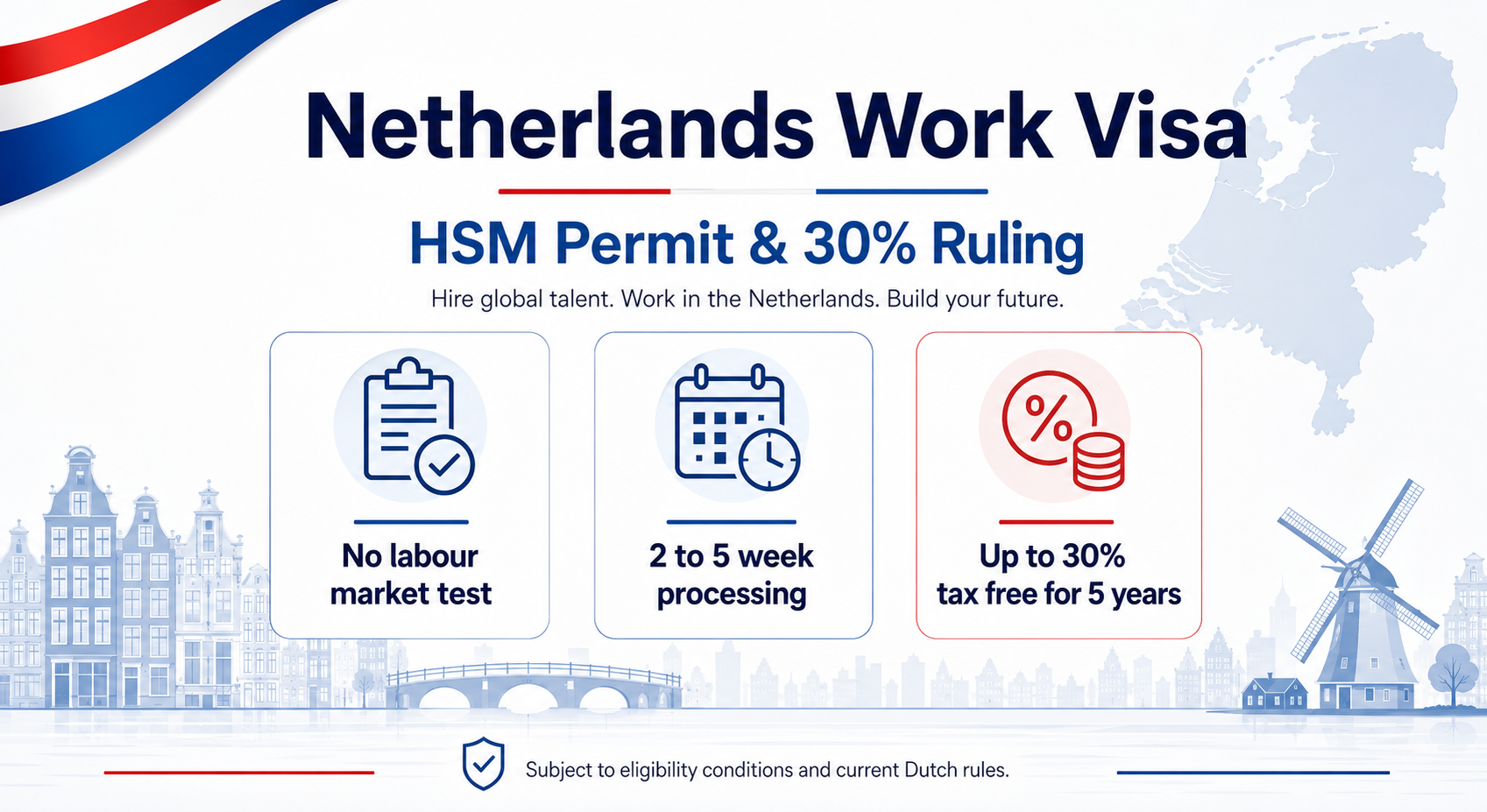
The Netherlands is one of the strongest destinations in Europe for Indian professionals, particularly in IT, engineering, and finance, offering a fast, employer-sponsored route through the Highly Skilled Migrant (HSM) permit, no labour market test, processing in as little as two to five weeks, and one of Europe’s most generous tax incentives for internationally recruited talent, the 30% ruling.
This guide covers every Netherlands work visa route available to Indian applicants, current 2026 salary thresholds, the HSM permit process end to end, fees, processing times, and how the 30% ruling actually affects your take-home pay.
NOTE: Most Indian professionals working in the Netherlands apply through the Highly Skilled Migrant (HSM) permit, which requires a job offer from an IND recognized sponsor employer and a minimum gross monthly salary of 5,942 euros for applicants aged 30 and above, or 4,357 euros for those under 30 (2026 thresholds). HSM applications require no labour market test and typically process in two to five weeks, significantly faster than the standard Single Permit (GVVA), which can take up to 90 days. Qualifying professionals can also access the 30% ruling, receiving up to 30 percent of their gross salary tax free for five years.
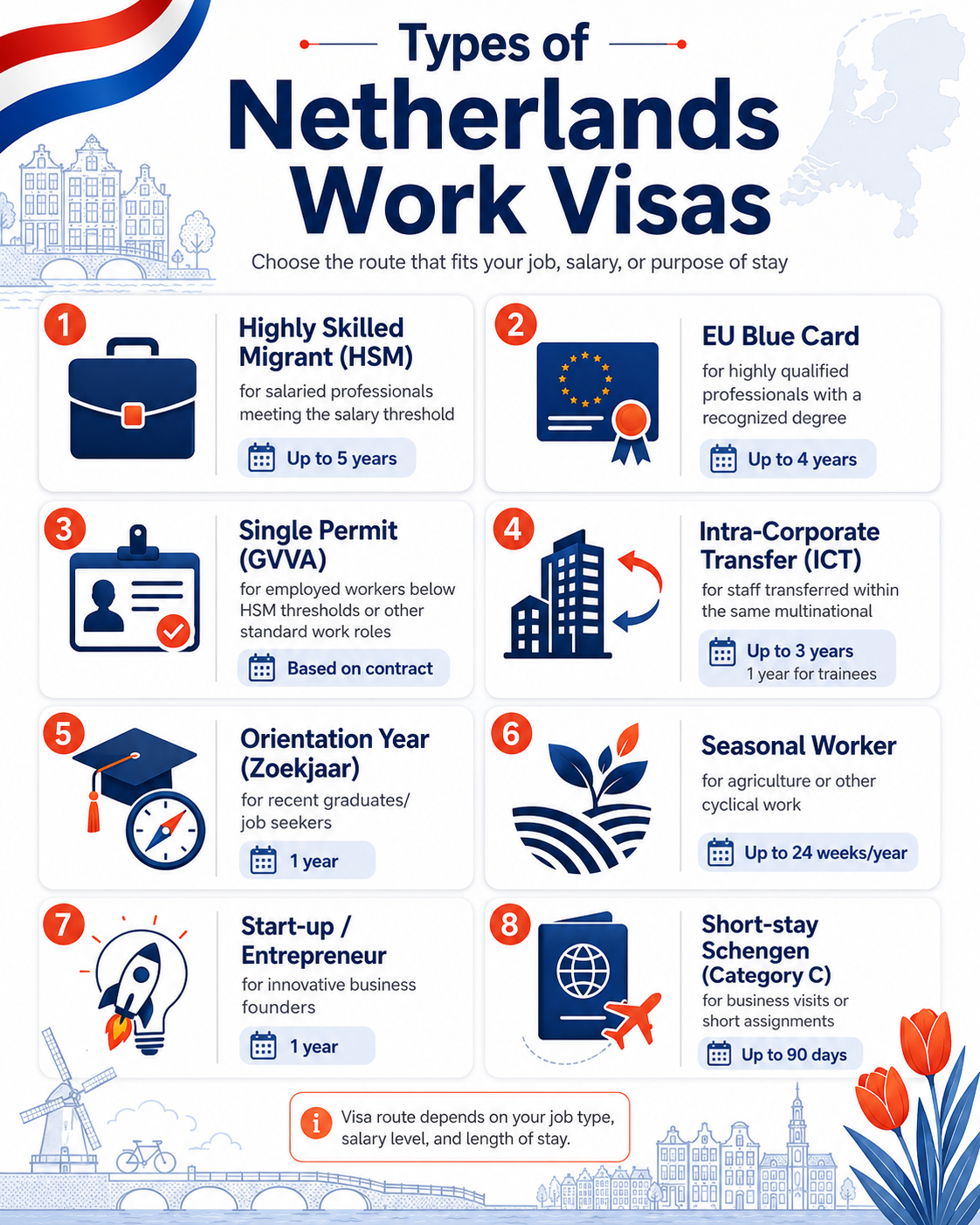
The Netherlands offers several distinct work visa routes depending on your job type, salary, and length of stay.
Visa Type | Best Suited For | Typical Validity |
Highly Skilled Migrant (HSM) permit | Salaried professionals meeting the salary threshold | Up to 5 years |
EU Blue Card | Highly qualified professionals with a recognized degree | Up to 4 years |
Single Permit (GVVA) | Roles below the HSM salary threshold | Tied to employment contract |
Intra-Corporate Transfer (ICT) permit | Employees transferred within the same multinational | Up to 3 years, 1 year for trainees |
Orientation Year (Zoekjaar) permit | Recent graduates seeking employment without a job offer yet | 1 year, non-renewable |
Seasonal Workers visa | Agriculture and cyclical sectors | Up to 24 weeks per year |
Entrepreneur / Start-up visa | Non-EU entrepreneurs with an innovative business plan | 1 year |
Short-stay Schengen visa (Category C) | Business travel and short-term assignments under 90 days | Up to 90 days |
The HSM permit is the fastest and most commonly used pathway for Indian professionals moving to the Netherlands for work. Its key advantage: no labour market test. Your employer does not need to advertise the role or prove no suitable Dutch or EU candidate exists, they simply need to be an IND recognized sponsor (erkend referent) and submit the application directly.
2026 HSM salary thresholds (gross monthly, excluding 8 percent holiday allowance):
Category | Minimum Gross Monthly Salary |
Age 30 and above | 5,942 euros |
Under age 30 | 4,357 euros |
Reduced threshold (post orientation year graduates) | 3,122 euros |
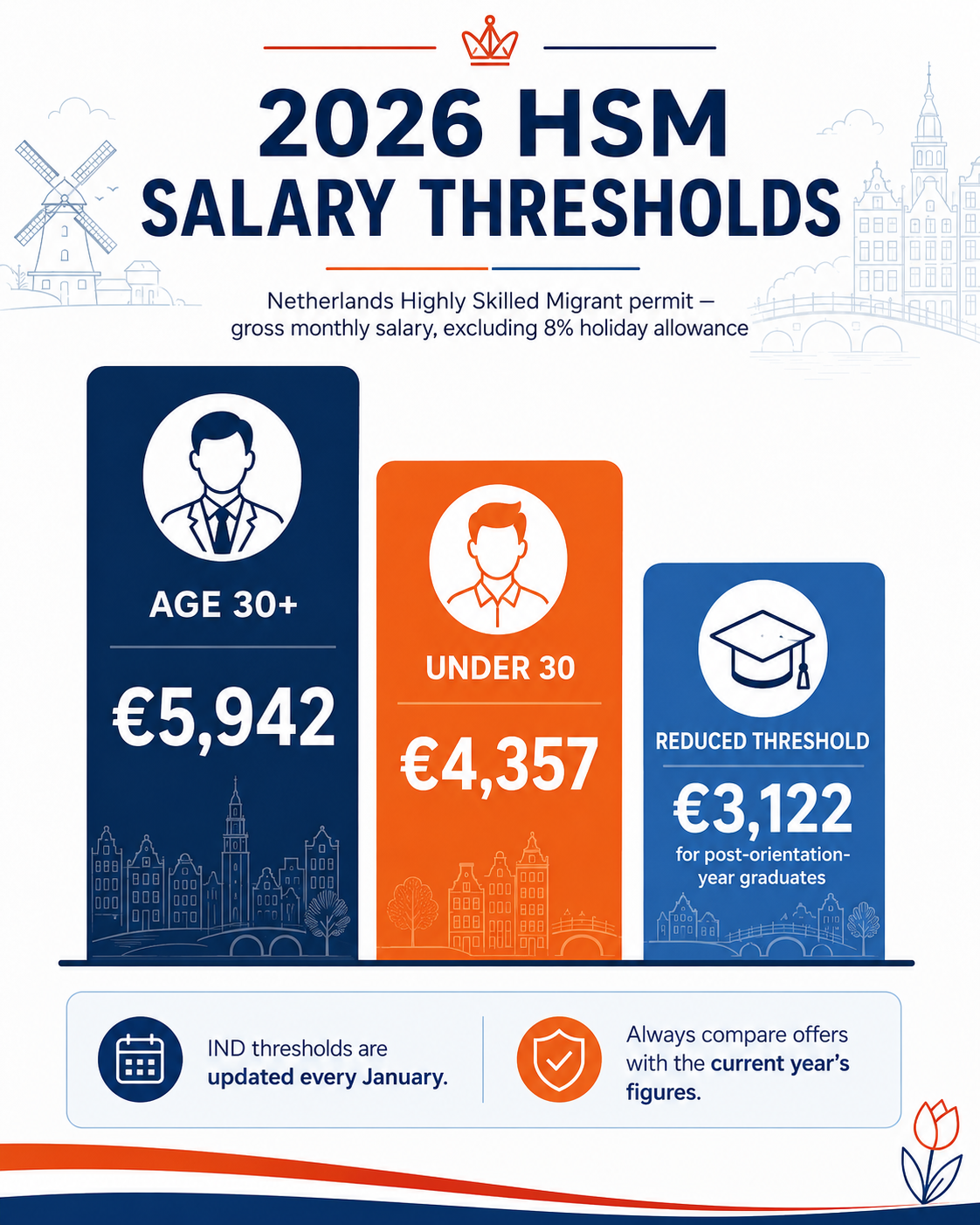
These thresholds are set by the IND (Immigratie- en Naturalisatiedienst) and adjusted annually every January based on wage indexation. If you are comparing an offer against an older figure you found online, confirm it reflects the current year, since thresholds typically increase by four to five percent annually.
Before accepting a job offer, confirm your prospective employer’s IND recognized sponsor status directly at ind.nl. A non-sponsored employer cannot submit an HSM application on your behalf, regardless of the salary offered.
Factor | HSM Permit | Single Permit (GVVA) |
Labour market test | Not required | Required, employer must advertise locally |
Processing time | 2 to 5 weeks | Up to 90 days |
Salary threshold | 5,942 euros (30+) or 4,357 euros (under 30) | Market-based salary, no fixed threshold |
30% ruling eligibility | Typically eligible | Case by case basis |
Permit validity | Up to 5 years | Tied to employment contract |
Employer requirement | IND recognized sponsor required | Standard Dutch employer |
Best suited for | IT, engineering, and finance professionals meeting the salary threshold | Roles below the HSM salary threshold |
If your job offer meets the HSM salary threshold and your employer is an IND recognized sponsor, HSM is almost always the faster, more advantageous route. GVVA exists as the fallback for roles that do not meet the HSM salary bar.
The EU Blue Card targets highly qualified professionals with a recognized higher education degree (minimum three years of study) and a job contract of at least twelve months. It is valid for up to four years and offers mobility rights across EU member states after twelve to eighteen months, an advantage the HSM permit does not carry. Both require an IND recognized sponsor employer and carry the same 2026 application fee.
Most Indian applicants find HSM processes faster for straightforward employer-sponsored moves, but the EU Blue Card is worth considering if broader EU mobility is a priority for your career plans.
If you already work at an Indian IT company with Netherlands operations, TCS, Infosys, Wipro, HCL Technologies, and Tech Mahindra all maintain a presence there, you may qualify for the ICT permit instead of applying fresh from outside the company. Requirements: at least three months with your current employer before the transfer, and a specialist, manager, or trainee role. No labour market test is required, and this route can be faster than a standalone HSM application since your employment relationship is already established.
The Orientation Year permit allows recent graduates, from a recognized Dutch university or a qualifying top-ranked international university, to live in the Netherlands for up to twelve months while searching for employment, without needing a job offer first. It is non-renewable, and once you secure a qualifying job offer during that year, the reduced HSM salary threshold (3,122 euros) applies, making the transition to a full HSM permit meaningfully easier than applying fresh from outside the country.
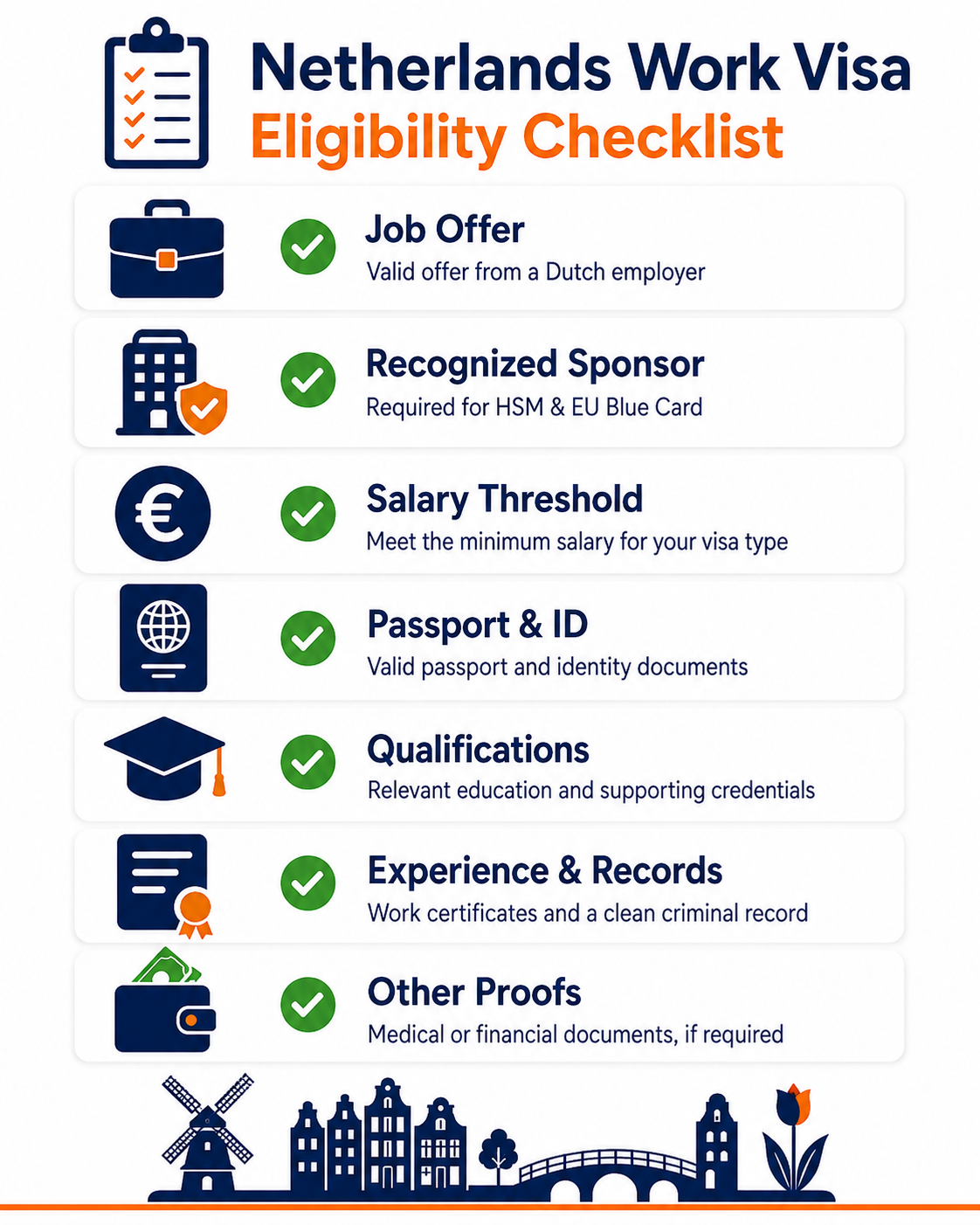
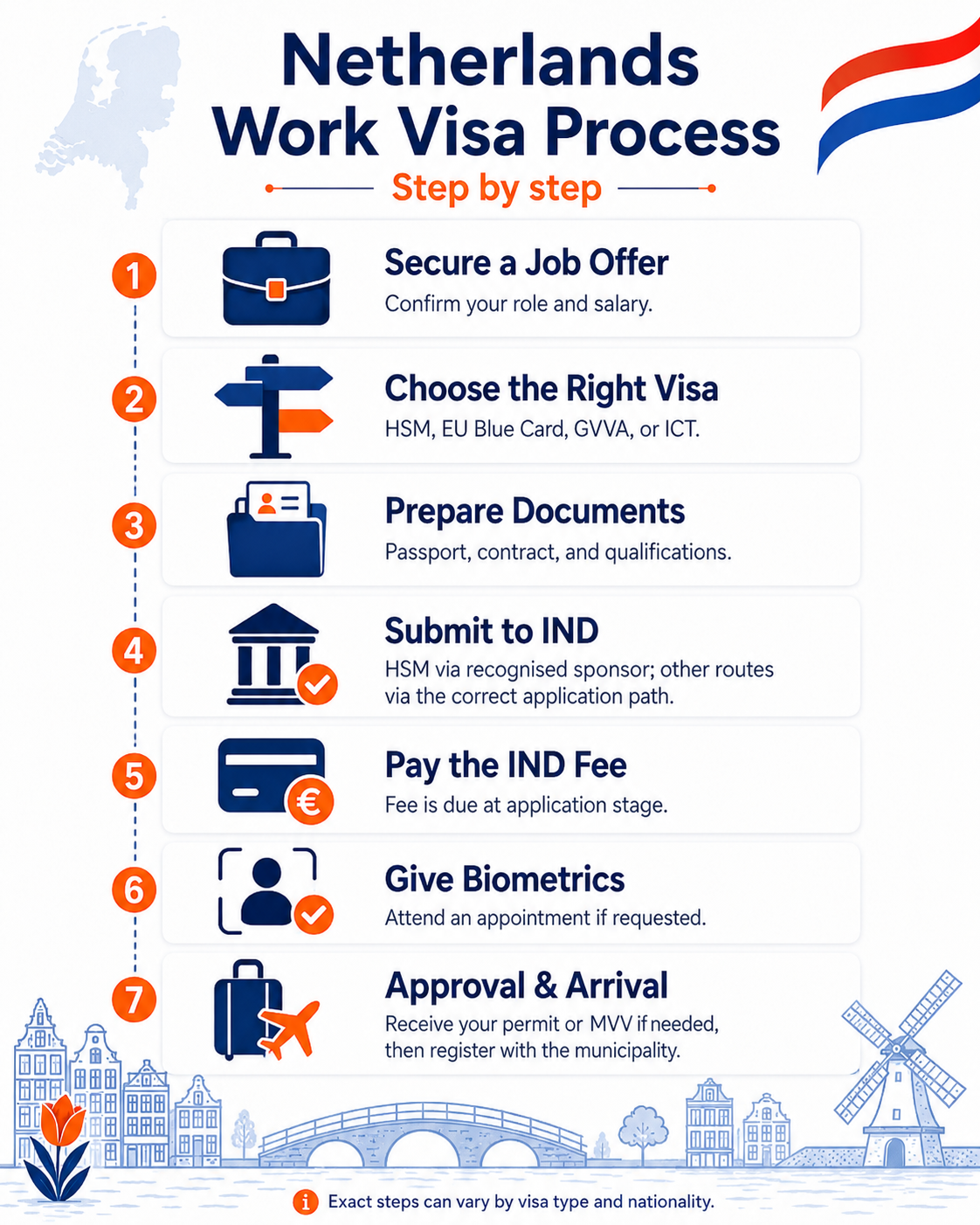
Step 1: Secure a job offer from a Dutch employer. For HSM and EU Blue Card routes, confirm your employer is an IND recognized sponsor before accepting.
Step 2: Confirm which visa category fits your role, salary, and circumstances, HSM, EU Blue Card, GVVA, or ICT.
Step 3 (HSM or EU Blue Card): Your employer, as the IND recognized sponsor, submits the application directly to IND on your behalf. You do not apply independently.
Step 3 (GVVA or other routes): Complete the online application and upload required documents yourself, including your passport, contract, and qualifications.
Step 4: Pay the applicable IND fee, due at the time of application.
Step 5: Attend a biometric appointment if requested.
Step 6: Once approved, receive your residence permit and, if required, your entry visa (MVV) to travel to the Netherlands.
Step 7: Register with your local municipality upon arrival to complete your residency formalities.
Visa Type | Fee |
Short-stay Schengen visa (Category C) | 90 euros |
Single Permit (GVVA) | 423 euros |
Seasonal Workers visa | 254 euros |
Entrepreneur / Start-up visa | 423 euros |
HSM permit, EU Blue Card, ICT permit | 423 euros |
Orientation Year permit | Approximately 254 euros |
Fees are set by IND, reviewed annually, and are generally non-refundable even if an application is refused. Confirm the exact current figure at ind.nl/en/costs before applying, since these amounts are updated periodically.
Visa Type | Typical Processing Time |
HSM permit / EU Blue Card (via IND recognized sponsor) | 2 to 5 weeks |
Single Permit (GVVA) | Up to 90 days |
Seasonal Workers visa | 3 to 7 weeks |
Entrepreneur / Start-up visa | Approximately 90 days |
Short-stay Schengen visa (Category C) | Approximately 15 days, up to 45 in special cases |
If a provisional residence visa (MVV) is also required, allow an additional 2 to 4 weeks after IND approval to complete embassy processing before travel.
This is one of the most valuable, and most search-worthy, aspects of moving to the Netherlands for work, and a genuine differentiator worth explaining clearly rather than mentioning in passing.
The 30% ruling allows qualifying internationally recruited professionals to receive up to 30 percent of their gross salary tax free for five years. This is applied on top of your normal salary, not a separate benefit you need to negotiate away from your base pay.
2026 eligibility criteria:
What this looks like in practice:
Gross Annual Salary | 30% Tax Free Amount | Approximate Annual Tax Saving |
60,000 euros | 18,000 euros | Roughly 5,400 to 6,300 euros |
70,000 euros | 21,000 euros | Roughly 6,300 to 7,350 euros |
80,000 euros | 24,000 euros | Roughly 7,200 to 8,400 euros |
Worth flagging clearly: from 2027, the ruling is scheduled to reduce from 30 percent to 27 percent. If you are planning a move and want to benefit from the current, higher rate, starting before that change takes effect is worth factoring into your timeline.
Sector | Typical Annual Salary Range (EUR) |
Software Engineering and Development | 55,000 to 95,000 |
Cybersecurity | 55,000 to 90,000 |
Data Science and AI | 60,000 to 100,000 |
Healthcare (Doctors, Consultants) | 80,000 and above |
Nursing | 35,000 to 55,000 |
Civil and Structural Engineering | 50,000 to 85,000 |
Finance and FinTech | Varies by role and seniority |
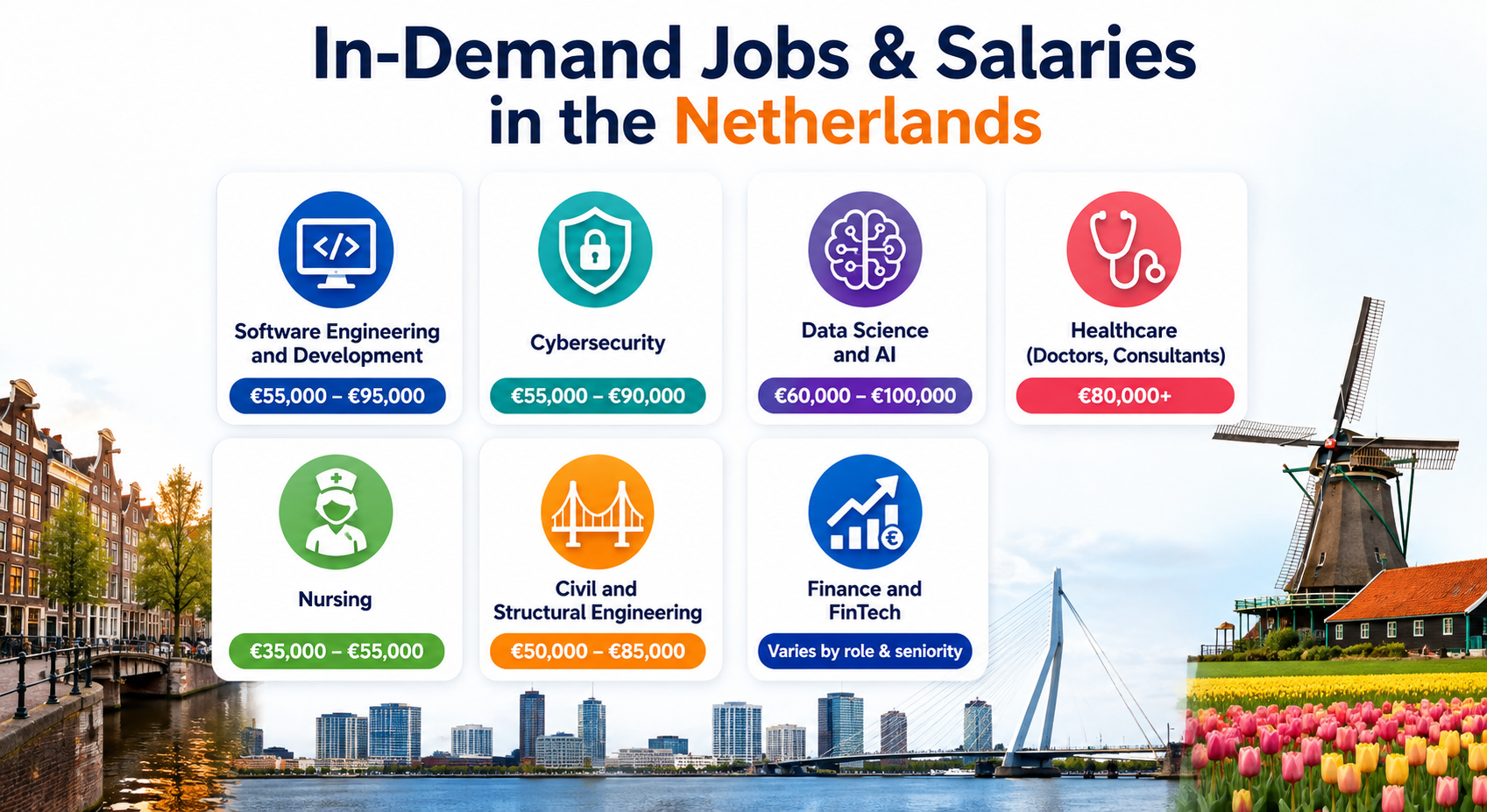
Key sectors actively hiring international talent include IT and software (Amsterdam, Eindhoven), semiconductor and high-tech manufacturing (Eindhoven, Delft), finance (Amsterdam), healthcare (Rotterdam, Amsterdam), and clean energy (Rotterdam, Groningen). The Netherlands has projected a need for tens of thousands of additional skilled healthcare workers by the early 2030s, alongside continued strong demand in technology and engineering.
If you are willing to know more about the Canada Netherlands Application process, you can certainly contact us by writing us an email at mail@pioverseas.com and one of our experts will help you out in every possible way. Call us at +91-9310-10-6988 or you can also receive a call back from our expert once you fill out the inquiry form. You can also talk to our experts directly through our live chat feature and clear your doubts instantaneously.
We at Pi Overseas is one of the best Canada Immigration Consultancy and have a team of dedicated experts that cater to every need of the clients. We have a proven track record in the immigration industry which was achieved in a very short span of time. Our experts will help and guide you through every step of the filing process and keep you posted throughout the whole cumbersome process of visa filing.