Atlantic Immigration Program (AIP)

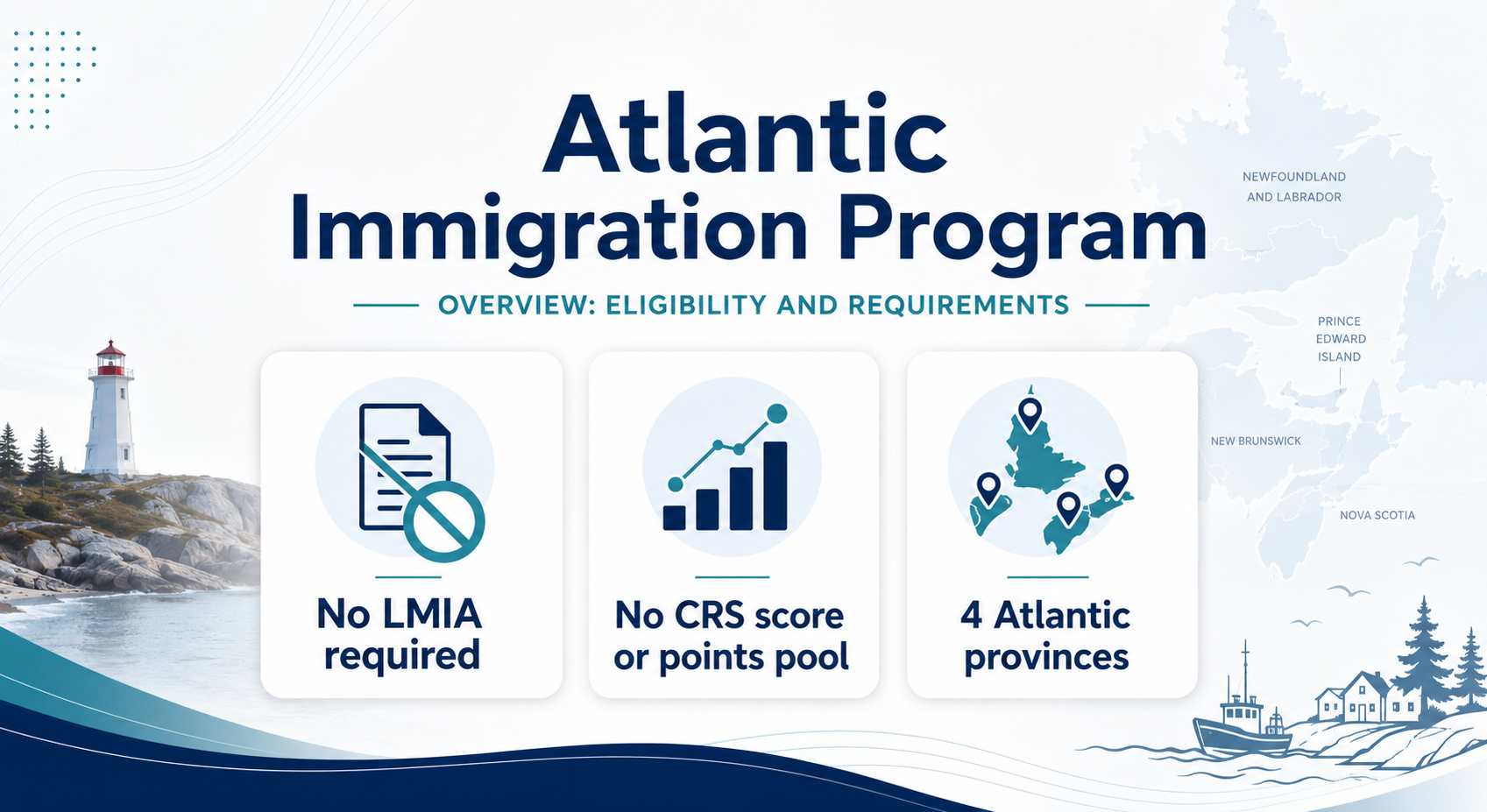
Atlantic Immigration Program (AIP) is a Canadian immigration program offering PR visa to skilled workers. This AIP programs helps candidates to settle in provinces like, Nova Scotia, New Brunswick, Newfoundland & Labrador, or Prince Edward Island.

This program is designed to fill the needs of local employers and communities by welcoming newcomers to the Atlantic Canadian Region.

Local employers uses AIP to identify, recruit and retain global talent. The main purpose of this program is to support population growth, increasing skilled workforce and employment rates.

AIP has become a success to employers, Immigrants and Atlantic regions. Thousands of PR status is given to immigrants via this program. This in turns promotes employment rates, population and economic growth.

Atlantic Immigration Program: How it Works

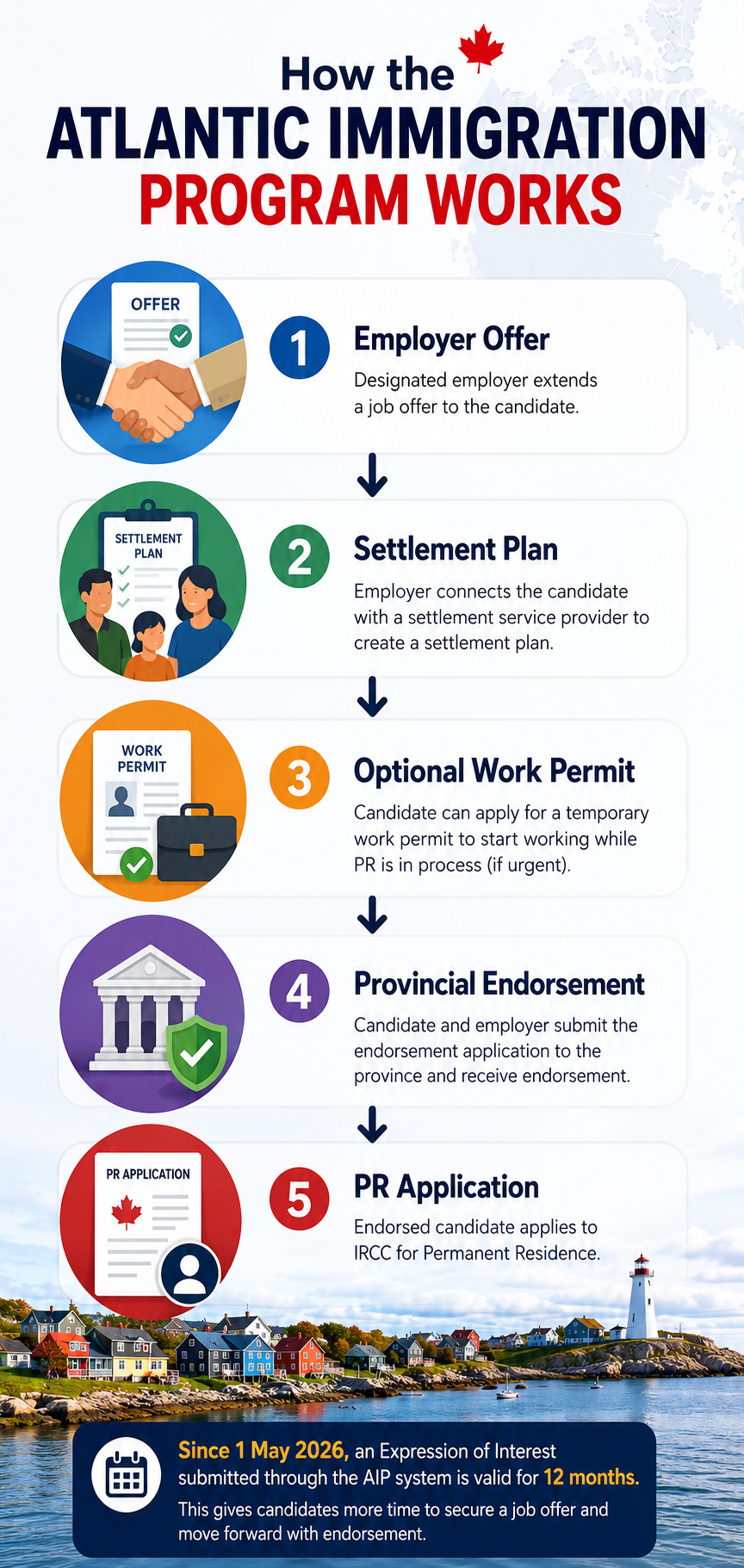
The Atlantic Immigration Programs is essentially a program that promotes foreign hiring for local employers. It is required for a candidate to have a valid job offer letter from a designated employer to arrive in Canada under this program. There is also a need for a settlement plan for the main applicant and for their family as well.

Designated employers once they find an eligible candidate, meeting the employers’ requirement and the program’s requirement as well. They send out an offer letter to them. There is no need for an employer to go through the process of obtaining an LMIA for this program.

As soon as a candidate accepts the job offer, employer will connect with the candidate for settlement plan. This is done through a designated settlement service provider after accessing the candidate’s needs. The new immigrant and their family will be supported by employer for a long term integration of settlement plan, once they arrive in Canada.

A temporary work permit will be provided to the employer who needs the job vacancy to be filled quickly. This is done so that the applicant can applicant and his/her family may enter Canada as quickly as possible. The applicant to get a work permit, he/she will need following things:

  • Job Offer Letter
  • Letter from the province
  • 90 days commitment to apply for Canada (PR) visa after the work permit application.

Candidate Requirements

Eligibilty criteria for AIP is as follows:

  • Work experience (Exemption for International Students who have completed their graduation from an Atlantic post-secondary institute in Canada.)
  • Educational qualifications
  • Language proficiency
  • Proof Of funds

Work experience

Work experience required to be eligible for AIP is atleast 1560 hours within the span of last 5 years.

Working hours are calculated as follows:

  1. Full-time or part-time jobs working hours.
  2. Working hours are counted only for paid work, not for unpaid or volunteer work..
  3. Self-employed working hours are not counted.
  4. Working hours can be counted for Canada or abroad both. For Canada, you must have a valid work permit to work in Canada as a temporary resident.
  5. Working hours should be accumulated for alteast a period of 12 months.
  6. The hours can also be taken into account even while studying if your work hours adhere to the study permit conditions.

Working experience should be of the occupation falling in NOC TEER category 0,1,2, or 3. The duties of your work experience should also match with the description of the NOC corresponding to your category.

International graduates

There is no need for an International students to have a working experience who has graduated from Canada. In order to be considered as an International graduate, the following requirements should be met:

  1. Must have a diploma, certificate, degree or trade/apprenticeship certificate that took atleast years of studies. Also all these should be from a recognised post-secondary institute in:
    1. New Brunswick
    2. Nova Scotia
    3. Prince Edward Island
    4. Newfoundland & Labrador
  2. Must a full time student during your studies
  3. Must had a visa permit for study, work or training when they lived in Canada.
  4. Must have lived in one of the Atlantic Provinces for atleast 16 months before they graduated.

Canada Atlantic Immigration Program (AIP)

Educational requirements

  • For NOC TEER 0 & 1, the applicant should have a one year post-secondary education or higher. For education outside of Canada, the education should be equivalent to that of Canada.
  • For NOC TEER 2, 3, or 4, Canadian high school or equivalent education outside Canada.

Note: For education outside of Canada, the applicant is required to get an ECA (Educational Credential Assessment). This is done to check whether the education credential matches the Canadian standard for a job offer letter. ECA report should be less than 5 years old when you apply for this or any other IRCC program.

Language requirements

  1. For English CLB 5 or French NCLC 5 is required for NOC TEER category 0 and 1 job offers.
  2. CLB 4 or NCLC 4 is required job offers in the NOC TEER category 2,3, or 4.

Note: Applicant is required to submit the test results from a recognised testing organization. Also the test results should not be more than 2 years old when you apply for AIP or any other program.

Settlement funds

  • There is no proof of funds required if the applicant is already living in Canada with a valid work permit.
  • For other applicants, there is need to show enough amount to support yourself and your family members. List of proof of funds required as per family member is given below:

Proof Of Funds Atlantic Immigration Program

Documentation for the Atlantic Immigration Program

To apply for the Atlantic Immigration Program (AIP), you will need to provide several documents to support your application. The specific documents required may vary depending on your individual circumstances, but typically, you will need to provide the following:

  1. Language Test Results: You will need to provide the results of an approved language test to demonstrate your proficiency in English or French. At the time of application, the language test results must be less than two years old.
  2. Education Credentials: You will need to provide proof of your education credentials, such as a high school diploma or a post-secondary degree or diploma. If you completed your education outside of Canada, you will also need to provide an assessment of your credentials by a designated organization.
  3. Work Experience: You will need to provide documentation of your work experience, such as employment letters, pay stubs, and tax documents. If you are exempt from the work experience requirement, you will need to provide documentation to support your exemption.
  4. Job Offer: You will need to provide a copy of your job offer from a designated employer in the Atlantic region. The job offer must meet the requirements of the AIP.
  5. Settlement Funds: You will need to provide documentation to show that you have sufficient funds to support yourself and your family members when you arrive in Canada. The amount of funds required depends on the number of family members and is determined by the Low Income Cut-Off (LICO) for the Atlantic region.
  6. Other Documents: Depending on your individual circumstances, you may also need to provide additional documents, such as police certificates, medical exams, and proof of your relationship to your family members.

Additional documents :

  • Proof of experience (if needed)
  • Marriage license (if needed)

It is important to ensure that all of your documents are complete, accurate, and up-to-date. Any missing or incomplete information can delay the processing of your application or even lead to a refusal. It is recommended to seek the guidance of an immigration lawyer or a regulated immigration consultant to help you with your application.

Application Process for the Atlantic Immigration Program

The application process for the Atlantic Immigration Program (AIP) generally involves the following steps:

  • Determine Your Eligibility: Before you apply for the AIP, you should determine whether you meet the eligibility requirements, including having a job offer from a designated employer in one of the Atlantic provinces and meeting the language and education requirements.
  • Obtain Required Documents: You will need to gather all the required documents to support your application, including language test results, education credentials, work experience documentation, job offer, settlement funds, and other documents as required.
  • Submit Your Application: You can submit your application online through the Immigration, Refugees, and Citizenship Canada (IRCC) website. You will need to pay the application fee and upload all the required documents. Make sure to review your application carefully before submitting it to avoid any errors or omissions.
  • Wait for a Decision: After submitting your application, you will need to wait for a decision. Processing times can vary depending on the volume of applications and the completeness of your application. You may be required to attend an interview or provide additional information or documents to support your application.
  • Receive a Decision: Once a decision has been made on your application, you will receive a letter from IRCC informing you of the decision. If your application is approved, you will be issued a Confirmation of Permanent Residence (COPR) document, which you will need to present to an immigration officer when you arrive in Canada.
  • Prepare for Arrival: Before you leave for Canada, you will need to prepare for your arrival, including making travel arrangements, arranging for temporary housing, and ensuring that you have sufficient settlement funds to support yourself and your family members.

It is important to note that the AIP is a highly competitive immigration program, and meeting the eligibility requirements does not guarantee that your application will be approved. It is recommended to seek the guidance of an immigration lawyer or a regulated immigration consultant to help you with your application.

REASON TO CHOOSE PI OVERSEAS:

Consultations at Pi Overseas are provided by professional and authorized immigration consultants

  • A step-by-step guide to the eligibility and application process
  • Our online process is secure and transparent
  • For any process, there is a system addressing complaints for a smooth consumer experience.
  • Having processed thousands of applications
  • We assess every case multiple times before submitting it
  • Qualifications and other skills are evaluated by our certified experts for error-free proceeding.

If you are willing to know more about Canada (AIP) PR Visa process, you can certainly contact us by writing us an email at mail@pioverseas.com and one of our experts will help you out in every possible way. Call us at +91-9310-10-6988 or you can also receive a call back from our expert once you fill out the inquiry form. You can also talk to our experts directly through our live chat feature and clear your doubts instantaneously.

We at Pi Overseas have a team of dedicated experts that cater to every need of the clients. We have a proven track record in the immigration industry which was achieved in a very short span of time. Our experts will help and guide you through every step of the filing process and keep you posted throughout the whole cumbersome process of visa filing.

Let’s Start Your Visa Journey — Contact Us Today

Frequently Asked Questions

The Atlantic Immigration Program is an employer-driven pathway to Canadian permanent residence for skilled workers and international graduates who have a job offer from a designated employer in one of Canada’s four Atlantic provinces. Originally launched as a pilot in 2017, it became a permanent federal immigration program in 2022. Unlike Express Entry, there’s no CRS score or points-based competition — eligibility hinges on securing a genuine job offer and meeting baseline language, education, and work experience requirements.

You’re eligible for the AIP if you have a full-time, non-seasonal job offer from a designated employer in Nova Scotia, New Brunswick, PEI, or Newfoundland and Labrador, and you meet the program’s baseline requirements: at least 1,560 hours (about 1 year) of qualifying work experience in the last 5 years (waived for graduates of recognized Atlantic institutions), a minimum CLB 5 language score for most occupation levels, education matching your job’s TEER level, and enough settlement funds unless you’re already working in Canada on a valid work permit. There’s no CRS score or points ranking involved; eligibility is assessed directly against these fixed criteria.

Eligibility Checklist:

Requirement

Standard

Job offer

Full-time (30+ hrs/week), non-seasonal, from a designated Atlantic employer

Work experience

1,560 hours in the last 5 years (waived for Atlantic graduates)

Language

Minimum CLB 5 for most TEER 0–3 roles (IELTS, CELPIP, TEF, TCF)

Education

Matches TEER level of the job offer (1-yr post-secondary for TEER 0/1; high school equivalent for TEER 2–4)

Settlement funds

Required, unless already working in Canada with a valid work permit

Settlement plan

Mandatory, developed with a designated settlement service provider

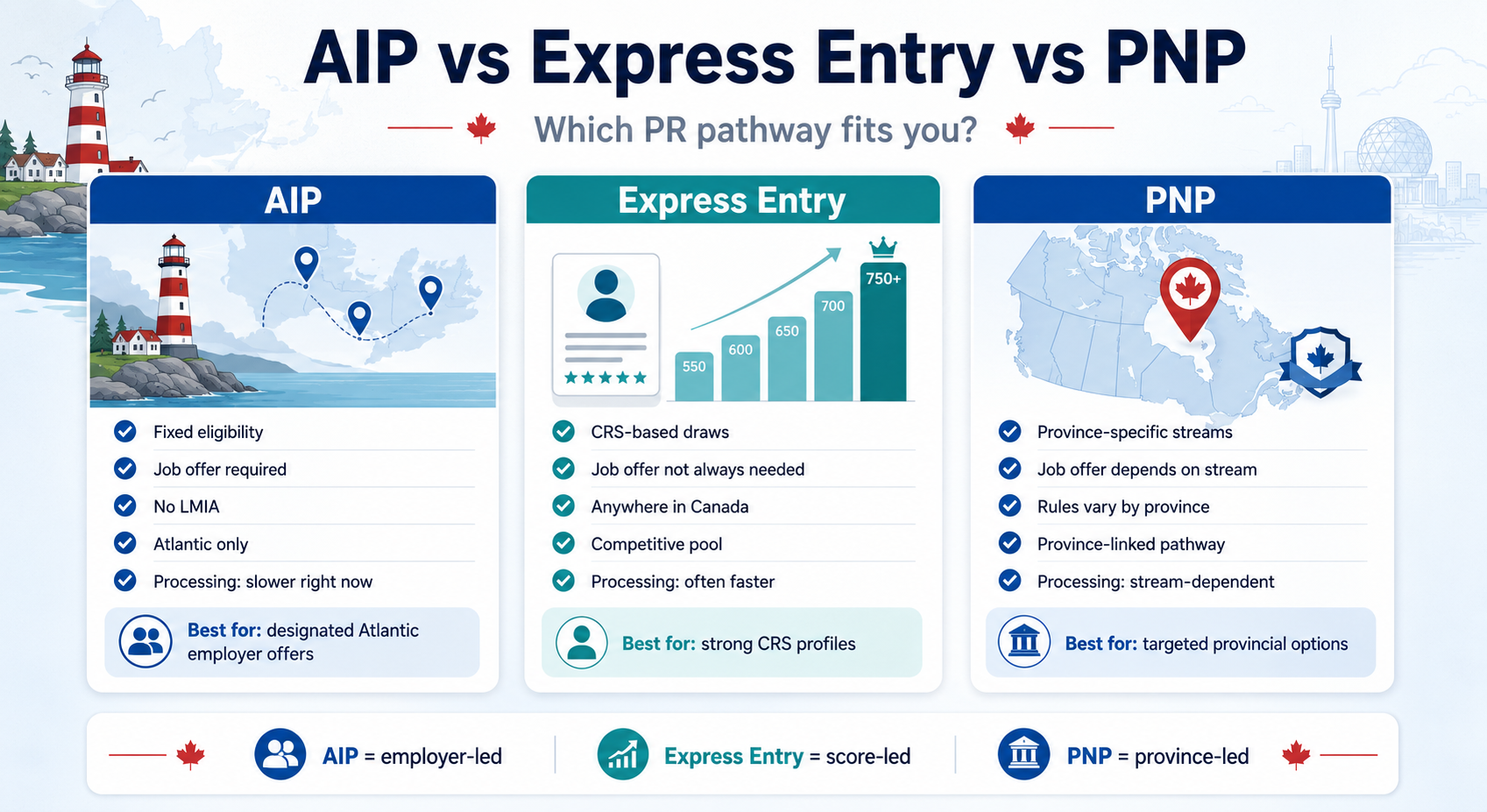
Neither is universally “better”. They suit different profiles. AIP requires a job offer upfront but is LMIA-exempt and has no CRS/points competition, making it strong for candidates who already have (or can secure) an Atlantic employer. PNP offers far more streams and provincial choice across the country, some of which don’t require a job offer at all, and its enhanced streams (linked to Express Entry) generally process faster federally — around 6 months — than AIP’s currently reported total timeline of 26–38 months amid its 2026 application backlog.

AIP vs. PNP at a Glance:


Atlantic Immigration Program (AIP)

Provincial Nominee Program (PNP)

Geographic scope

4 Atlantic provinces only

Every province/territory except Quebec and Nunavut

Job offer required

Yes, always

Depends on stream — many don’t require one

LMIA required

No (LMIA-exempt)

N/A (PNP doesn’t involve a work permit LMIA directly)

CRS points added

N/A — not CRS-based

+600 for enhanced/Express Entry-linked streams

Federal processing (post-approval)

~6 months (standard), but total 2026 timeline running 26–38 months

~6 months (enhanced) / ~16 months (base)

Best for

Candidates with an Atlantic job offer already in hand

Candidates with no job offer, or ties to a specific non-Atlantic province

 Practical takeaway: if you already have a job offer from a designated Atlantic employer, AIP remains a legitimate route despite the current backlog. If you don’t have a job offer yet, or you’re weighing multiple provinces, a PNP stream, particularly one without a job offer requirement, like several Saskatchewan or Manitoba categories, may currently offer a more predictable timeline.

It depends on your situation. AIP is a strong option if you already have, or can realistically secure, a job offer from a designated Atlantic employer and wouldn’t be competitive in general Express Entry draws, its lower language and CRS-free eligibility bar makes it more accessible for many candidates. However, given the 2026 processing backlog, candidates who also qualify for Express Entry (with a reasonably competitive CRS score) may find that route faster overall in the current environment, since Express Entry’s federal processing standard is holding around 6–7 months. Many immigration advisors now recommend applying to both simultaneously where eligible, rather than treating AIP and Express Entry as mutually exclusive strategies.

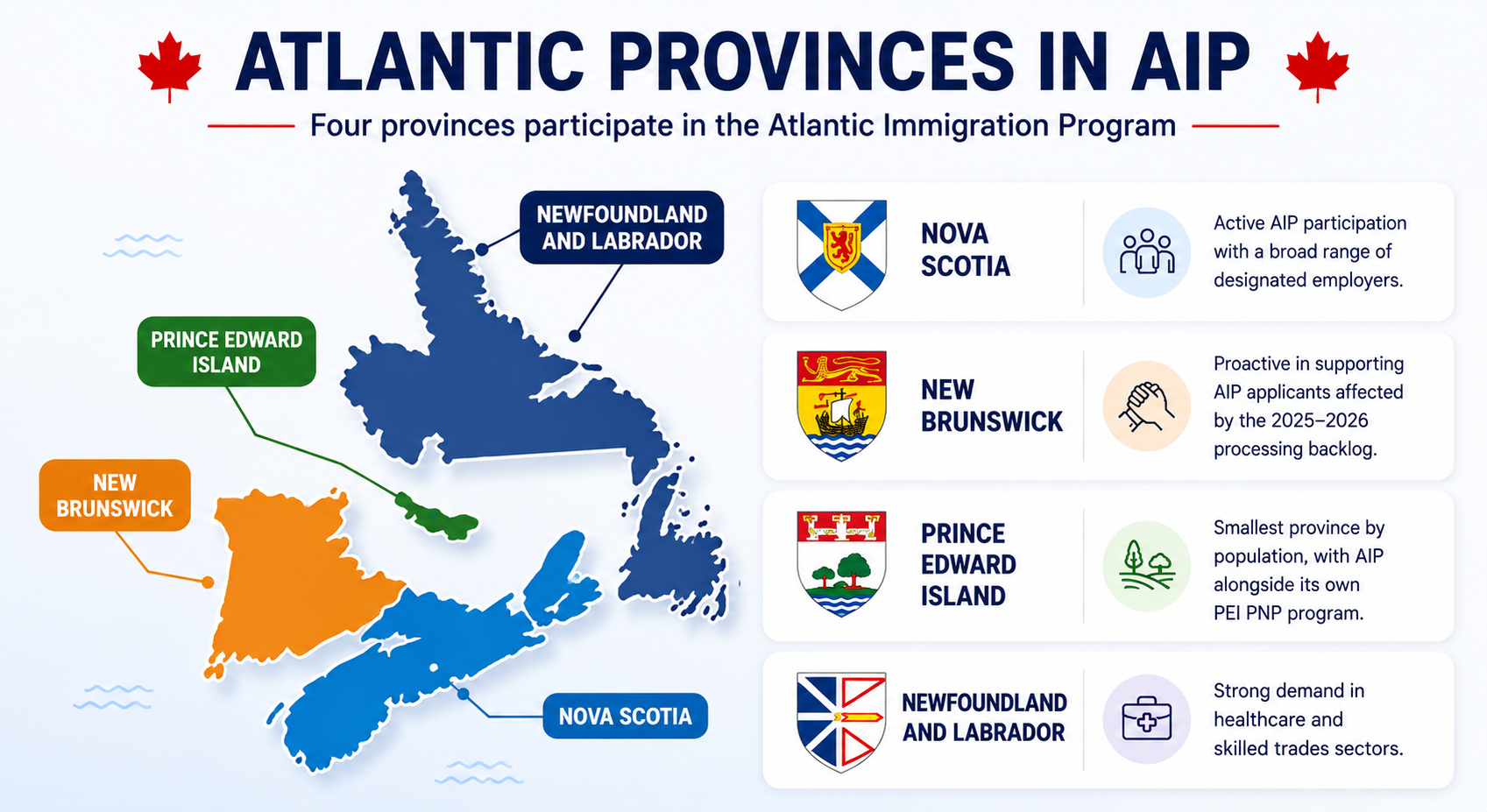
Four provinces participate: Nova Scotia, New Brunswick, Prince Edward Island, and Newfoundland and Labrador. Each province maintains its own list of designated employers and processes endorsement applications independently, though the overall program structure, eligibility criteria, and federal PR processing are consistent across all four.

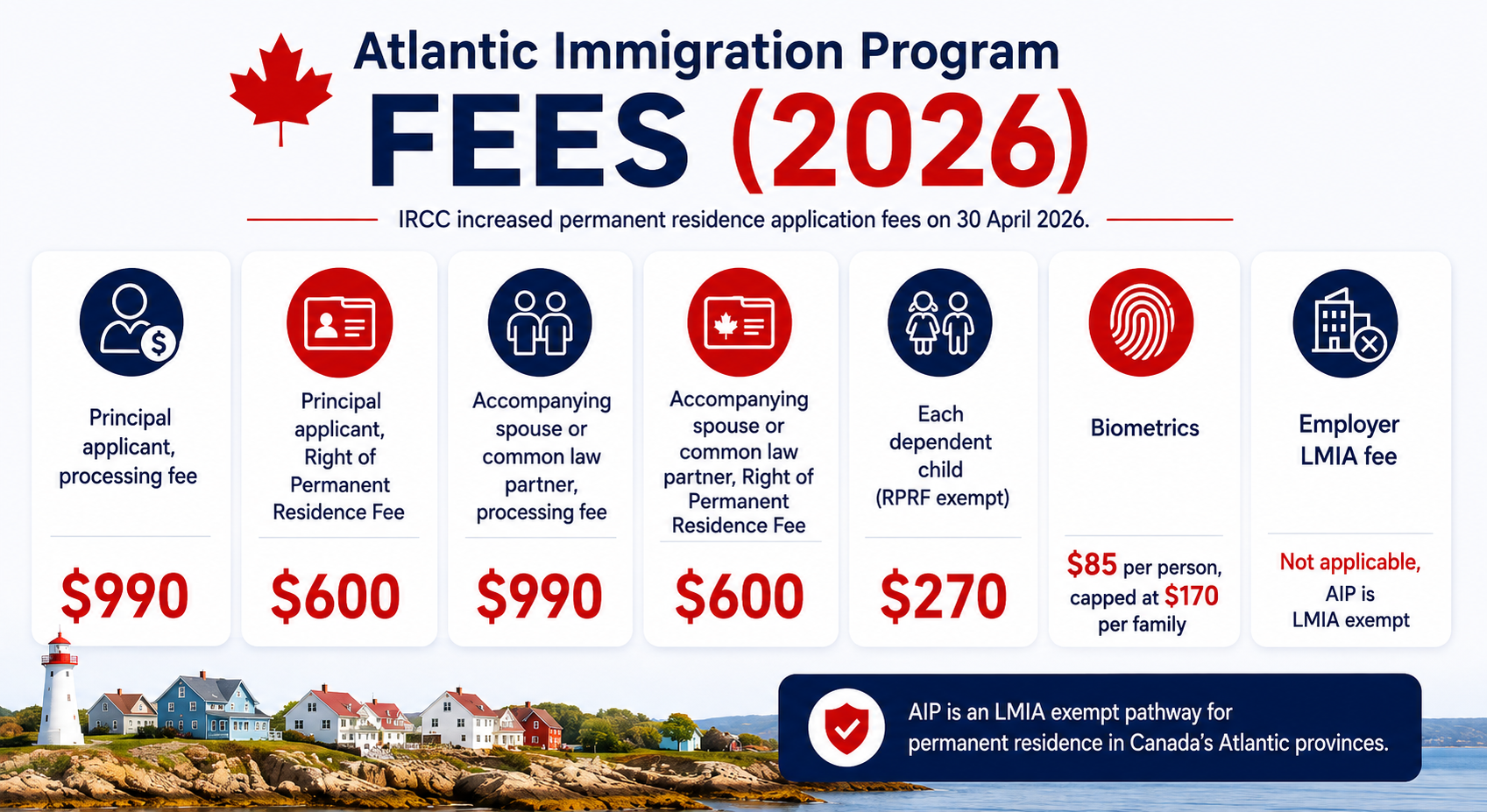
As of 2026 fee updates, the government fee is approximately $1,525 CAD for the principal applicant (including a $575 CAD Right of Permanent Residence Fee), $1,525 CAD for an accompanying spouse, and $260 CAD per dependent child (who is exempt from the RPRF). Biometrics cost $85 CAD per person, capped at $170 CAD per family. Employers benefit from not having to pay the standard $1,000 CAD LMIA fee, since AIP is LMIA-exempt.

Fee

Amount (CAD)

Principal applicant (incl. $575 RPRF)

~$1,525

Accompanying spouse

~$1,525

Dependent child (RPRF exempt)

~$260

Biometrics

$85/person, capped at $170/family

Employer LMIA fee

$0 (exempt)

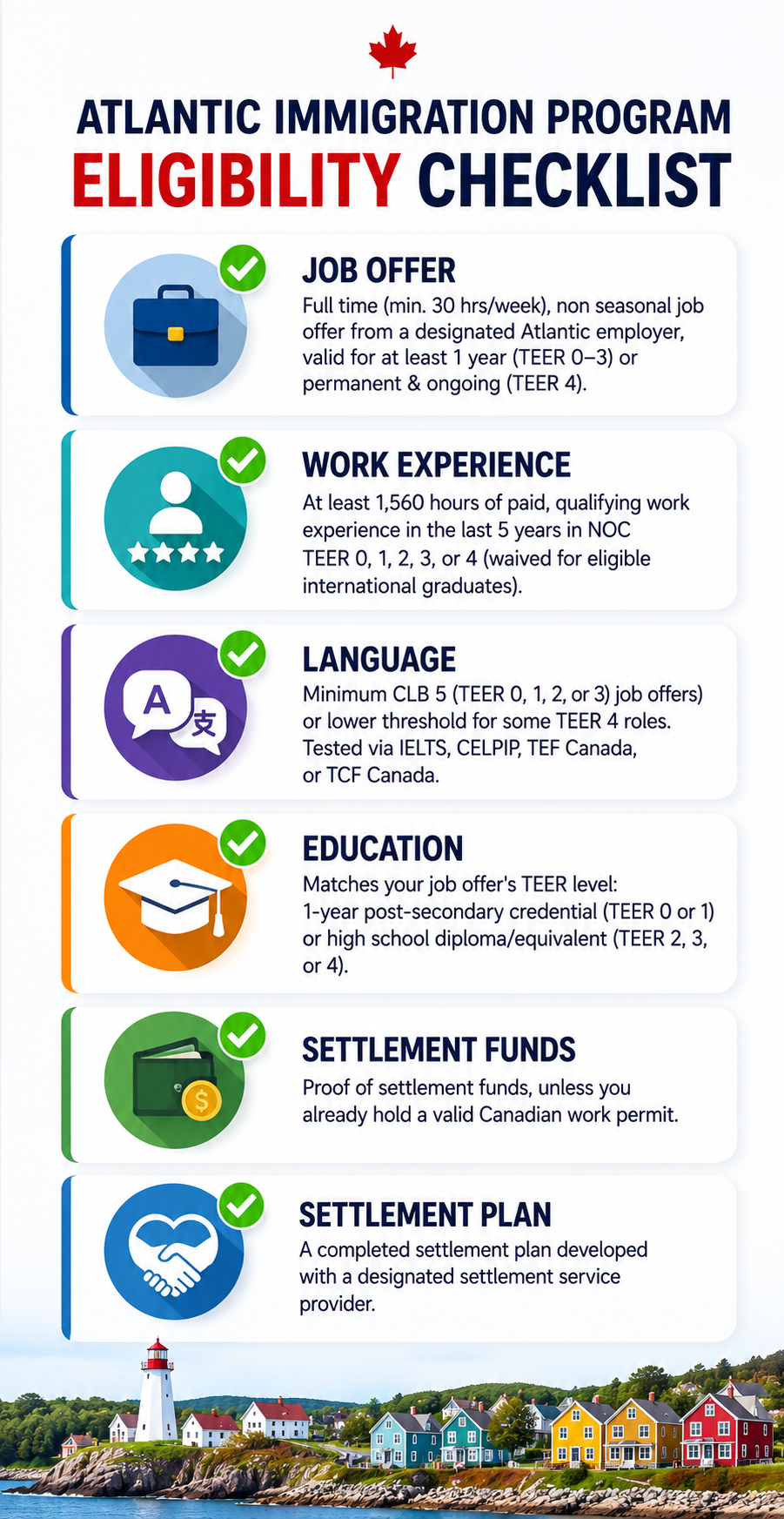
The core requirements are:

(1) A qualifying job offer from a designated Atlantic employer,

(2) Sufficient work experience (1,560 hours in the last 5 years, or an exemption for Atlantic graduates),

(3) A language test result meeting the minimum CLB threshold for your occupation’s TEER level,

(4) Education credentials matching that TEER level,

(5) Proof of settlement funds (unless already working in Canada), and

(6) A completed settlement plan prepared with a designated settlement organization.

All six elements must be satisfied together, meeting most, but not all, of these will result in an ineligible application.

Yes. The Atlantic Immigration Program is a direct pathway to Canadian permanent residence, not a temporary status program. Once a candidate secures a job offer, obtains a provincial endorsement, and IRCC approves the permanent residence application, they and their accompanying family members become Canadian permanent residents. Some candidates also use an optional 1-year, LMIA-exempt temporary work permit to start working in Canada while their PR application is processed in parallel, but the program’s end goal; and the reason it exists, is permanent residence, not a standalone temporary work status.

A designated employer is a company that’s been formally reviewed and approved by one of the four Atlantic provinces specifically to hire international candidates through the AIP. This designation replaces the need for an LMIA, the province vets the employer once, rather than requiring federal labour-market approval for every individual hire. Only job offers from currently, actively designated employers count toward AIP eligibility; a genuine job offer from a legitimate but non-designated company doesn’t qualify, which is one of the most common points of confusion for applicants. Each province publishes and regularly updates its own designated employer list, so it’s essential to check the current, dated version before relying on any specific employer’s status.

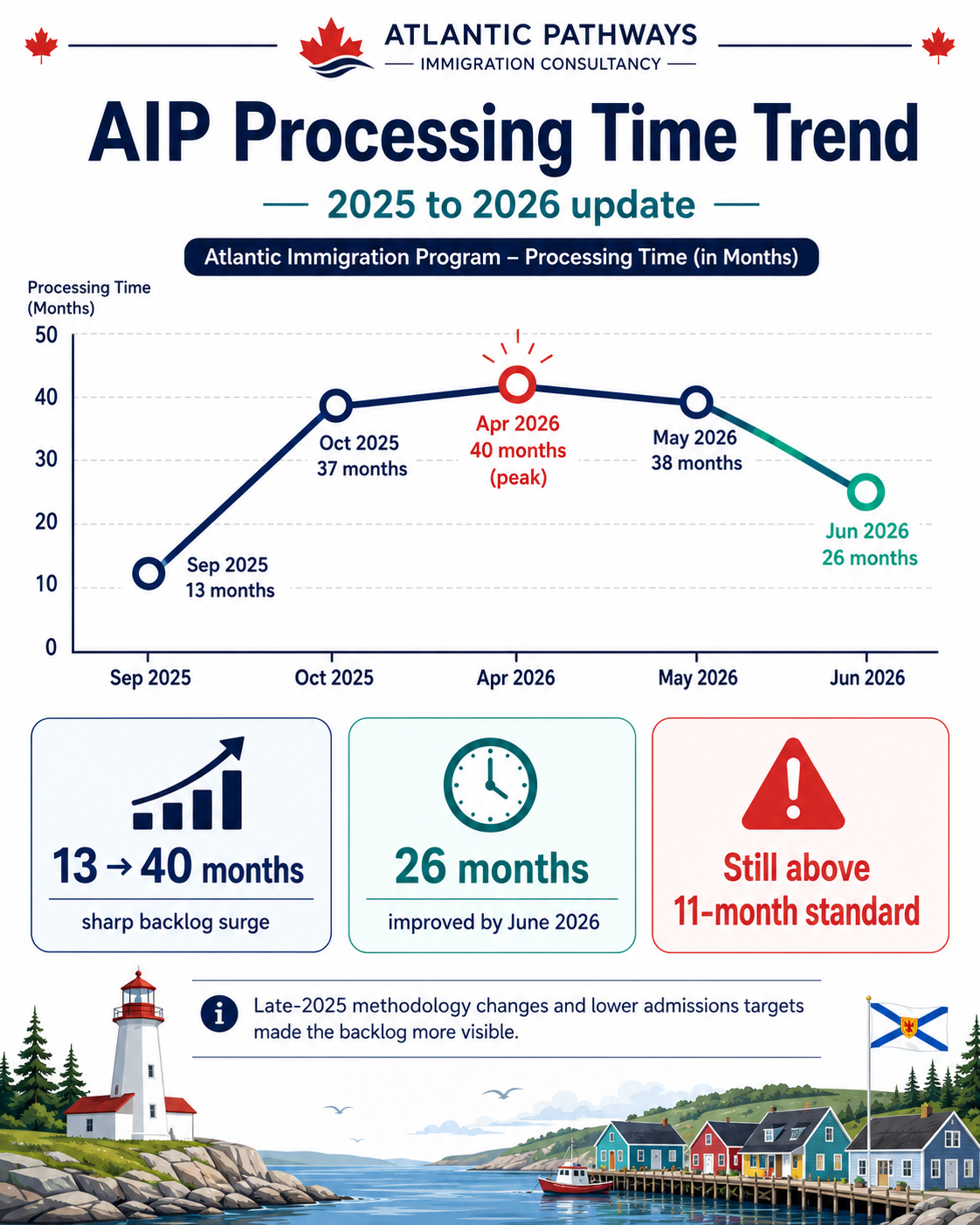
This is genuinely important to know before applying: AIP’s overall processing time has increased dramatically in 2026. While IRCC’s federal PR service standard for AIP remains around 6 months once a provincial endorsement is issued, published total, end-to-end processing times (job offer to PR decision) spiked to as high as 37–38 months by March–May 2026, up sharply from a roughly 13-month median just one year earlier — a direct result of application volume surging since AIP became a permanent program. A more recent update (June 2026) reported the estimate falling back to around 26 months, suggesting some improvement, though IRCC still maintains a substantial application inventory.

Stage

Typical Time

Employer designation (if new)

Weeks, if employer isn’t already designated

Provincial endorsement

4–8 weeks, if the file is complete

Federal PR processing (post-endorsement)

~6 months (official standard)

Total published processing time (2026)

~26–38 months, depending on month reported

Note: This is one of the fastest-moving figures on this page. Given the significant swings reported between March and June 2026 alone, always check IRCC’s live processing time tool for the current AIP estimate before setting expectations, do not rely on a single cached number.

It depends on your situation. AIP is a strong option if you already have, or can realistically secure, a job offer from a designated Atlantic employer and wouldn’t be competitive in general Express Entry draws, its lower language and CRS-free eligibility bar makes it more accessible for many candidates. However, given the 2026 processing backlog, candidates who also qualify for Express Entry (with a reasonably competitive CRS score) may find that route faster overall in the current environment, since Express Entry’s federal processing standard is holding around 6–7 months. Many immigration advisors now recommend applying to both simultaneously where eligible, rather than treating AIP and Express Entry as mutually exclusive strategies.

AIP Settlement Fund Requirements by Family Size

Family Size

Minimum Funds Required (CAD)

1 person

$3,815

4 people

$7,090

Applicants already living and working in Canada on a valid work permit are exempt from the settlement funds requirement entirely. This exemption doesn’t apply to applicants outside Canada or those without current valid work authorization. They must show the full applicable amount for their family size regardless of any other financial circumstances.

Yes. A job offer is the central, non-negotiable requirement. You need a full-time (minimum 30 hours/week), non-seasonal job offer from an employer that’s been officially designated by one of the four Atlantic provinces. For TEER 0–3 occupations, the offer must be valid for at least 1 year from the date of PR approval; for TEER 4 occupations, it must be a permanent, ongoing offer. Unlike Express Entry, you cannot enter a general pool speculatively; you must already have, or actively secure, a genuine offer from a qualifying employer before the process can begin.

Yes. Employers hiring through the AIP do not need to obtain a Labour Market Impact Assessment (LMIA); a major advantage over standard work permit routes, which typically take 48–60 business days and cost the employer $1,000 CAD per position. Provinces vet and designate employers once, upfront, rather than requiring per-hire federal labour-market approval, which makes repeat hiring significantly faster for approved employers. This LMIA exemption is one of the program’s biggest practical selling points for both employers and candidates.

AIP is structured around two main applicant categories:

  1. A skilled worker stream for candidates with qualifying work experience in an eligible NOC TEER level, and
  2. An international graduate stream for recent graduates of recognized post-secondary institutions in Atlantic Canada, who are exempt from the work experience requirement

Note: some older resources reference three separate legacy streams: High-Skilled, Intermediate-Skilled, and International Graduate; from the program’s original 2017–2022 pilot structure; the current permanent program operates with simplified eligibility criteria applied across TEER levels.

Most applicants need at least 1,560 hours (roughly the equivalent of 1 year full-time) of paid work experience within the last 5 years, in an occupation classified under NOC TEER 0, 1, 2, 3, or 4. International graduates from a recognized Atlantic Canada post-secondary institution are fully exempt from this requirement, provided they have a qualifying job offer. Some occupational cross-recognition also applies, for example, experience as a licensed practical nurse or registered nurse can qualify a candidate for certain related TEER 3/4 caregiving roles.

Language requirements are generally lower than Express Entry’s, and vary by occupation skill level: candidates for TEER 0, 1, 2, or 3 positions typically need a minimum of CLB 5, while some TEER 4 roles may require a lower threshold. Accepted tests include IELTS, CELPIP (English) and TEF Canada or TCF Canada (French). This relatively accessible language bar is one reason AIP is often recommended to candidates who wouldn’t be competitive in general Express Entry draws.

Education requirements scale with the job offer’s TEER level: for TEER 0 or 1 job offers, you generally need a Canadian one-year post-secondary credential or a recognized foreign equivalent (assessed via an Educational Credential Assessment if obtained abroad); for TEER 2, 3, or 4 job offers, a Canadian high school diploma or foreign equivalent is generally sufficient. International graduates applying under the graduate stream automatically satisfy this requirement through their Atlantic Canada credential.

A designated employer is a company that’s been formally vetted and approved by an Atlantic province specifically to hire through the AIP. This designation is separate from, and doesn’t require, an LMIA. Only job offers from currently designated employers count toward AIP eligibility; an otherwise legitimate job offer from a non-designated company does not qualify, a mistake applicants frequently make. Each province publishes and regularly updates its own official designated employer list, always check the current, dated list on the relevant provincial or IRCC page, since these lists change frequently (one major federal update refreshed designated-employer data as recently as April 1, 2026).

Yes, every AIP applicant needs a personalized settlement plan. This is a document, typically developed with help from a designated settlement service provider organization that outlines how the applicant and their family will integrate into their new Atlantic community (housing, schools, healthcare access, employment support, community connections). It’s a mandatory part of both the endorsement application and the eventual permanent residence application, and reflects the program’s broader goal of long-term regional retention, not just filling a short-term job vacancy.

Yes, in many cases. If you have an urgent job offer, you can apply for a 1-year, LMIA-exempt, employer-specific work permit once you receive a referral letter from the province issued after the province receives your job offer, needs assessment, and settlement plan, and after you commit to submitting a PR application within 90 days of your work permit application. This lets you start working in Canada relatively quickly while your full permanent residence application is processed in the background, which is especially valuable given the extended 2026 total processing timelines.

The Expression of Interest system is how candidates register initial interest before a full endorsement application. As of May 1, 2026, IRCC set Expressions of Interest to be valid for 12 months, with transition measures applying to EOIs already in the system at that time. This change gives candidates a clearer, defined window to secure a qualifying job offer and move forward with endorsement before needing to resubmit their interest.