Canada Super Visa

The Canada Super Visa is a special type of visa that allows parents and grandparents of Canadian citizens and permanent residents to visit Canada for extended periods of time. Unlike a regular visitor visa, which is typically valid for up to six months, a Super Visa is valid for up to ten years and allows multiple entries into Canada.

The application process for a Super Visa typically involves submitting an application form, supporting documents, and paying the required fees. The processing time for a Super Visa can vary depending on the volume of applications being processed by Immigration, Refugees, and Citizenship Canada (IRCC).

It’s important to note that the Super Visa is not a pathway to permanent residency in Canada, and applicants should be prepared to demonstrate that they intend to return to their home country at the end of their stay in Canada.

Eligibility for Canada Super Visa

To be eligible for a Canada Super Visa, the applicant must meet the following requirements:

  1. They must be the parent or grandparent of a Canadian citizen, permanent resident of Canada or registered Indian under the Indian Act (over 18 years of age and live in Canada).
  2. They must be admissible to Canada, which means they must not have any criminal or medical issues that would make them inadmissible.
  3. They must provide a letter of invitation from their child or grandchild in Canada, which must include a promise of financial support during their stay in Canada.
  4. They must provide evidence of private medical insurance coverage for at least one year from any insurance company approved by the Office of the Superintendent of Financial Institutions (OSFI).
  5. They must undergo a medical examination.
  6. They must provide proof of ties to their home country, such as ownership of property or business, or evidence of family ties, employment, and financial support.
  7. They must provide evidence that they intend to leave Canada at the end of their authorized stay.

Duration for Canada Super Visa

The Canada Super Visa is valid for up to 10 years and allows multiple entries into Canada during that time. However, each entry is limited to a maximum stay of 5 years.

This means that a Super Visa holder can stay in Canada for up to five years at a time, and then leave and re-enter Canada as many times as they like during the 10-year period. However, each entry will be subject to the discretion of the border officer at the port of entry, who will determine the length of stay authorized for that particular entry.

Canada Super Visa cost

The cost of a Canada Super Visa application includes several fees, which may vary depending on the applicant’s nationality and country of residence. The following are the typical fees involved:

  • Processing fee: CAD $100 per person
  • Biometric fee (if applicable): CAD $85 per person or CAD $170 for family applying together.
  • Medical exam fee (if applicable): varies depending on the country and the doctor conducting the exam
  • Private medical insurance: The cost of private medical insurance for a Super Visa can vary depending on the age and health of the applicant, as well as the duration of coverage required. Generally, applicants can expect to pay several hundred dollars per year for medical insurance.

It’s important to note that these fees are subject to change, and applicants should check the Immigration, Refugees, and Citizenship Canada (IRCC) website for the most up-to-date fee information.

Additionally, applicants should be prepared to provide evidence of financial support, such as a letter of invitation from their child or grandchild in Canada, and evidence of their income and assets. The IRCC may also request additional documents or information during the application process, which could affect the overall cost of the Super Visa application.

Documents Requirement for Canada Super Visa

To apply for a Super Visa for Canada, you will need to submit several documents to prove your eligibility. Given below is the list of documents that the applicant will need to provide:

  1. Valid passport: You will need to provide a valid passport that has a minimum validity of 6 months.
  2. Proof of relationship: You will need to provide documents that prove your relationship with your child or grandchild who is a Canadian citizen or permanent resident. This can include birth certificates, marriage certificates, and other supporting documents.
  3. Proof of medical insurance: You will need to provide proof of private medical insurance that is valid for at least 1 year and provides a minimum coverage of $100,000 from an insurance company approved by the Office of the Superintendent of Financial Institutions (OSFI).
  4. Proof of financial support: You will need to provide proof that you have enough funds to support yourself during your stay in Canada. These documents can include bank statements, pay stubs, and other financial-related documents.
  5. Invitation letter: You will need to provide a letter of invitation from your child or grandchild who is a Canadian citizen or permanent resident. This letter should include details about the purpose of your visit, the duration of your stay, and other relevant information.
  6. Travel itinerary: You will need to provide a detailed travel itinerary that includes your travel dates, flight details, and accommodation information.
  7. Police clearance certificate: You may be required to provide a police clearance certificate from any country where you have lived for more than 6 months in the past 10 years.

It’s important to note that the above list of documents is not exhaustive, and additional documents may be required based on your individual circumstances. It’s recommended that you consult with a licensed immigration consultant or lawyer to ensure that you have all the necessary documents for your Super Visa application.

Canada Super Visa Income Requirements
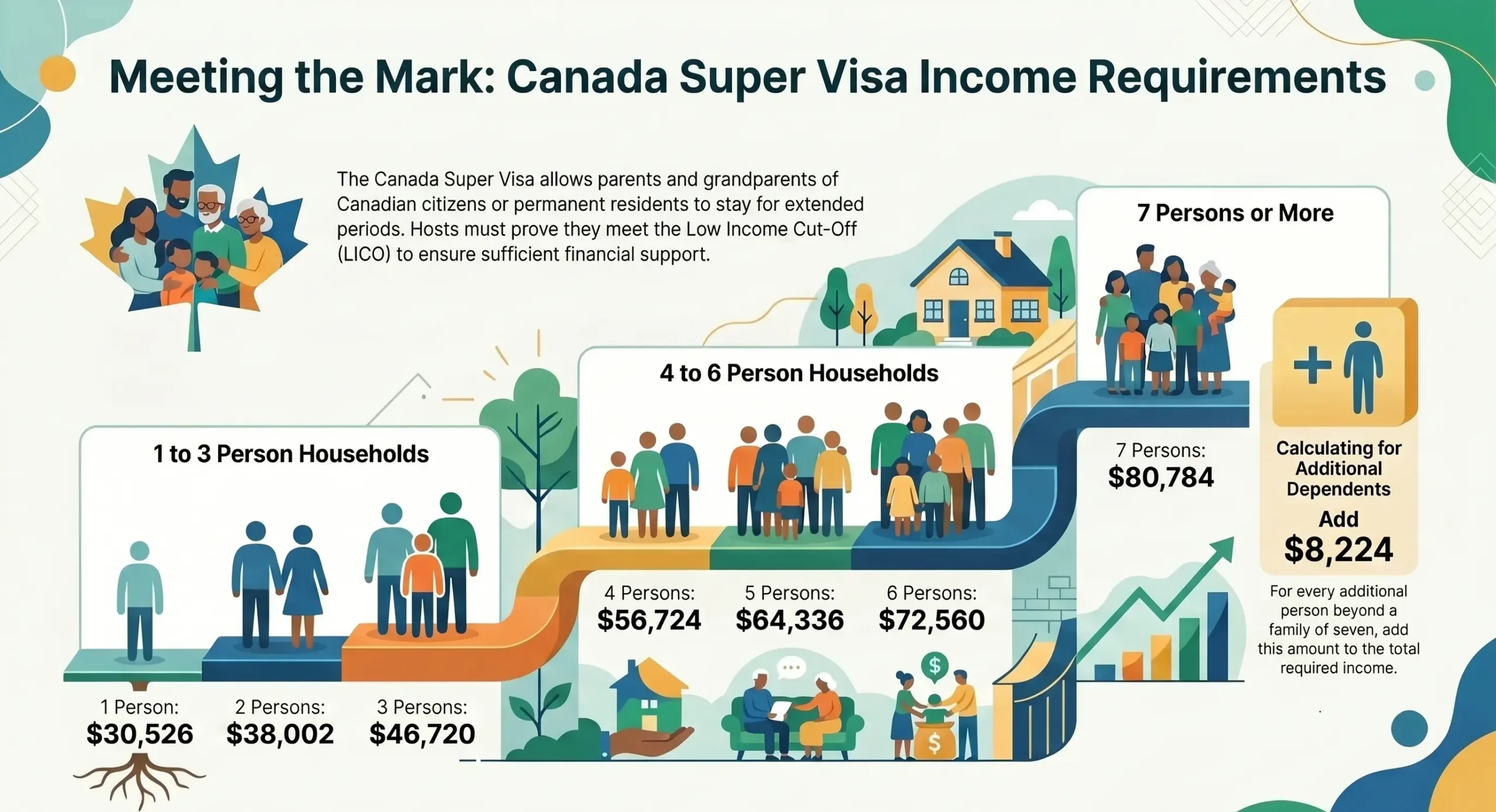
Canada Super Visa Income Requirements

Note: These income requirements are based on the Low Income Cut-Off (LICO) figures and are subject to change. It’s important to note that meeting the income requirements alone does not guarantee the approval of a Super Visa application, as there are other eligibility criteria that must also be met.

Canada Super Visa Application Procedure

The following is a general outline of the Canada Super Visa application procedure:

  • Determine eligibility: Before applying for a Super Visa, you must ensure that you meet the eligibility criteria, which include being the parent or grandparent of a Canadian citizen or permanent resident, passing a medical exam, and having valid medical insurance.
  • Gather documents: Gather all the required documents, which include a valid passport, proof of relationship with a Canadian citizen or permanent resident, proof of medical insurance, proof of financial support, invitation letter, travel itinerary, and police clearance certificate (if required).
  • Apply online or by mail: The application for Canadian Super Visa is mainly done online through the Canadian government’s website. Mailing in a paper application is also an option but it is done for some special situations. Make sure to fill out the application form accurately and completely, and pay the application fee.
  • Wait for processing: Once your application is submitted, it will be reviewed by Canadian immigration officials. Processing times can vary, but you can check the current processing times on the Canadian government’s website.
  • Attend biometrics appointment: If required, you will need to attend a biometrics appointment at a designated location to have your fingerprints and photo taken.
  • Wait for decision: After your application is processed, you will receive a decision letter indicating whether your Super Visa has been approved or not.
  • Travel to Canada: If your Super Visa is approved, you can travel to Canada and stay for up to 5 years per visit. You will need to present your Super Visa and other required documents at the Canadian border.

REASON TO CHOOSE PI OVERSEAS

  • Consultations at Pi Overseas are provided by professional and authorized immigration consultants
  • A step-by-step guide to the eligibility and application process
  • Our online process is secure and transparent
  • For any process, there is a system addressing complaints for a smooth consumer experience.
  • Having processed thousands of applications
  • We assess every case multiple times before submitting it
  • Qualifications and other skills are evaluated by our certified experts for error-free proceedings.

If you are willing to know more about the Canada Super Visa process, you can certainly contact us by writing us an email at mail@pioverseas.com and one of our experts will help you out in every possible way. Call us at +91-9310-10-6988, or you can also receive a call back from our expert once you fill out the inquiry form. You can also talk to our experts directly through our live chat feature and clear your doubts instantaneously.

We at Pi Overseas have a team of dedicated experts who cater to every need of the clients. We have a proven track record in the immigration industry, which was achieved in a very short span of time. Our experts will help and guide you through every step of the filing process and keep you posted throughout the whole cumbersome process of visa filing.

Let’s Start Your Visa Journey — Contact Us Today

Frequently Asked Questions

The Super Visa is a 10-year, multiple-entry visitor visa that lets eligible parents and grandparents of Canadian citizens and permanent residents stay in Canada for up to 5 years per visit, without needing to renew their status every 6 months like a standard visitor visa. It doesn’t grant permanent residence; it’s a long-stay temporary visa, but it’s currently the most practical way for parents and grandparents to spend extended time in Canada while the Parents and Grandparents Program (PGP) remains closed to new general applications.

Two notable changes have landed in 2026: (1) as of March 31, 2026, hosts gained more flexibility on the income test, they can now use either of the two most recent tax years, and can supplement their own income with the visiting parent or grandparent’s income (pensions, investments, savings) if they meet a minimum independent threshold; and (2) as of July 3, 2026, IRCC significantly cut Super Visa processing times for applicants from India to around 50 days, down from the standard 90–120 day range. Both changes apply automatically to new and in-progress applications.

The Super Visa is a 10-year multiple-entry visa allowing parents and grandparents of Canadian citizens or PRs to stay in Canada for up to 5 years per visit, without needing a lottery or annual intake window. It’s the recommended alternative while the PGP remains closed. Requirements include proof of the sponsor’s income (based on LICO, generally lower than PGP’s MNI threshold) and private medical insurance of at least $100,000 CAD covering healthcare, hospitalization, and repatriation. As of July 3, 2026, IRCC significantly cut Super Visa processing times for applicants from India to around 50 days.


PGP

Super Visa

Result

Permanent residence

Long-term visitor status (not PR)

Intake

Closed / invitation-only in 2026

Open year-round

Income test

Minimum Necessary Income (MNI), 3 tax years

Low Income Cut-Off (LICO), generally lower bar

Stay length

Permanent

Up to 5 years per entry, visa valid 10 years

Medical insurance

Not required

$100,000 CAD minimum, mandatory

To qualify, the applicant must be the parent or grandparent of a Canadian citizen or permanent resident, and the Canadian host must meet Canada’s Low Income Cut-Off (LICO) threshold for their household size. The applicant must also pass a medical examination, hold valid private medical insurance (minimum $100,000 CAD coverage), and be otherwise admissible to Canada (no serious criminal or medical inadmissibility issues). A signed letter of invitation from the host in Canada is also required.

A Super Visa is valid for up to 10 years, and each entry allows a stay of up to 5 years without needing to leave and re-enter or renew status. This is the single biggest advantage over a standard visitor visa, which typically limits stays to 6 months at a time and requires either leaving the country or applying for an extension well before that period ends.

The Canadian host must meet Canada’s Low Income Cut-Off (LICO), which scales by household size, for 2026, roughly $54,743 CAD for a household of 3 and $66,466 CAD for a household of 4, with about $9,636 CAD added per additional person. As of a March 31, 2026 policy change, hosts now have more flexibility: they can use income from either of the two most recent tax years (not just the latest), and if they meet a required minimum percentage of the threshold independently, the visiting parent or grandparent’s own income (pensions, investments, savings) can be added to cover the rest.

Household Size

Approx. LICO Threshold (2026, CAD)

3 people

$54,743

4 people

$66,466

Each additional person

+~$9,636


Note: LICO thresholds are updated annually and vary slightly by source region. Confirm the exact current figure on IRCC’s official Super Visa page before applying.

Super Visa processing generally takes 90–120 days globally, with IRCC’s official service standard around 112 days (aiming to process 80% of applications within that window). Processing time varies significantly by country of application — for example, applications from the Philippines have recently run 95–116 days, while as of July 3, 2026, IRCC cut processing times for applicants from India to approximately 50 days. IRCC’s overall immigration backlog has also recently dropped below 1 million applications, which may improve processing speed further through the rest of 2026.

No. The Super Visa is a temporary, long-stay visitor visa — it doesn’t provide a path to permanent residence, doesn’t require a sponsorship undertaking, and doesn’t count toward any settlement timeline. Parents and grandparents wanting actual PR status need to go through the Parents and Grandparents Program (PGP), which is currently invitation-only and closed to new general applications in 2026. Many families use the Super Visa as a practical bridge while waiting for a future PGP intake window to open.

The core government fees are $100 CAD for the visa application plus $85 CAD for biometrics per applicant. The largest cost is private medical insurance, typically running $1,200–$3,500 CAD per year depending on the applicant’s age, health, and chosen deductible, older applicants and those with pre-existing conditions generally pay more. Add a medical exam fee (varies by panel physician and country) on top of these.

Cost Item

Typical Amount (CAD)

Visa application fee

$100

Biometrics fee

$85 per person

Medical insurance (annual)

$1,200–$3,500+, depending on age/health

Medical exam

Varies by panel physician

Super Visa applicants need private medical insurance with at least $100,000 CAD in coverage, valid for a minimum of 1 year from the date of entry, covering healthcare, hospitalization, and repatriation. The policy must come from a Canadian insurance company, or a foreign insurer that’s OSFI-approved (appearing on the Office of the Superintendent of Financial Institutions’ list of federally regulated providers). Proof of paid insurance, not just a quote, must be submitted with the application; buying a policy after submitting the application is a common and automatically disqualifying mistake.

A complete application typically includes: a valid passport, proof of the parent/grandparent relationship, a letter of invitation from the Canadian host, proof of the host’s income (Notice of Assessment or equivalent), proof of paid medical insurance meeting the coverage requirements, results of an immigration medical exam, and a police clearance certificate if required for the applicant’s country. Missing or inconsistent documentation is one of the most common causes of delay or refusal.

According to IRCC’s own report to Parliament, the Super Visa has an average approval rate of around 78% across all applications from 2011 to 2023, rising to 81% in 2023 specifically. Approval rates vary meaningfully by country of residence — applicants from India (87%) and Bangladesh (88%) have historically had higher-than-average approval rates, while the Philippines (75%) has run somewhat below average. Since India accounts for over half of all Super Visa holders, the strong India-specific rate meaningfully lifts the overall average.

Approval Rates by Top Source Country (2011–2023, Official IRCC Data)

Country

Share of All Super Visas

Approval Rate

India

56%

87%

China

11%

79%

Philippines

4%

75%

Bangladesh

2%

88%

All other countries

22%

75%

Overall average

100%

~78%

Two notable changes have landed in 2026: (1) as of March 31, 2026, hosts gained more flexibility on the income test — they can now use either of the two most recent tax years, and can supplement their own income with the visiting parent or grandparent’s income (pensions, investments, savings) if they meet a minimum independent threshold; and (2) as of July 3, 2026, IRCC significantly cut Super Visa processing times for applicants from India to around 50 days, down from the standard 90–120 day range. Both changes apply automatically to new and in-progress applications.

A regular visitor visa typically allows stays of up to 6 months per entry and doesn’t require private medical insurance. A Super Visa allows stays of up to 5 years per entry (valid for 10 years total) but is only available to parents and grandparents of citizens/PRs, and requires mandatory private medical insurance with at least $100,000 CAD coverage — a requirement that doesn’t apply to standard visitor visas.


Regular Visitor Visa

Super Visa

Who can apply

Most foreign nationals

Parents/grandparents of citizens or PRs only

Max stay per entry

Up to 6 months

Up to 5 years

Visa validity

Varies

Up to 10 years

Mandatory medical insurance

No

Yes, minimum $100,000 CAD

Income test for host

No

Yes, LICO-based

Yes. A parent or grandparent already in Canada on a Super Visa can apply to extend their stay from within Canada before their current authorized period expires, without needing to leave the country. This flexibility is one of the practical advantages of the Super Visa over some other temporary status types, and it’s worth applying for an extension well ahead of the expiry date to avoid any gap in valid status.

For parents and grandparents planning an extended stay, the Super Visa is almost always the better choice, it allows up to 5 years per visit (versus 6 months on a regular visitor visa) and doesn’t require renewing status every few months. A regular visitor visa is better for shorter trips, for visitors who aren’t a parent or grandparent of the host (since only they qualify for a Super Visa), or for anyone who doesn’t want to take on mandatory private medical insurance and the host income requirement that come with the Super Visa.

Side-by-Side Comparison


Super Visa

Regular Visitor Visa

Who can apply

Only parents/grandparents of a Canadian citizen or PR

Most foreign nationals

Max stay per entry

Up to 5 years

Up to 6 months

Visa validity

Up to 10 years

Up to 10 years

Requires host invitation

Yes, with promise of financial support

No

Host income test

Yes (Low Income Cut-Off)

No

Mandatory medical insurance

Yes, minimum $100,000 CAD

No

Application fee

$100 CAD

$7–$100 CAD

Historical approval rate

~78% average (2011–2023)

~66% average (2019–2023); refusals have trended higher since


The Honest Trade-Off

The Super Visa’s extra requirements; the income test and mandatory insurance, exist precisely because it grants a much longer stay. In exchange for that flexibility, IRCC wants stronger assurance the visitor is financially supported and covered medically for the whole period. A regular visitor visa is lighter on paperwork but locks you into short stays with more frequent renewals if you want to extend a visit.

Bottom line: if the visitor is a parent or grandparent and you want them to stay for more than a few months at a time, the Super Visa’s added requirements are worth it. If it’s a shorter trip, or the visitor doesn’t qualify as a parent/grandparent of the host, a regular visitor visa is the only, and simpler option.

The most common refusal reasons are: insufficient or improperly formatted insurance (buying a policy after submitting the application, or from a non-compliant insurer), the host not meeting the LICO income threshold, incomplete or inconsistent documentation, failed medical or admissibility checks, and an unclear or unconvincing letter of invitation and relationship evidence. Because insurance and income requirements are strictly verified, careful preparation of these two elements specifically prevents the majority of avoidable refusals.

A Super Visa is valid for up to 10 years, and each entry allows a stay of up to 5 years without needing to leave and re-enter or renew status. This is the single biggest advantage over a standard visitor visa, which typically limits stays to 6 months at a time and requires either leaving the country or applying for an extension well before that period ends.

For most families in 2026, the Super Visa is the more practical near-term choice, since the PGP is closed to new general applications and only processing invitations from a 2020 interest pool. The Super Visa offers no lottery, year-round applications, and long stays (up to 5 years per entry), but results in visitor status, not permanent residence. Families who specifically want their parent or grandparent to become a Canadian permanent resident should still register interest for future PGP rounds while using the Super Visa as a practical bridge in the meantime.