The Canada Family Sponsorship Visa is a program that allows Canadian citizens and permanent residents to sponsor their family members for immigration to Canada. Under this program, eligible family members can apply for permanent residence in Canada and join their sponsor in the country.
The Canada Family Sponsorship Visa program covers several categories of family members, including:
To be eligible to sponsor a family member under this program, the sponsor must be at least 18 years old, a Canadian citizen or permanent resident, and meet certain financial requirements to ensure they can support their sponsored family member(s). The sponsored family member must also meet certain eligibility requirements, including passing a medical exam and a background check.
To be eligible to become a sponsor for the Canada Family Sponsorship Visa program, a person must meet the following criteria:
A Canadian citizen or permanent resident who lives in Canada can apply to sponsor family members for a Canada Family Sponsorship visa.
If the sponsor is living outside Canada, they can still apply, but only to sponsor their spouse, partner, or dependent children. In this case, the sponsor must be a Canadian citizen and must plan to return to Canada when the person they are sponsoring becomes a permanent resident.
It is important to note that the sponsor’s financial situation will be assessed to ensure that they are capable of supporting the sponsored family member(s) for the duration of the undertaking period. If the sponsor does not meet the financial requirements, the sponsorship application may be refused.
In addition, the sponsor must demonstrate a genuine relationship with the sponsored family member(s) and meet the specific eligibility criteria for the family member(s) they are sponsoring, such as age, relationship, and immigration status.
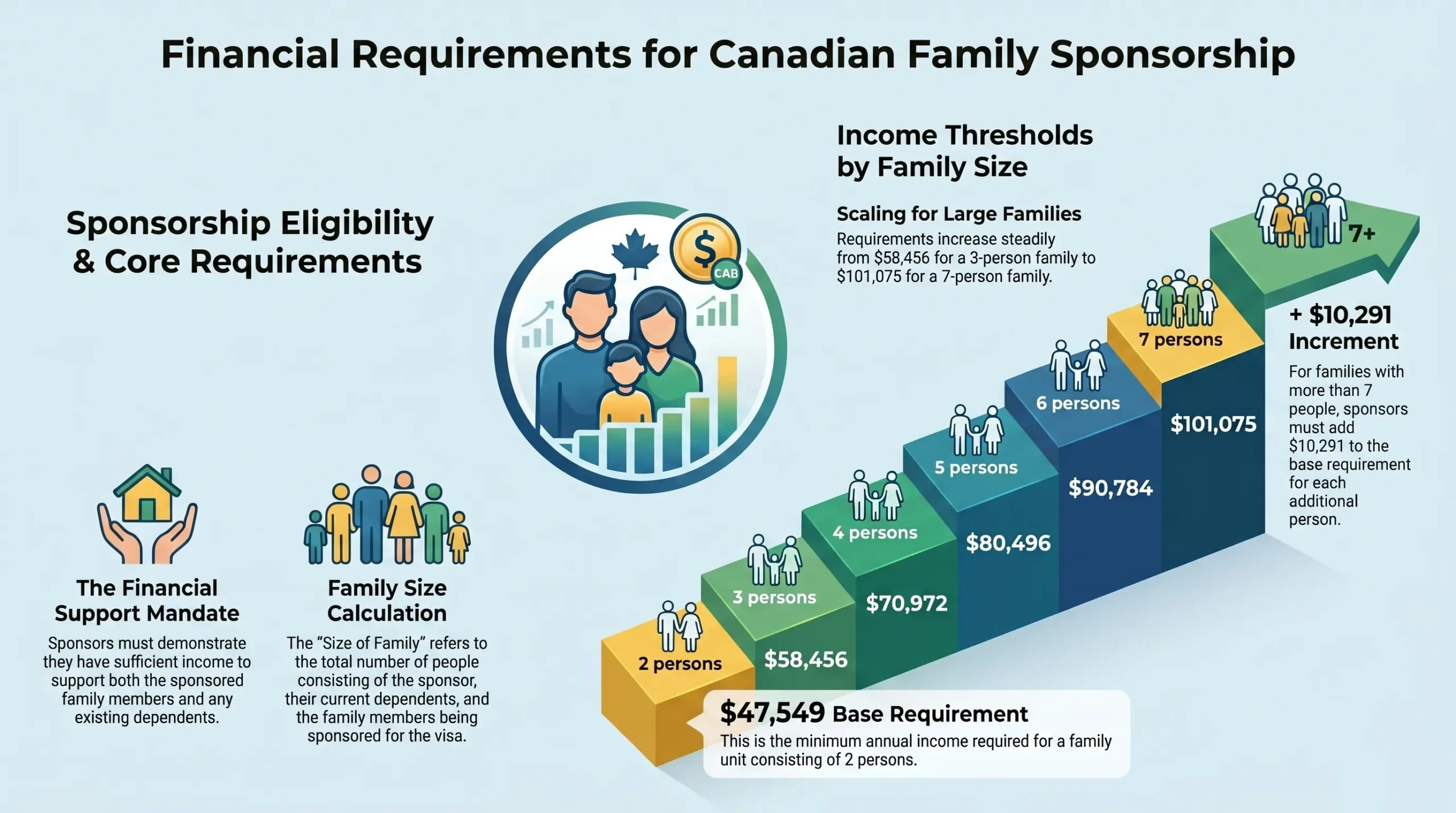
To sponsor a family member for immigration to Canada under the Family Sponsorship Visa program, the sponsor must demonstrate that they have sufficient income to support the sponsored family member(s) and any dependents they may have. The income requirement is based on the size of the sponsor’s family, including the sponsored family member(s) and any dependents, and is determined by the Low-Income Cut-Off (LICO) figures published by Statistics Canada.
A sponsorship undertaking is a legal agreement that sponsors sign when sponsoring a family member under the Canada Family Sponsorship Visa program. The undertaking is a binding contract that outlines the sponsor’s responsibilities and obligations to support the sponsored family member(s) for a specified period of time.
By signing the sponsorship undertaking, the sponsor agrees to provide the sponsored family member(s) with the necessary financial and emotional support to help them settle in Canada. The undertaking period varies depending on the relationship between the sponsor and the sponsored family member.
The sponsor’s responsibilities under the undertaking include:
It is important to note that the sponsorship undertaking is a serious commitment, and the sponsor may be held legally and financially responsible if they fail to meet their obligations under the agreement. Therefore, it is recommended that sponsors fully understand the terms of the undertaking before signing it and seek legal advice if necessary.
The application process for the Canada Family Sponsorship Visa program can vary depending on the specific category of the family member being sponsored, but the general process is as follows:
There are several costs associated with the Canada Family Sponsorship Visa program, including:
It is important to note that these costs are subject to change and do not include other expenses, such as travel costs and the cost of settling in Canada. Therefore, it is recommended that individuals budget accordingly and fully understand the costs involved before proceeding with an application.
If you are willing to know more about the Canada Family Sponsorship Visa process, you can certainly contact us by writing us an email at mail@pioverseas.com and one of our experts will help you out in every possible way. Call us at +91-9310-10-6988 or you can also receive a call back from our expert once you fill out the inquiry form. You can also talk to our experts directly through our live chat feature and clear your doubts instantaneously.
We at Pi Overseas have a team of dedicated experts that cater to every need of the clients. We have a proven track record in the immigration industry which was achieved in a very short span of time. Our experts will help and guide you through every step of the filing process and keep you posted throughout the whole cumbersome process of visa filing.
You can sponsor your:
In specific, limited circumstances, a Canadian citizen with no other family in Canada or abroad may sponsor a more distant relative, such as an orphaned sibling, niece, or nephew under 18 — these cases are rare and assessed individually. Canada does not have a fiancé visa; couples must be legally married, in a common-law relationship (cohabiting 12+ months), or in a conjugal partnership to qualify.
Relationship | Category | Notes |
Spouse | Family Class | Legally married |
Common-law partner | Family Class | Cohabited continuously for 12+ months |
Conjugal partner | Family Class | Used when cohabitation wasn’t possible (e.g., legal/immigration barriers) |
Dependent child | Family Class | Under 22 and unmarried, or 22+ with a disability preventing self-support |
Parent / grandparent | PGP (invitation-only in 2026) | Also eligible for the Super Visa as an alternative |
Orphaned sibling/niece/nephew/grandchild under 18 | Other eligible relative | Only if sponsor has no other family in Canada or abroad |
To sponsor a family member, you generally need to meet all of the following:
Requirement | Detail |
Status | Canadian citizen or permanent resident (not just a temporary resident) |
Age | At least 18 years old |
Residency | Live in Canada, or if a citizen living abroad, show intent to live in Canada once the sponsored person becomes a PR |
Financial standing | Not receiving social assistance for reasons other than disability; must meet Minimum Necessary Income (MNI) if sponsoring parents/grandparents |
Sponsorship history | No outstanding sponsorship debts or defaults from a previous undertaking |
Legal/criminal status | No serious criminal convictions or immigration-related bans that would make you ineligible to sponsor |
Relationship undertaking | Willing to sign a legally binding agreement to financially support the sponsored person for 3–20 years depending on relationship type |
A permanent resident can sponsor most family categories, but some rules differ slightly for citizens versus PRs — for example, PRs sponsoring from outside Canada generally aren’t eligible, since they must reside in Canada to sponsor.
Yes. Canadian citizens and permanent residents can sponsor a spouse, common-law partner, dependent child, or eligible parent/grandparent for permanent residence through the Family Class program. As of the April 2026 fee update, sponsoring a spouse or partner costs $1,260 CAD (including the RPRF), or $660 CAD if you defer the RPRF payment until later in the process.
Genuineness of the relationship is scrutinized closely — joint finances, a clear photo timeline, and a detailed relationship narrative are generally expected as supporting evidence.
Family sponsorship is the Canadian immigration pathway that lets citizens and permanent residents bring close relatives — spouses, common-law or conjugal partners, dependent children, and parents or grandparents — to Canada as permanent residents. The sponsor signs a legally binding undertaking to financially support the sponsored person for a set period (typically 3 years for a spouse/partner, 10–20 years for parents/grandparents), and IRCC assesses both the sponsor’s eligibility and the applicant’s admissibility together.
No, the PGP is closed to new general applications in 2026. IRCC is instead processing applications from sponsors who were invited from the 2020 interest-to-sponsor pool, with the most recent invitation round issued in mid-2025 and applications from that round still being processed into 2026. New Ministerial Instructions for the program took effect January 1, 2026, but no new public intake window has been announced. Prospective sponsors currently on the interest list should monitor IRCC’s official PGP page for updates on future rounds.
Spousal and partner sponsorship costs approximately $1,260–1,290 CAD in government fees, following IRCC’s April 2026 fee update (this can be split, paying roughly $660 CAD upfront with the Right of Permanent Residence Fee deferred until later in the process). Budget an additional $300–800 CAD for third-party costs — medical exams, police certificates, and certified translations — depending on your country. Quebec residents pay an additional $328 CAD provincial fee, and should note that Quebec’s MIFI paused new spousal undertaking applications, expected to lift around June 25, 2026.
As of mid-2026, spousal sponsorship processing time is reported inconsistently across sources — official IRCC service standards suggest roughly 12–18 months, while some practitioners report current real-world queues closer to 24–25 months given application backlogs. Inland applications (sponsored partner already in Canada) typically process in around 12 months, while outland applications (partner abroad) often take 12–18 months, though the applicant can travel more freely during processing.
Processing Stream | Who It’s For | Typical Timeline |
Inland | Partner is already in Canada | ~12 months |
Outland | Partner resides abroad | ~12–18 months |
Current reported queue (2026) | Both streams, per recent practitioner data | Up to ~24–25 months in some cases |
Processing times fluctuate monthly with intake volume and are not guarantees. Always check IRCC’s live processing time tool for your specific application type before relying on any figure here.
Sponsors must meet the Minimum Necessary Income (MNI) — calculated as Canada’s Low Income Cut-Off (LICO) plus 30% — for each of the three most recent tax years, with the required amount scaling by family size. For 2026, the MNI for a 4-person family is approximately $54,595 CAD. This is a materially higher bar than the Super Visa’s income requirement, which uses standard LICO without the 30% addition.
Yes, if you’re applying inland (already in Canada). Sponsored spouses and partners applying through the inland stream can apply for an open work permit, valid until a decision is made on the PR application, letting them work for any Canadian employer without needing a separate job offer. This is one of the main practical advantages of inland sponsorship over outland sponsorship, where no equivalent work permit is automatically available during processing.
IRCC looks for evidence that a relationship is genuine and not entered into primarily for immigration purposes, typically including a marriage or common-law relationship certificate, joint financial records (bank accounts, leases, utility bills), photos together over time, travel records showing time spent together, and correspondence or communication history. A single type of evidence is rarely sufficient — officers generally look for a consistent, corroborated pattern across multiple document types rather than any one piece of proof.
Only in narrow, specific circumstances. Canada’s standard family class covers spouses/partners, dependent children, and parents/grandparents — not siblings, cousins, aunts, or uncles as a general rule. The one exception is for a Canadian citizen who has no other eligible relative in Canada or abroad (including no spouse, common-law partner, conjugal partner, child, parent, grandparent, or sibling who could otherwise be sponsored); in that specific case, they may be able to sponsor one relative regardless of relationship, or an orphaned sibling, niece, nephew, or grandchild under 18. These cases are legally complex and individually assessed.
If a spousal or family sponsorship application is refused, you generally have the right to appeal to the Immigration Appeal Division (IAD) within 30 days of receiving the refusal decision, provided the refusal wasn’t based on misrepresentation or certain inadmissibility grounds. Common refusal reasons include insufficient proof of a genuine relationship, incomplete documentation, sponsor eligibility issues (unpaid debts, income shortfalls for PGP/MNI cases), or admissibility concerns for the sponsored person. A refusal significantly extends the overall timeline, so addressing likely weaknesses in the original application; particularly relationship evidence, is generally more effective than hoping a resubmission will succeed without changes.