
+91 9310106988
mail@pioverseas.com
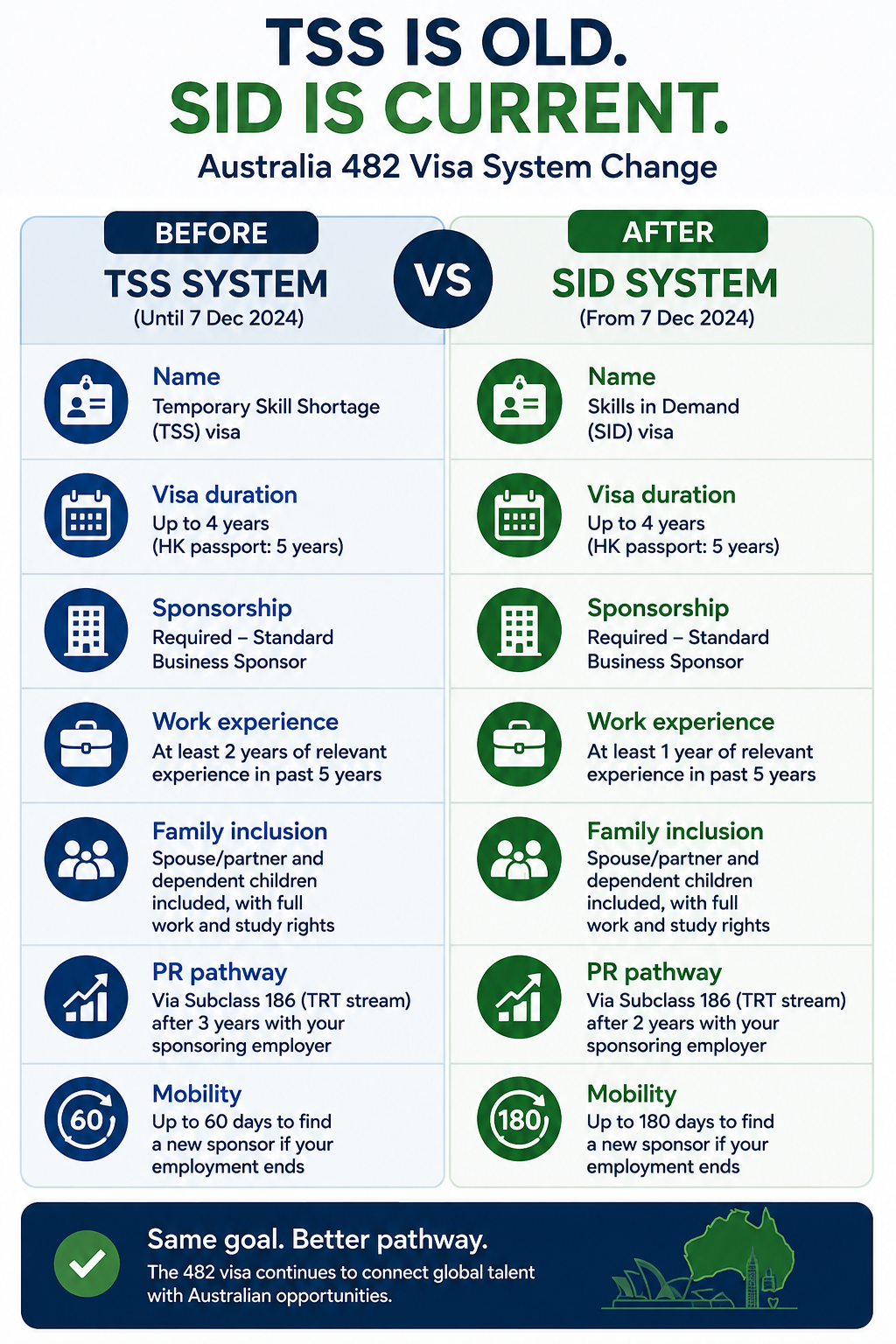
” or the STSOL/MLTSSL occupation lists — that information is out of date. On 7 December 2024, the Temporary Skill Shortage (TSS) visa was fully replaced by the Australia Subclass 482 Skills in Demand (SID) visa, still numbered Subclass 482 but restructured around four streams: Core Skills, Specialist Skills, Labour Agreement, and Subsequent Entrant. Salary thresholds, work experience requirements, and the pathway to permanent residency have all changed since then, most recently again on 1 July 2026.
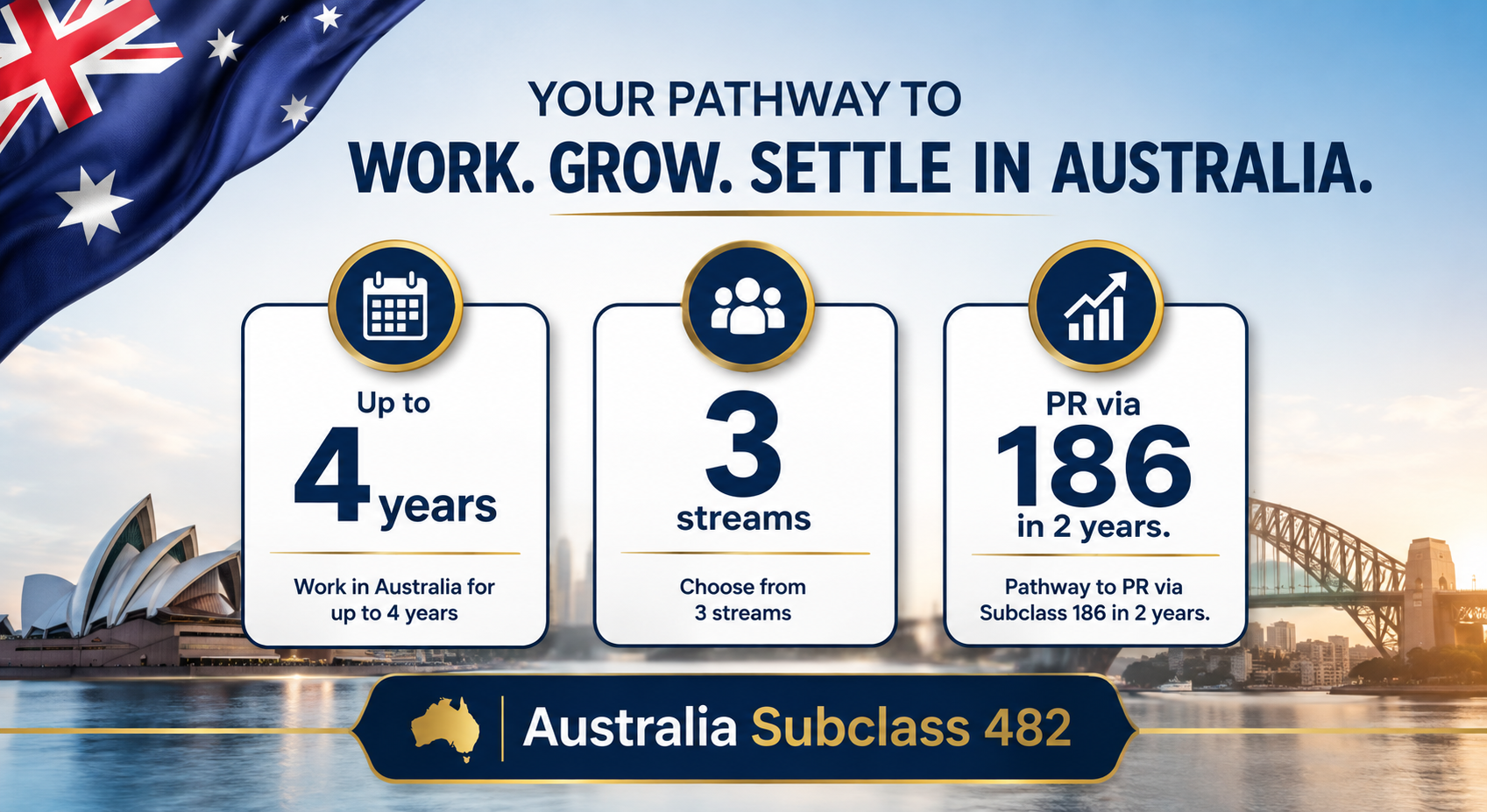
The 482 remains Australia’s primary employer-sponsored temporary work visa: an approved Australian employer sponsors you for a genuine skilled role, and in exchange you get up to 4 years of full work rights in Australia, with a realistic pathway to permanent residency via the Subclass 186.
This guide covers the current four streams, salary thresholds, occupation list requirements, eligibility, fees, processing times, and the 482-to-186 permanent residency pathway — all reflecting the system as it actually operates today, not the retired TSS framework.
NOTE: The Subclass 482 (Skills in Demand) visa requires sponsorship from an approved Australian employer, at least 1 year of relevant work experience, and a salary that meets either the Core Skills Income Threshold (AUD 79,423) or the Specialist Skills Income Threshold (AUD 146,576), depending on your stream. It grants up to 4 years of work rights, with a pathway to permanent residency via Subclass 186 after 2 years with your sponsoring employer.
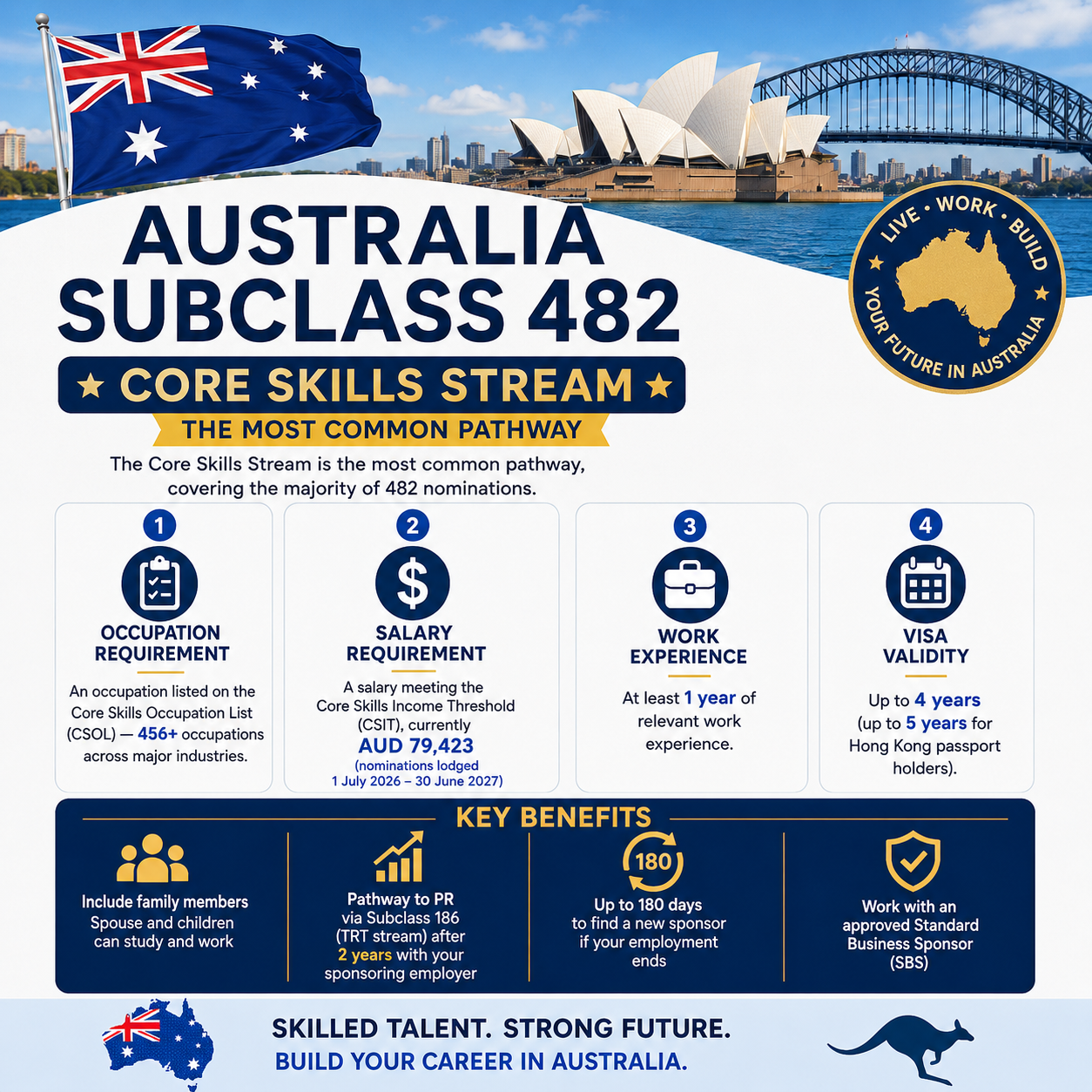
The most common pathway, covering the majority of 482 nominations.
Requires:
Visa validity: up to 4 years (up to 5 years for Hong Kong passport holders).
For highly paid professionals in management, professional, technical, and community/personal service roles. Requires:
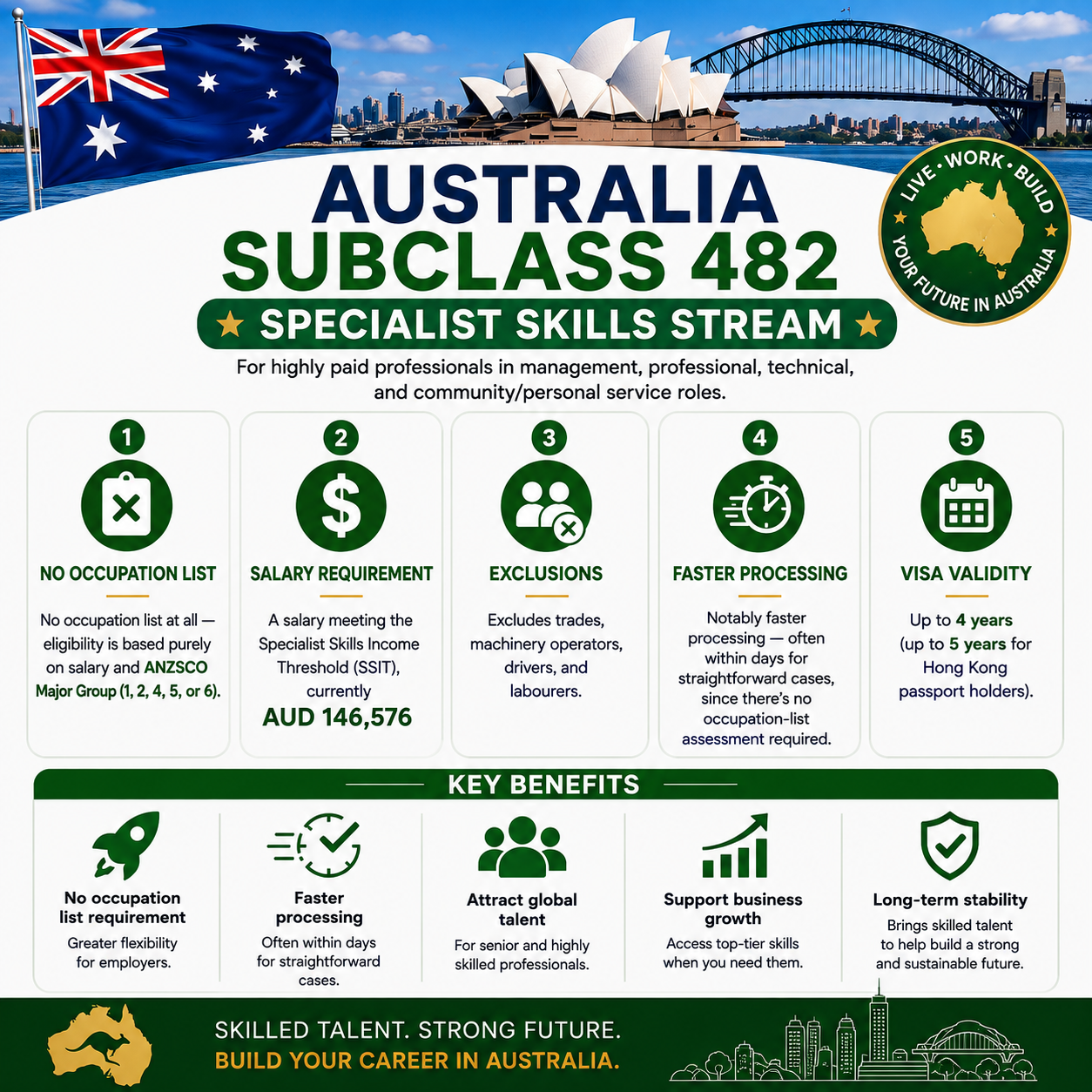
Visa validity: up to 4 years (up to 5 years for Hong Kong passport holders).
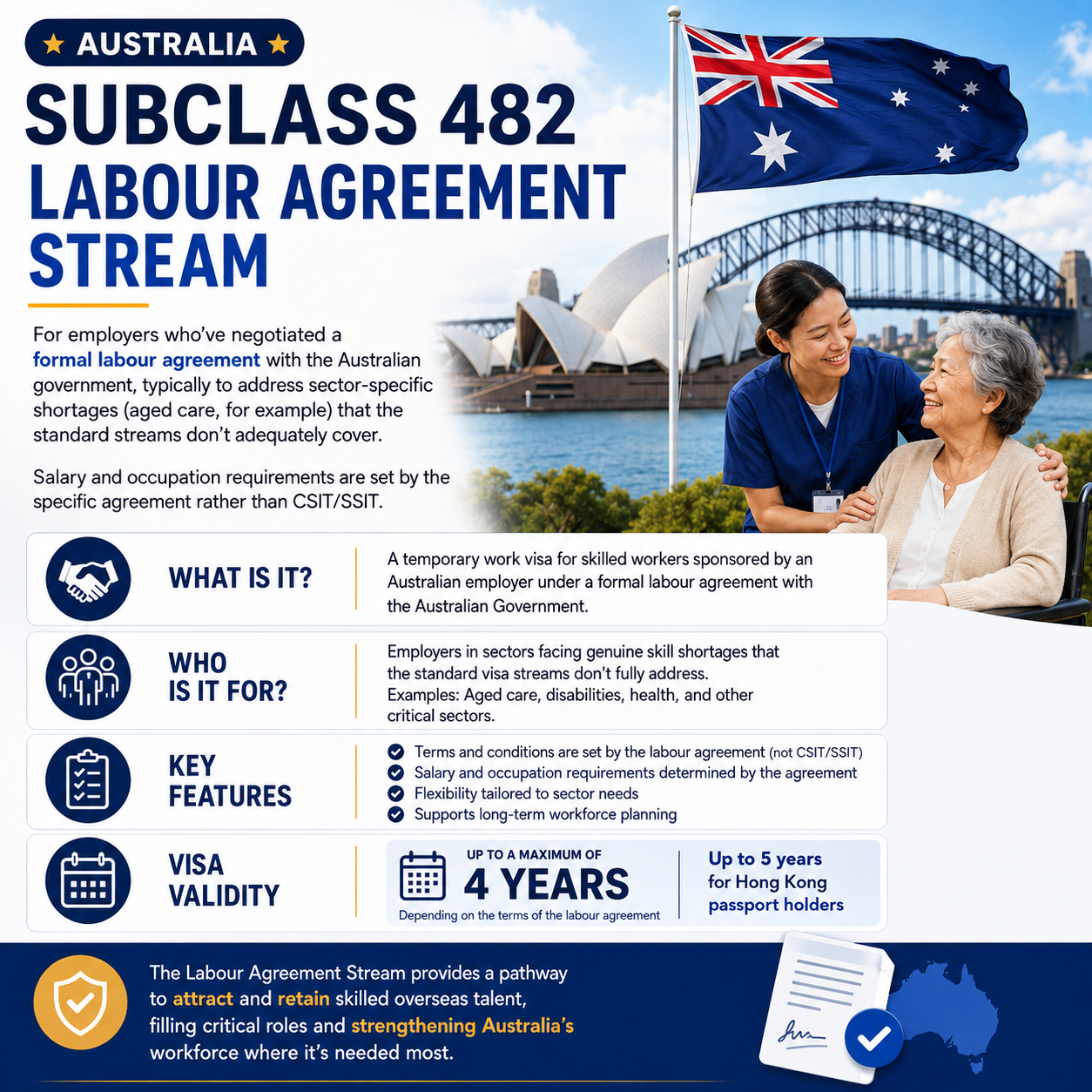
For employers who’ve negotiated a formal labour agreement with the Australian government, typically to address sector-specific shortages (aged care, for example) that the standard streams don’t adequately cover. Salary and occupation requirements are set by the specific agreement rather than CSIT/SSIT.
Visa validity: up to a maximum of 4 years, depending on the terms of the labour agreement (up to 5 years for Hong Kong passport holders).
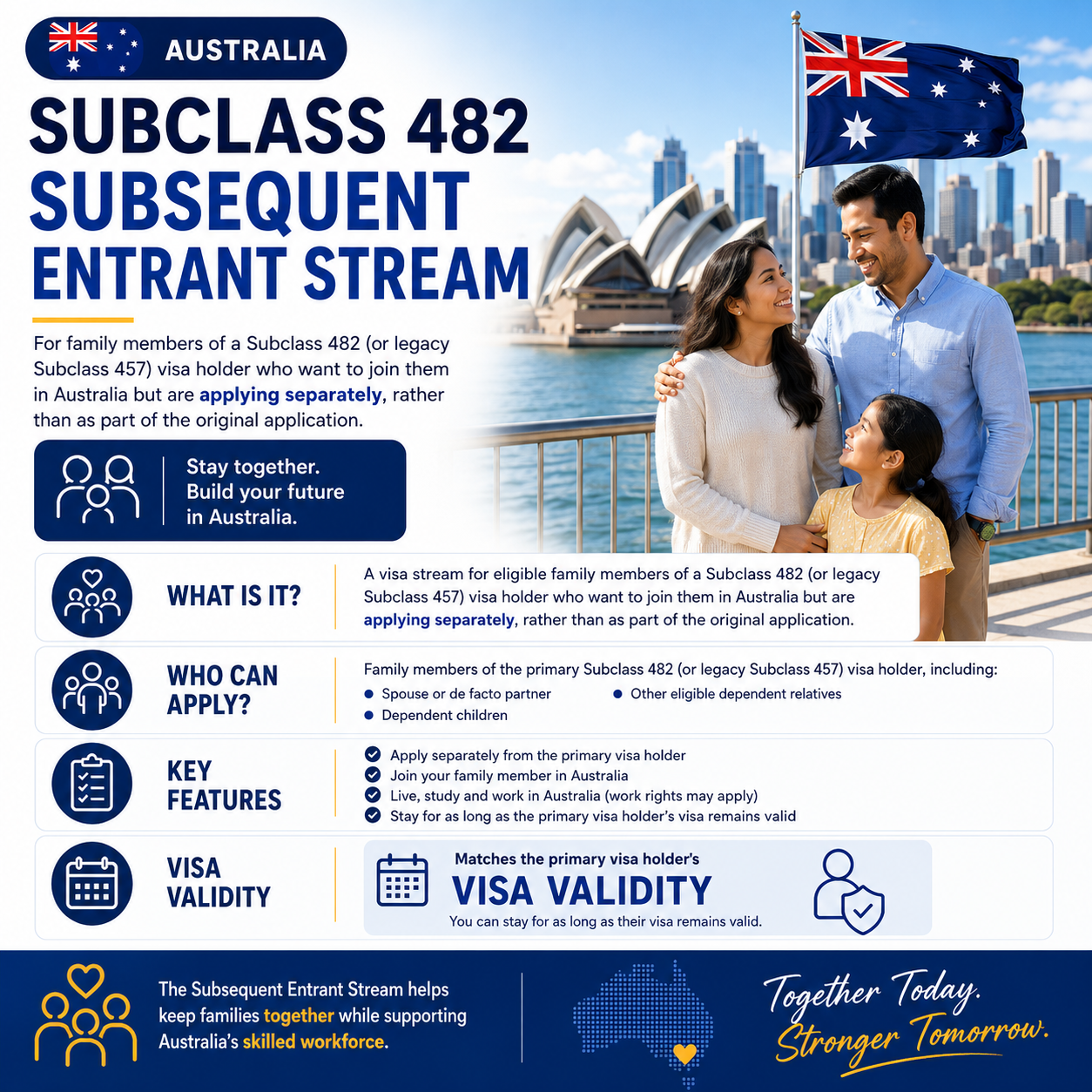
For family members of a Subclass 482 (or legacy Subclass 457) visa holder who want to join them in Australia but are applying separately, rather than as part of the original application.
Visa validity matches the primary visa holder’s — you can stay for as long as their visa remains valid.
Every 482 nomination must meet the relevant income threshold or the Annual Market Salary Rate (AMSR) for the role and location — whichever is higher.
Stream | Threshold Name | Current Amount (1 July 2026–30 June 2027) |
Core Skills | Core Skills Income Threshold (CSIT) | AUD 79,423 |
Specialist Skills | Specialist Skills Income Threshold (SSIT) | AUD 146,576 |
Labour Agreement | Set by the specific agreement | Varies |
These figures exclude superannuation and non-monetary benefits (like a car allowance) — only guaranteed cash earnings count.
Since 7 December 2024, Core Skills stream nominations draw from the Core Skills Occupation List (CSOL) — a single, consolidated list of 456+ occupations replacing the old STSOL/MLTSSL split used under the TSS system. If you’ve previously been told your occupation isn’t eligible based on STSOL/MLTSSL criteria, it’s worth rechecking against the current CSOL, since the list was substantially restructured.
The Specialist Skills stream requires no occupation list at all — eligibility is salary and ANZSCO-group based, which is a genuinely useful option for high earners in occupations that don’t sit neatly on a skills list.
Step 1: Confirm Your Employer’s Sponsorship Status
Your employer must be an approved Standard Business Sponsor, or apply to become one (often lodged together with your nomination).
Step 2: Employer Nominates Your Position
Your employer lodges a nomination application, demonstrating the role is genuine and meets the relevant salary threshold.
Step 3: Confirm Your Occupation & Stream
Check whether your occupation is on the CSOL (Core Skills) or whether your salary qualifies you for Specialist Skills instead.
Step 4: Gather Supporting Documents
Passport, English test results (unless exempt), evidence of work experience, skills assessment (if required for your occupation), and health/character documentation.
Step 5: Lodge Your Visa Application
Submit through ImmiAccount alongside or shortly after your nomination is lodged.
Step 6: Health & Character Checks
Complete medical examinations and provide police clearance certificates.
Step 7: Visa Grant
Receive your visa grant and begin working for your sponsoring employer in Australia.
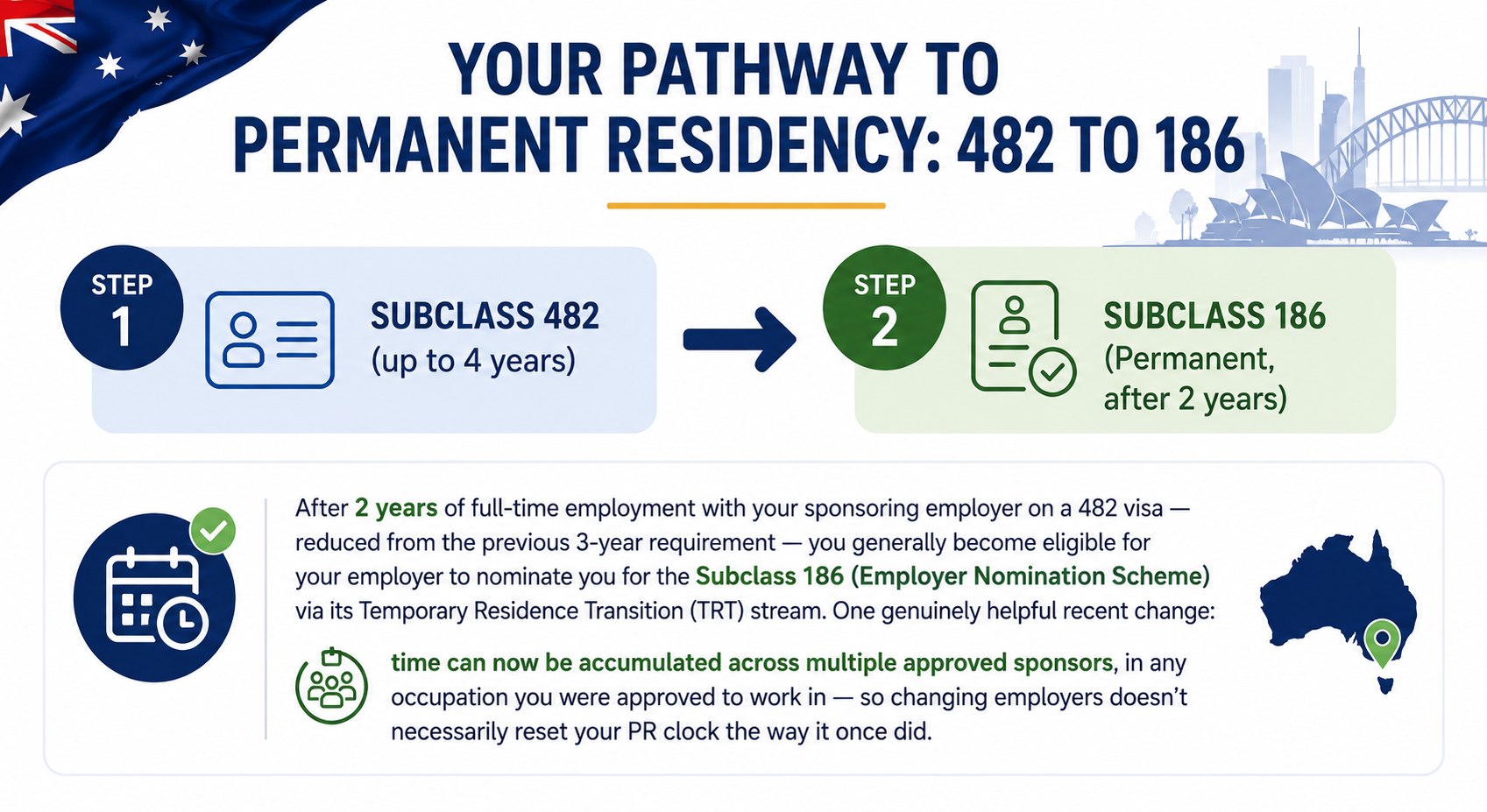
After 2 years of full-time employment with your sponsoring employer on a 482 visa — reduced from the previous 3-year requirement — you generally become eligible for your employer to nominate you for the Subclass 186 (Employer Nomination Scheme) via its Temporary Residence Transition (TRT) stream. One genuinely helpful recent change: time can now be accumulated across multiple approved sponsors, in any occupation you were approved to work in — so changing employers doesn’t necessarily reset your PR clock the way it once did.
Read our full Subclass 186 Visa Guide for the complete streams breakdown, salary thresholds, and TRT eligibility criteria.
Subclass 482 Visa Fees (2026)
Cost Component | Amount (AUD) | Who Pays |
Visa application charge (primary applicant) | From AUD 4,015.00, same across all four streams | Applicant |
Sponsorship application fee (if not already approved) | ~420 | Employer |
Nomination fee | Varies | Employer |
SAF (Skilling Australians Fund) levy — annual | AUD 1,200/year (business turnover under $10M) or AUD 1,800/year (turnover $10M+), per year of proposed stay | Employer |
A lower visa cost applies from 1 July 2026 for eligible Pacific Island and Timor-Leste citizens who lodge a valid application.
Note that it doesn’t include the second instalment (where applicable) or other associated costs like health checks and skills assessments.
By law, employers cannot pass the SAF levy or nomination fee on to the visa applicant.
Processing times differ sharply by stream, and one gap is worth being direct about: Core Skills processing has extended significantly since the framework transition.
Processing times are published as two benchmarks — the time within which 50% of applications are decided, and the time within which 90% are decided — and are updated regularly.
If you are willing to know more about the Australia Subclass 482 Visa process, you can certainly contact us by writing us an email at mail@pioverseas.com and one of our experts will help you out in every possible way. Call us at +91-9310-10-6988 or you can also receive a call back from our expert once you fill out the inquiry form. You can also talk to our experts directly through our live chat feature and clear your doubts instantaneously.
We at Pi Overseas have a team of dedicated experts that cater to every need of the clients. We have a proven track record in the immigration industry which was achieved in a very short span of time. Our experts will help and guide you through every step of the filing process and keep you posted throughout the whole cumbersome process of visa filing.